What Are LSI Keywords? Simple SEO Guide for Beginners
Published: 23 Jul 2026
If you are learning SEO, you might have heard terms like what are LSI keywords, LSI for SEO, or even SEO LSI and felt a bit confused. Many beginners think these are some advanced or technical keywords that are hard to understand, but that’s not really the case.
To clear this confusion, I’ve created this simple guide where I’ll explain what LSI keywords are in SEO, how they actually work, and why they are important for improving your content and rankings.
What are LSI Keywords?
So guys, here is the definition of LSI keywords:
LSI keywords (Latent Semantic Indexing keywords) are words and phrases that are closely related to your main keyword and help search engines understand the full topic of your content. They are not exactly synonyms, but they are terms that naturally appear when a topic is explained in detail.
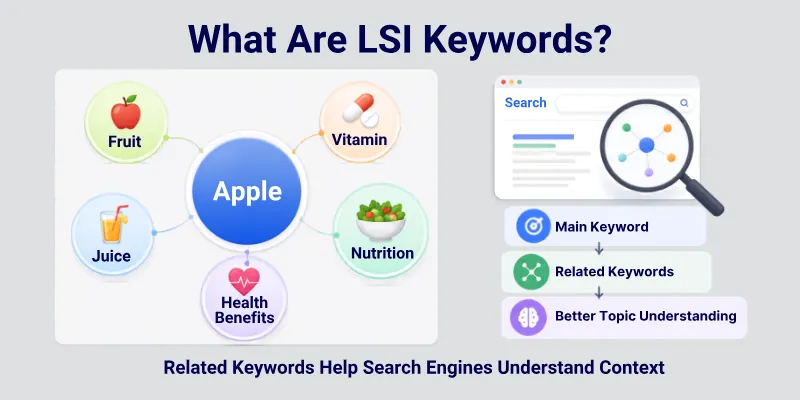
For example, if your main keyword is “Apple”, LSI keywords could be fruit, nutrition, vitamin, juice, or health benefits. These related terms help Google understand that you are talking about the fruit Apple, not the tech company.
In simple words, LSI keywords make your content more clear, relevant, and easier for search engines to rank.
Why Are LSI Keywords Important?
Here are the reasons why LSI keywords are important to use:
- Better Content Understanding: LSI keywords help search engines understand the full meaning and context of your content, not just one keyword.
- Improves SEO Rankings: When your content includes related terms, it becomes more relevant, which can improve your chances of ranking higher.
- Avoids Keyword Stuffing: Instead of repeating the same keyword again and again, LSI keywords make your content natural and easy to read.
- Increases Content Relevance: They make your article more complete by covering related topics and ideas.
- Helps Google Match User Intent: LSI keywords help search engines connect your content with what users are actually searching for.
- Improves User Experience: Readers get more helpful and detailed information, which keeps them engaged for longer.
How LSI Keywords Work in SEO (Step by Step Example)
Let’s understand how SEO works with LSI keywords using a simple step-by-step example.
Example Topic: “Digital Marketing”
- Step 1: You choose a main keyword: You select the main keyword “digital marketing” for your article.
- Step 2: You add LSI keywords: You naturally include related words like SEO, social media marketing, content marketing, email marketing, and online ads.
- Step 3: Search engines read your content: Google scans your page and sees not just “digital marketing,” but also all these related terms.
- Step 4: Google understands full context: Now Google clearly understands that your content is about the complete topic of digital marketing, not just one small part of it.
- Step 5: Better matching with search queries: When users search for things like “how SEO works” or “social media marketing basics,” your content becomes eligible to appear because it covers related terms.
- Step 6: Higher chances of ranking: Since your content looks more complete and relevant, Google gives it better ranking opportunities.
In simple words: LSI keywords help your content look more natural, more detailed, and more useful, which improves your SEO performance.
Difference Between LSI Keywords and Main Keywords
Many people still get confused between the main keyword and LSI keywords. Although from above you have some understanding, still here is a quick difference for you:
- Focus: Main keyword is the primary topic of your content, while LSI keywords are related supporting terms.
- Purpose: Main keyword tells Google what your page is mainly about, while LSI keywords help explain the full context.
- Usage: Main keyword is used directly in titles and headings, while LSI keywords are used naturally in the content body.
- Quantity: You usually have one main keyword, but multiple LSI keywords in one article.
- SEO Role: Main keyword targets ranking for a specific search, while LSI keywords help improve overall relevance and ranking power.
- Example: Main keyword: “digital marketing” | LSI keywords: SEO, social media, content marketing, online ads.
Difference Between LSI Keywords and Long-Tail Keywords
Many people also get confused between LSI keywords and long-tail keywords, but both are different in SEO. Here is a simple comparison for you:
- Meaning: LSI keywords are related terms that support your main topic, while long-tail keywords are longer and more specific search phrases.
- Focus: LSI keywords focus on context and meaning, while long-tail keywords focus on a specific search query.
- Structure: LSI keywords can be single words or phrases, while long-tail keywords are usually full sentences or longer phrases.
- User Intent: LSI keywords help search engines understand the topic, while long-tail keywords directly show what the user wants.
- SEO Role: LSI keywords improve content relevance, while long-tail keywords help target specific audiences and bring targeted traffic.
- Example: LSI keywords: SEO, backlinks, content marketing | Long-tail keyword: “best SEO tools for beginners 2026”
How to Find LSI Keywords
Here are the ways to find the best latent semantic indexing keywords:
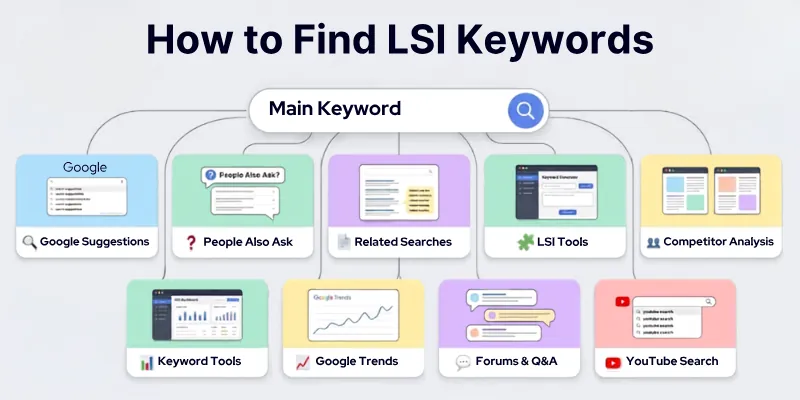
- Google Search Suggestions: Type your main keyword in Google and check the auto-suggestions for related terms.
- People Also Ask Section: Use this section to find real questions people are searching for around your topic.
- Related Searches (Bottom of Google): Scroll down on Google search results to find related keyword ideas.
- LSI Keyword Generator Tools: Use tools like an LSI keyword generator to quickly find related terms for your main keyword.
- Keyword Research Tools: Tools like Ahrefs, SEMrush, and Ubersuggest help you find semantically related keywords.
- Competitor Analysis: Check top-ranking pages and see what related keywords they are using in their content.
- Google Trends: Use it to find trending topics and related search terms in your niche.
- Forums and Q&A Sites: Platforms like Quora and Reddit help you discover how people naturally talk about your topic.
- YouTube Search Suggestions: YouTube auto-suggestions also show related keywords people are actively searching for.
Where to Use LSI Keywords
LSI keywords should be placed naturally in your content so search engines can understand the full topic better. Here are the best places to use them:
- In Blog Content Body: Use LSI keywords naturally in your paragraphs to make your content more relevant and topic-rich.
- In Headings and Subheadings: Adding related terms in headings helps Google understand different sections of your content.
- In Meta Title and Description: Using LSI keywords here improves click relevance and helps match more search queries.
- In Introduction and Conclusion: Place related keywords in your opening and ending paragraphs to strengthen topic context.
- In Image Alt Text: Use LSI keywords in image descriptions to improve SEO and image search visibility.
- In FAQs Section: Adding LSI keywords in questions and answers helps cover more related search terms.
- In Internal Links: Use related keywords as anchor text when linking to other pages on your website.
Common Mistakes to Avoid
Many people make simple mistakes while using LSI keywords, which can reduce their SEO results. Here are the common ones you should avoid:
- Overusing LSI Keywords: Adding too many related keywords can make your content look unnatural and spammy.
- Thinking LSI Means Synonyms Only: LSI keywords are not just synonyms; they are related terms that give context to your topic.
- Forcing Keywords into Content: Using LSI keywords in a forced way makes your content hard to read and lowers user experience.
- Ignoring Content Quality: Only adding keywords without helpful content will not improve rankings or engagement.
- Using Irrelevant Keywords: Adding unrelated LSI keywords confuses search engines instead of helping them understand your topic.
- Not Doing Proper Keyword Research: Relying only on guesses instead of tools or research leads to weak SEO performance.
- Skipping Natural Usage: LSI keywords should flow naturally in content, not be placed randomly just for SEO.
- Not Covering Full Topic Context: If you miss related terms, your content may look incomplete to search engines.
Final Thoughts
So guys, that’s a simple and clear explanation of what are LSI keywords and how they actually work in SEO. I hope now your confusion about LSI for SEO is fully cleared and you understand how important these related terms are for improving your content quality and rankings.
My personal recommendation is this: don’t overthink LSI keywords as a technical trick. Just focus on writing naturally and covering your topic in detail. If your content is helpful and answers user questions properly, LSI keywords will automatically become part of your writing.
At the end, always remember, good SEO is not just about keywords; it’s about clear content, user intent, and value.
And if you found this guide helpful, make sure to check out our other SEO guides for more simple learning. Also, explore our blogging course, where we teach how to write, rank, and earn from your content step by step.
FAQs
Here are some of the most frequently asked questions related to what are LSI keywords:
An LSI keyword is a related term that helps search engines understand the context of your main topic. It is not exactly a synonym but a supporting word or phrase connected to your content. For example, for “apple,” LSI keywords could be fruit, nutrition, or juice. These keywords improve content clarity and SEO relevance.
LSI keywords are words and phrases that are related to your main keyword and help explain your topic better. They give search engines more context about what your page is about. In simple terms, they make your content more complete and easier to understand. This improves your chances of ranking in search results.
Latent Semantic Indexing (LSI) is a method used to understand relationships between words in content. In SEO, it helps search engines find related terms and topics in your article. For example, if your topic is “digital marketing,” LSI keywords could be SEO, social media, and ads. This helps Google understand your content better.
LSI for SEO works by helping search engines understand the full meaning of your content. When you use related keywords, Google can easily match your page with different search queries. This improves your content relevance and ranking. It also helps avoid keyword stuffing.
SEO LSI keywords are used to make content more natural and topic-focused. They help search engines understand what your page is really about. These keywords also improve ranking chances by adding context. Overall, they make your SEO stronger and more effective.
You can find LSI keywords using Google suggestions, related searches, and “People Also Ask” sections. Tools like an LSI keyword generator also help you quickly find related terms. Competitor analysis is another useful method. These ways help you discover strong supporting keywords for SEO.
An LSI keyword generator is a tool that gives you related keywords for your main topic. It helps you find terms that improve content relevance and SEO. You just enter your main keyword, and it shows related ideas. This makes keyword research faster and easier.
Yes, LSI keywords are important because they help improve content relevance. They allow search engines to understand your topic more clearly. This can increase your chances of ranking for multiple search terms. They also improve user experience by making content more detailed.
No, LSI keywords are not only synonyms. They are related terms that give context to your main keyword. For example, for “car,” LSI keywords could be engine, fuel, or driving. They help explain the topic more deeply.
Yes, beginners can easily use LSI keywords in their content. They don’t require advanced SEO knowledge. Just focus on writing naturally and include related terms. This helps improve ranking and content quality.




- Be Respectful
- Stay Relevant
- Stay Positive
- True Feedback
- Encourage Discussion
- Avoid Spamming
- No Fake News
- Don't Copy-Paste
- No Personal Attacks
- Be Respectful
- Stay Relevant
- Stay Positive
- True Feedback
- Encourage Discussion
- Avoid Spamming
- No Fake News
- Don't Copy-Paste
- No Personal Attacks
