Difference Between Short, Medium & Long Tail SEO Keywords
Published: 24 Jul 2026
Guys, when you start learning SEO, one thing that always comes up is keywords like short tail, medium tail, and long tail keywords.
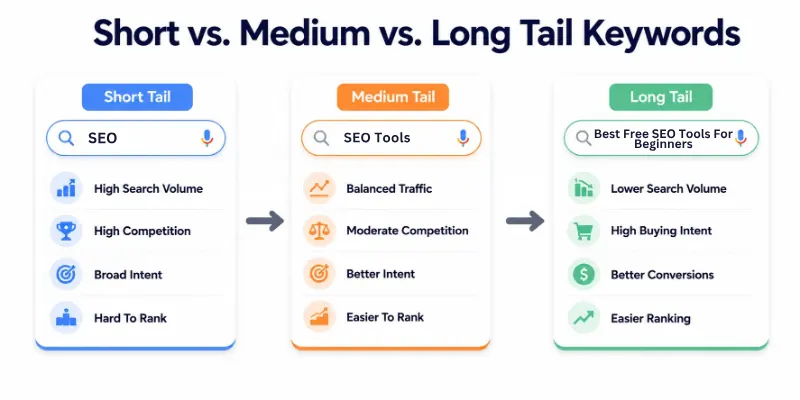
Short tail keywords are very small and broad search terms, medium tail keywords are a bit more specific, and long tail keywords are very detailed and focused search phrases. But many people still get confused about how they are different and when to use them.
So in this guide, I will explain the difference between short vs. medium vs. long tail keywords in a very simple way so you can use them properly in your SEO strategy.
Difference between Short vs. Medium vs. Long Tail Keywords
We will differentiate them based on these important factors:
- Search Volume
- Keyword Length
- Competition Level
- User Intent
- Conversion Rate
- Traffic Quality
- Ranking Difficulty
- Cost per Click (CPC)
- Content Specificity
- Audience Targeting
Now let us cover all in detail.
1. Search Volume
Search volume means how many times people search a keyword on Google in a certain time. It helps you understand how popular a topic is and how much traffic it can bring.
High search volume means more people are interested, while low search volume means fewer people are searching. It is very important for choosing the right keywords for your website. It also helps you plan your content based on demand.
Difference:
- Short tail keywords = high search volume
- Medium tail keywords = medium search volume
- Long tail keywords = low but targeted search volume
Short Tail Keywords:
- Very high searches
- Broad topics
- Example: “laptop”
Medium Tail Keywords:
- Moderate searches
- Somewhat specific
- Example: “gaming laptop”
Long Tail Keywords:
- Low searches
- Very specific intent
- Example: “best gaming laptop under 1000 dollars”
2. Keyword Length
Keyword length means how many words are used in a keyword. It helps you understand how simple or detailed a search term is. Short keywords are broad and general, while long keywords are more clear and specific. This factor also affects SEO difficulty and targeting. It is useful for understanding user search behavior.
Difference:
- Short tail = 1–2 words
- Medium tail = 2–3 words
- Long tail = 4+ words
Short Tail Keywords:
- Very short keywords
- Broad meaning
- Example: “shoes”
Medium Tail Keywords:
- Slightly detailed
- Clear topic
- Example: “running shoes”
Long Tail Keywords:
- Very detailed
- Exact search intent
- Example: “best running shoes for flat feet men”
3. Competition Level
Competition level means how hard it is to rank on Google for a keyword. If many websites are using the same keyword, ranking becomes difficult.
If fewer websites are targeting it, ranking becomes easier. This helps you understand how much effort is needed for SEO. It is very important for keyword selection.
Difference:
- Short tail keywords = high competition
- Medium tail keywords = medium competition
- Long tail keywords = low competition
Short Tail Keywords:
- Very hard to rank
- Many big websites compete
- Example: “phones”
Medium Tail Keywords:
- Moderate competition
- Some big players involved
- Example: “best smartphones”
Long Tail Keywords:
- Easy to rank
- Less competition
- Example: “best smartphone under 30000 in Pakistan”
4. User Intent
User intent means what the user really wants when they search something. It shows the purpose behind the search, like learning, comparing, or buying.
This helps you create content that matches what users need. If you match intent correctly, your ranking improves. It is one of the most important SEO factors.
Difference:
- Short tail = unclear intent
- Medium tail = semi-clear intent
- Long tail = very clear intent
Short Tail Keywords:
- No clear purpose
- Just browsing
- Example: “phone”
Medium Tail Keywords:
- Some idea of need
- Comparison stage
- Example: “best phone”
Long Tail Keywords:
- Clear buying or action intent
- Ready to decide
- Example: “best phone under 30000 with camera review”
5. Conversion Rate
Conversion rate means how many users take action after visiting your site. Action can be buying, signing up, or clicking a link. Some keywords bring general visitors, while others bring serious buyers. This helps measure keyword success. It is very important for business results.
Difference:
- Short tail = low conversion
- Medium tail = medium conversion
- Long tail = high conversion
Short Tail Keywords:
- Low conversions
- General audience
- Example: “laptop”
Medium Tail Keywords:
- Medium conversions
- Some interest
- Example: “gaming laptop”
Long Tail Keywords:
- High conversions
- Ready-to-buy users
- Example: “best gaming laptop under 1000 dollars for students”
6. Traffic Quality
Traffic quality means how useful and targeted your website visitors are. It is not just about getting visitors, but getting the right visitors who are actually interested in your topic. Good traffic quality means people stay longer and interact more with your content.
Low-quality traffic means random visitors who leave quickly. This factor helps you understand the real value of your keywords.
Difference:
- Short tail = low quality traffic
- Medium tail = medium quality traffic
- Long tail = high quality traffic
Short Tail Keywords:
- Broad and random visitors
- Less interested users
- High bounce rate
- Example: “phone”
- Not very targeted traffic
- Low engagement
Medium Tail Keywords:
- Somewhat targeted visitors
- Mixed interest users
- Medium engagement
- Example: “best phone”
- Balanced traffic quality
- Some relevant users
Long Tail Keywords:
- Highly targeted visitors
- Strong interest users
- Low bounce rate
- Example: “best phone under 30000 in Pakistan”
- Very relevant audience
- High engagement
7. Ranking Difficulty
Ranking difficulty means how hard it is to rank your page on Google for a keyword. Some keywords are very hard because many big websites already rank for them. Others are easier because fewer people are targeting them.
This factor helps you decide where you should focus your SEO efforts. It also affects how long it takes to rank.
Difference:
- Short tail = very hard
- Medium tail = moderate
- Long tail = easy
Short Tail Keywords:
- Very difficult to rank
- High competition websites
- Needs strong SEO
- Example: “shoes”
- Takes long time
- Big brands dominate
Medium Tail Keywords:
- Moderately difficult
- Some competition
- Needs decent SEO effort
- Example: “running shoes”
- Possible to rank
- Medium effort needed
Long Tail Keywords:
- Easy to rank
- Low competition
- Good for beginners
- Example: “best running shoes for flat feet men”
- Faster ranking
- Less SEO effort
8. Cost per Click (CPC)
CPC means how much advertisers pay when someone clicks on their ad. It is mainly used in Google Ads. High CPC keywords are more competitive because advertisers value them more. Low CPC keywords are less competitive and cheaper. This helps in understanding keyword value in paid marketing.
Difference:
- Short tail = high CPC
- Medium tail = medium CPC
- Long tail = low CPC
Short Tail Keywords:
- Very high CPC
- Expensive ads
- Strong competition
- Example: “insurance”
- High commercial value
- Big ad spend
Medium Tail Keywords:
- Medium CPC
- Balanced ad cost
- Moderate competition
- Example: “car insurance”
- Good for ads
- Decent value
Long Tail Keywords:
- Low CPC
- Cheap ads
- Less competition
- Example: “best car insurance for new drivers in Pakistan”
- High targeting value
- Low ad cost
9. Content Specificity
Content specificity means how detailed your content needs to be for a keyword. Some keywords need general content, while others need very detailed and focused content. This helps you understand how deep your article should be.
The more specific the keyword, the more detailed your content must be. It also affects ranking quality.
Difference:
- Short tail = low specificity
- Medium tail = medium specificity
- Long tail = high specificity
Short Tail Keywords:
- Very general content
- Broad topic coverage
- Example: “laptops”
- Less detail needed
- General information
- Wide audience focus
Medium Tail Keywords:
- Moderately detailed content
- Some focus needed
- Example: “gaming laptops”
- Balanced explanation
- More structured content
- Clear topic direction
Long Tail Keywords:
- Very detailed content
- Highly focused topic
- Example: “best gaming laptop under budget for students”
- Deep explanation needed
- Exact user need covered
- Very targeted content
10. Audience Targeting
Audience targeting means how well you can reach the right group of people with a keyword. Some keywords reach a wide audience, while others reach a very specific group. This helps you understand who your content is actually for. Better targeting means better results. It also improves engagement and conversions.
Difference:
- Short tail = broad audience
- Medium tail = semi-targeted audience
- Long tail = highly targeted audience
Short Tail Keywords:
- Very wide audience
- Less focused users
- Example: “mobile”
- Everyone included
- Low targeting accuracy
- General interest crowd
Medium Tail Keywords:
- Somewhat focused audience
- Mixed user groups
- Example: “smartphone reviews”
- Better targeting
- More relevant users
- Moderate focus
Long Tail Keywords:
- Highly specific audience
- Clear user group
- Example: “best smartphone for students under 30000 in Pakistan”
- Very precise targeting
- Strong intent users
- High relevance traffic
How to Find Short, Medium, and Long Tail Keywords
Guys, finding the right keywords is one of the most important parts of SEO. If you know how to find short, medium, and long tail keywords, you can easily target the right audience and get better traffic.
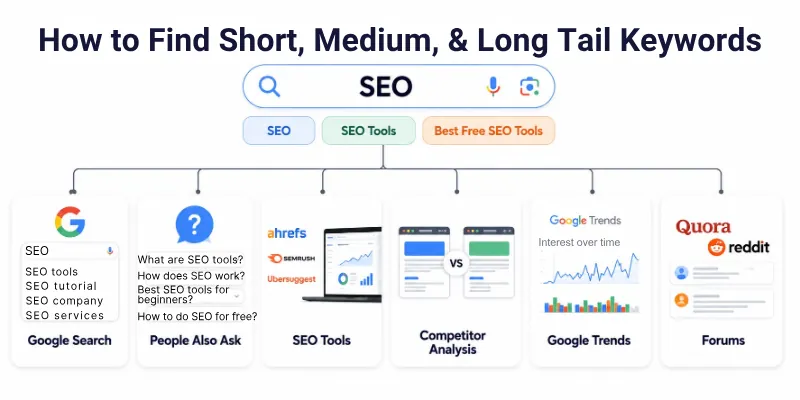
These keywords are not hard to find if you use the right methods. You just need to observe search behavior and use simple tools.
Let’s see some easy ways to find them.
- Use Google search suggestions (autocomplete while typing)
- Check “People also ask” section on Google
- Use keyword tools like Ubersuggest, Ahrefs, or SEMrush
- Analyze competitor websites and their ranking pages
- Look at Google Trends for keyword ideas
- Break big topics into smaller specific phrases
- Use forums like Quora and Reddit for real user questions
- Check related searches at the bottom of Google results
- Focus on problem-based queries for long tail keywords
- Observe customer questions in your niche
Benefits of Using a Mix of All Keyword Types
Using only one type of keyword is not enough for good SEO results. If you mix short, medium, and long tail keywords, your website performs much better. Each type plays a different role in bringing traffic, ranking, and conversions.
When you combine them, you create a balanced SEO strategy. This helps your website grow in a stable and smart way.
- Gives both high traffic and targeted traffic
- Helps balance short-term and long-term SEO growth
- Improves chances of ranking for different search levels
- Brings more organic visitors from different search intents
- Increases conversion rate with targeted long tail keywords
- Builds strong website authority over time
- Helps new websites grow faster with low-competition keywords
- Supports both general and specific content strategy
- Reduces dependency on only competitive keywords
- Improves overall SEO performance and visibility
Final Thoughts
In this guide, we have covered the difference between short, medium, and long tail keywords with great detail. Now you can clearly understand how each type works and how they impact your SEO results in different ways.
My personal recommendation is simple, don’t rely on just one type of keyword. If you are starting a new website, focus more on long tail keywords because they are easier to rank and bring targeted traffic. As your site grows, slowly mix in medium and short tail keywords to increase your reach and visibility. This balanced approach will help you get steady traffic, better rankings, and stronger SEO results over time.
FAQs
Here are some of the most frequently asked questions related to the difference between short vs. medium vs. long tail keywords:
Short tail keywords are very short and general search terms used on Google. They usually bring high traffic but also have very high competition. These keywords are not very specific, so it is harder to rank for them. They are mostly used for broad topics.
- 1–2 words keywords
- High traffic
- High competition
- Broad search
- Example: “laptop”
Medium tail keywords are slightly more specific than short tail keywords. They bring balanced traffic with medium competition. These keywords are easier to rank than short tail keywords. They help target a more focused audience.
- 2–3 words keywords
- Medium traffic
- Medium competition
- More focused
- Example: “gaming laptop”
Long tail keywords are very specific search phrases with more words. They usually have low traffic but high conversion rate. These keywords are easier to rank because competition is low. They are best for targeting ready-to-act users.
- 4+ words keywords
- Low traffic
- Low competition
- High conversion
- Example: “best gaming laptop under 1000 dollars”
Long tail keywords are important because they bring highly targeted users to your website. People searching them usually know exactly what they want. This increases the chances of conversions like sales or sign-ups. They also help new websites rank faster.
Short tail keywords are broad and highly competitive, while long tail keywords are specific and easier to rank. Short tail brings more traffic but less targeted users. Long tail brings less traffic but better results. Both are useful for SEO success.
Long tail keywords are best for beginners because they are easy to rank. They have low competition and bring targeted traffic. New websites can grow faster using them. They also improve conversion chances.
Yes, short tail keywords still work but they are very competitive. Big websites usually dominate these keywords. They are hard for new websites to rank. They work better when combined with other keyword types.
Keyword length means how many words are used in a keyword. Short tail keywords are 1–2 words, medium are 2–3 words, and long tail are 4 or more words. This helps understand how specific a keyword is. It also affects SEO difficulty.
Medium tail keywords help balance traffic and competition. They are more specific than short tail keywords but not too long. They are easier to rank and bring relevant users. They are useful for steady SEO growth.
Yes, using all keyword types together is the best SEO strategy. Short tail brings traffic, medium tail brings balance, and long tail brings conversions. This mix improves rankings and audience reach. It helps in overall website growth.



- Be Respectful
- Stay Relevant
- Stay Positive
- True Feedback
- Encourage Discussion
- Avoid Spamming
- No Fake News
- Don't Copy-Paste
- No Personal Attacks
- Be Respectful
- Stay Relevant
- Stay Positive
- True Feedback
- Encourage Discussion
- Avoid Spamming
- No Fake News
- Don't Copy-Paste
- No Personal Attacks
