How to Rank in People Also Ask Boxes: Complete Step-by-Step Guide
Published: 17 Jul 2026
People Also Ask (PAA) boxes are those expandable question sections you see in Google search results, where related questions appear along with short answers pulled from different websites.
These boxes help users quickly find additional information without opening multiple pages, and they are a powerful opportunity for websites to gain extra visibility in search results. Now you might be wondering, how to rank in People Also Ask boxes and get your content featured there?
So worry not, in this guide I will walk you through the complete ranking process so you can clearly understand how it works and what steps you need to follow.
But before jumping straight into the strategies, let’s first understand the basic algorithm behind how People Also Ask works.
How People Also Ask Works (Algorithm Basics)
Before jumping into ranking strategies, it’s important to understand how the People Also Ask (PAA) system actually works behind the scenes. Many people think it’s random, but in reality, it’s driven by Google’s advanced algorithms, user behavior data, and AI systems.
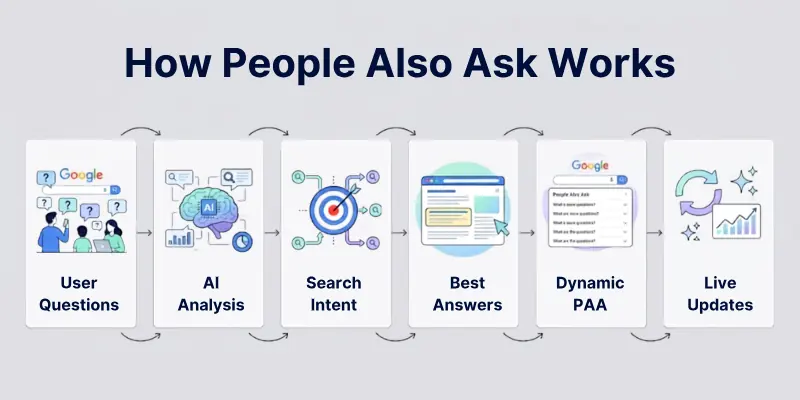
In 2026, PAA is even more dynamic and deeply connected with search intent and AI-driven results.
1. Based on Real User Questions & Search Behavior
Google generates PAA questions from real search data, what people actually ask, search, and click. These questions are not random; they are derived from patterns like follow-up queries, search journeys, and user intent signals.
Simply put: if many users search similar questions, Google groups them into PAA.
2. Dynamic & Expanding System (Not Static)
PAA is not fixed. When a user clicks on a question, Google dynamically loads more related questions in real time. This means the list keeps expanding based on query relationships and user interaction.
That’s why PAA can show “unlimited” questions for a single topic.
3. Strong Focus on Search Intent Matching
Google’s algorithm tries to understand why the user is searching. It then shows questions that match different angles of the same intent, informational, comparison, or clarification queries.
In 2026, intent matching is more important than keywords alone.
4. Pulls Answers from High-Quality Pages
The answers shown in PAA are extracted from web pages that:
- Provide clear, concise answers
- Match the question exactly
- Have topical authority
Google usually shows short answers (1–3 sentences) pulled from relevant content.
5. Influenced by AI & SERP Features (2026 Update)
In modern search (2025–2026), PAA is closely connected with:
- Featured snippets
- AI Overviews
- Entity-based search
Sometimes, AI-generated summaries even appear inside expanded PAA results, making it part of a broader AI-driven SERP ecosystem.
6. Continuously Updated with Trends & Fresh Content
PAA results keep changing based on:
- New content published
- Trending queries
- Algorithm updates
Google refreshes PAA boxes frequently, so newer and better answers can replace older ones.
PAA works by collecting real user questions, matching search intent, and dynamically showing the best short answers from authoritative pages using AI and behavioral data.
How to Rank in People Also Ask (Step-by-Step)
Ranking in People Also Ask (PAA) is not about luck, it’s about structuring your content exactly the way Google wants. In 2026, Google relies heavily on AI, search intent, and content clarity, so if your content is well-structured and directly answers user questions, your chances of getting featured increase significantly.
Let’s break it down step by step.
Step 1: Find the Right PAA Questions
Before anything else, you need to know what questions to target. PAA ranking starts with proper research.
Start by searching your main keyword on Google and note down the questions in the PAA box. Click a few questions and you’ll see more appear, this is how you can expand your list.
You can also use tools like:
- Ahrefs (PAA & Questions report)
- SEMrush (Keyword Magic Tool)
- AlsoAsked (for question mapping)
- AnswerThePublic
Focus on:
- Long-tail questions
- “How”, “Why”, “What” queries
- Questions closely related to your topic
Step 2: Understand Search Intent Deeply
Not all questions are the same. Google ranks answers based on intent match, not just keywords.
You need to figure out:
- Is the user looking for a quick answer?
- Do they want a step-by-step guide?
- Are they comparing options?
Example:
- “What is PAA?” → Needs a short definition
- “How to rank in PAA?” → Needs detailed steps
If your answer doesn’t match intent, it won’t rank, even if it’s well-written.
Step 3: Answer Questions Clearly and Immediately
This is one of the most important steps.
When you add a question in your content, answer it immediately in 2–4 lines right after the heading. Don’t add fluff before the answer.
Ideal PAA answer format:
- 40–60 words
- Simple and direct
- No complex sentences
Example structure:
- Question as heading
- Direct answer (short paragraph)
- Then detailed explanation below
This is exactly how Google extracts answers for PAA.
Step 4: Use Question-Based Headings (H2/H3)
Google prefers content that is structured like real questions.
Instead of writing:
- ❌ “PAA Ranking Tips”
Write:
- ✅ “How to rank in People Also Ask?”
Best practices:
- Use H2 or H3 for questions
- Match exact search queries
- Keep them natural (not keyword stuffed)
This increases your chances of being picked for PAA.
Step 5: Optimize for Featured Snippets (Very Important)
PAA and Featured Snippets are closely connected. Many PAA answers are pulled from snippet-optimized content.
Use these formats:
- Short paragraphs (definitions)
- Bullet points (steps or lists)
- Numbered lists (processes)
- Tables (comparisons)
Google prefers structured answers because they are easier to extract.
Step 6: Expand Content with Supporting Information
After giving a short answer, expand the topic in detail. This helps Google understand your authority.
Add:
- Examples
- Use cases
- Internal links
- Related subtopics
This creates topical depth, which is a major ranking factor in 2026.
Step 7: Build Topical Authority (Content Clusters)
You won’t rank in PAA consistently with just one article. Google prefers websites that cover a topic fully.
Create:
- Main pillar page (e.g., PAA guide)
- Supporting articles (related questions)
Examples:
- What is PAA in SEO?
- How to find PAA questions?
- PAA vs Featured Snippets
This signals authority to Google.
Step 8: Use Schema Markup (FAQ Schema)
Schema helps search engines understand your content better. Add:
- FAQ schema
- Structured data
While it doesn’t guarantee ranking, it improves your chances and visibility.
Step 9: Improve Content Readability & UX
Google tracks how users interact with your content. Make sure:
- Content is easy to read
- Use short paragraphs
- Add spacing and headings
- Avoid jargon
Better user experience = higher chances of ranking.
Step 10: Keep Updating Your Content (Freshness Factor)
PAA results change frequently. What ranks today might not rank tomorrow. Update regularly:
- Add new questions
- Improve answers
- Refresh outdated info
Fresh content signals relevance to Google.
Step 11: Analyze Competitors in PAA
Search your target keyword and see:
- Which sites are ranking in PAA
- How they structure answers
- Their content format
Then do better:
- More clarity
- Better structure
- Updated information
Quick Winning Formula (2026)
To rank in People Also Ask:
- Find real questions
- Match search intent
- Answer in 40–60 words
- Use question headings
- Structure content properly
- Build topical authority
- Keep content updated
Why Ranking in People Also Ask is Important
People Also Ask (PAA) is one of the most powerful SERP features in modern SEO. It gives your content extra visibility beyond traditional rankings and allows you to appear multiple times on the same search page.
In 2026, with AI-driven search results and evolving user behavior, ranking in PAA can bring consistent traffic, improve authority, and help you capture users at different stages of their search journey.
- Increases your visibility even if you are not ranking on page #1
- Drives additional organic traffic from multiple questions
- Helps you rank for long-tail keywords automatically
- Improves click-through rate (CTR) with quick answers
- Builds topical authority in your niche
- Gives you more SERP real estate alongside competitors
- Supports featured snippet rankings indirectly
- Matches different user intents in one place
- Keeps your content visible in expanding PAA results
- Strengthens your overall SEO strategy in AI-driven search
Best Practices to Rank in PAA
Here are the most effective and updated best practices you should follow to rank in People Also Ask (PAA):
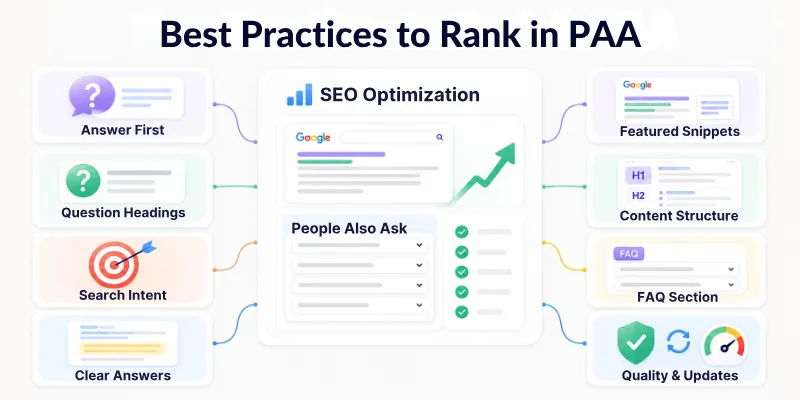
- Answer First, Then Explain: Provide a direct 40–60 word answer immediately after the question, then add details below
- Use Question-Based Headings: Write headings in the form of real user questions (H2/H3 format)
- Match Search Intent Precisely: Align your answer with what the user actually wants (definition, steps, comparison, etc.)
- Keep Answers Concise and Clear: Avoid fluff and use simple, easy-to-understand language
- Target Long-Tail Questions: Focus on specific queries like “how,” “why,” and “what” for better chances
- Optimize for Featured Snippets: Structure content using paragraphs, bullet points, and numbered lists
- Use Proper Content Formatting: Maintain clean structure with headings, spacing, and readable layout
- Build Topical Authority: Cover related subtopics and create content clusters around your main keyword
- Add FAQ Sections: Include multiple relevant questions to increase PAA coverage
- Use Schema Markup: Implement FAQ schema to help search engines understand your content better
- Keep Content Updated: Refresh answers regularly to stay relevant with changing SERPs
- Analyze Competitor Answers: Study what’s already ranking in PAA and improve upon it
- Focus on Content Accuracy: Provide fact-based and trustworthy information
- Improve User Experience (UX): Ensure fast loading, mobile-friendly, and easy-to-read content
- Use Natural Language & Conversational Tone: Write the way users actually search and ask questions
These practices help Google easily extract your content and increase your chances of appearing in PAA boxes.
Common Mistakes to Avoid
Even good content can fail to rank in People Also Ask (PAA) if it’s not structured properly. Many beginners make small mistakes that prevent Google from selecting their answers. Avoiding these can significantly improve your chances of ranking.
- Writing Long, Indirect Answers: Giving lengthy explanations instead of short, direct answers makes it hard for Google to extract content
- Ignoring Search Intent: Not matching the user’s intent (definition, steps, comparison) leads to poor relevance
- Not Using Question-Based Headings: Writing generic headings instead of actual questions reduces PAA chances
- Adding Fluff Before the Answer: Delaying the answer instead of giving it immediately after the heading
- Overcomplicating Language: Using difficult words instead of simple, clear language
- Keyword Stuffing: Forcing keywords unnaturally instead of writing for users
- Poor Content Structure: No headings, bullets, or formatting makes content hard to scan
- Not Targeting Long-Tail Questions: Ignoring specific queries that usually trigger PAA results
- Lack of Topical Depth: Covering only one question instead of building complete topic authority
- Ignoring Featured Snippet Optimization: Not structuring answers in extractable formats
- Outdated Content: Not updating answers as trends and SERPs change
- Weak Content Quality: Thin or low-value content that doesn’t fully answer the question
- No Internal Linking: Missing the chance to connect related topics and improve authority
- Poor Readability & UX: Large paragraphs, no spacing, and hard-to-read layout
Avoiding these mistakes will make your content more “PAA-friendly” and easier for Google to pick and display.
Tools to Find People Also Ask Questions
Finding the right PAA questions is the foundation of ranking. In 2026, there are many advanced tools that extract real-time questions directly from Google and help you understand search intent more deeply.
Here are the best tools you can use:
- AlsoAsked: Visualizes PAA questions in a tree format and groups them by intent, helping you build topic clusters easily
- JustPAA: Extracts questions 2–3 levels deep by expanding PAA boxes, giving you hidden questions your competitors may miss
- Ubenie PAA Finder: A simple free tool that pulls real-time People Also Ask questions directly from Google SERPs
- Kwrds.ai: Uses AI to find trending PAA questions and even helps generate optimized answers for them
- Keyword Profiler: Organizes PAA questions into clusters and helps you understand search intent visually
- Rankability PAA Tool: Provides fresh, real-time PAA data and helps identify content gaps and opportunities
- Frase: Helps you discover PAA questions and turn them into content briefs and optimized answers
- Backlinko PAA Tool: Offers a large database of millions of PAA questions and prioritizes them based on popularity
- Ahrefs & SEMrush: Premium SEO tools that show PAA questions inside keyword research and SERP analysis
- Google Search (Manual Method): The most accurate way, search your keyword, expand PAA boxes, and collect real user questions
How to Track PAA Rankings
Tracking your People Also Ask (PAA) rankings is important because these results change frequently. In 2026, PAA is highly dynamic, so you need to monitor performance regularly to see which questions you’re ranking for and where you can improve.
1. Track PAA Positions with SEO Tools
Use professional SEO tools to check if your content appears in PAA results for specific keywords.
- Ahrefs → Check SERP features for your keywords
- SEMrush → Use Position Tracking with SERP features enabled
- Rank tracking tools → Monitor PAA presence over time
These tools show whether your page is featured in PAA and for which queries.
2. Monitor Google Search Console (GSC)
Google Search Console doesn’t directly show PAA rankings, but it gives useful insights.
- Check Queries report
- Look for long-tail question keywords
- Track impressions and clicks growth
If impressions increase for question-based queries, you might be appearing in PAA.
3. Manually Check SERPs (Most Accurate)
Search your target keyword on Google and:
- Look for PAA boxes
- Expand questions to see if your content appears
- Test on both desktop and mobile
This gives you real-time and accurate results.
4. Track Featured Snippet Presence
Since PAA and featured snippets are closely linked:
- Monitor if your content ranks in snippets
- Optimize snippet content
If you win snippets, your chances of appearing in PAA increase.
5. Use PAA-Specific Tools
Some tools are built specifically for PAA tracking:
- AlsoAsked → Track question variations
- Frase → Monitor content performance
- Rankability → Identify PAA opportunities
6. Analyze Competitor Presence
Check which competitors are ranking in PAA:
- Search target keywords
- Note which domains appear repeatedly
- Analyze their answer structure
This helps you improve your own content strategy.
7. Track Changes Over Time
PAA results change frequently, so:
- Monitor weekly or monthly
- Update your content accordingly
- Track new questions appearing
Consistency is key to maintaining PAA rankings.
Final Thoughts
In this guide, we have covered how to rank in People Also Ask boxes with step-by-step details. If you follow these methods consistently, you can increase your chances of getting featured and drive more organic traffic from Google.
Personal Recommendation: Don’t just focus on writing content, focus on answering real user questions in the simplest and clearest way possible. Keep your answers short, structured, and updated regularly, because PAA is constantly changing. The more helpful and precise your content is, the higher your chances of ranking.
FAQs
Here are some of the most frequently asked questions related to how to rank in people also ask boxes:
A PAA box (People Also Ask) is a Google search feature that shows related questions users commonly search. It expands when clicked and displays short answers from different websites. It helps users explore more information without leaving the search results page.
To understand how to rank in People Also Ask, you need to create content that directly answers user questions in a clear and structured way. Use question-based headings and provide short, precise answers first. Google prefers content that is easy to extract and matches search intent.
PAA questions are real user queries that appear in Google’s “People Also Ask” section. These questions are based on search behavior and related topics. Targeting them helps improve visibility and increases chances of ranking in multiple SERP features.
People also ask schema refers to structured data (FAQ schema) used to help search engines understand question-answer content. It improves content clarity for Google and increases chances of appearing in rich results. While not mandatory, it supports better SEO performance.
To optimize for people also ask, write content in a question-answer format and keep answers short and direct. Use headings as real questions and include long-tail keywords naturally. Also, structure content with bullet points and clear formatting.
The PAA box is important because it increases visibility even if your page is not ranked in the top positions. It allows you to appear multiple times for different questions on the same search page. This leads to higher traffic and authority.
Google selects PAA answers based on relevance, clarity, and content structure. Pages that provide short, accurate, and well-formatted answers are more likely to be chosen. It also depends on authority and how well the content matches search intent.
Yes, small websites can rank in PAA if their content is highly relevant and well-structured. Google does not only prefer big websites, it prefers clear and helpful answers. Even new pages can appear if they match user intent properly.
A good PAA answer is usually 40–60 words long. It should be short enough for Google to extract easily but detailed enough to answer the question. After the short answer, you can expand with more explanation.
Yes, keywords still matter, but context and intent matter more. You should naturally include keywords in question-based headings and answers. Google in this year focuses more on meaning and relevance than keyword stuffing.