Types of URL in SEO: Difference Between Static & Dynamic URLs
Published: 16 Jul 2026
Guys, when we talk about SEO, one small thing that many people ignore is the URL structure. But trust me, URLs play a big role in ranking and user experience.
There are mainly two types of URL in SEO: static URLs and dynamic URLs. Static URLs are simple and clean, while dynamic URLs are more complex and include parameters like ?, =, id, or q. Many beginners get confused between them, so in this guide I will explain the full difference between static and dynamic URLs in very simple English.
So, let’s get in!
Types of URL in SEO: Static vs Dynamic URLs
Guys, here I am explaining both types of URLs’ definitions so you can clearly understand how they work and when to use them.
What is a Dynamic URL?
Dynamic URLs are those URLs that are automatically created by a system or database. These URLs usually contain symbols and parameters like ?, =, &, id, or q. They are mostly used in search pages, filters, or pagination. These URLs are not very clean and sometimes look confusing.
Examples of Dynamic URLs:
- https://dgaps.com/search?q=internet
- https://dgaps.com/earning-guide?page=2
- https://example.com/?course=seo-training-course
Key Points about Dynamic URLs:
- Contain special characters like ?, =, &
- Generated automatically by the system
- Mostly used in search and filter pages
- Harder to read for users
- Not always SEO-friendly
What is a Static URL?
Static URLs are simple, clean, and easy-to-read URLs. They do not contain any special parameters. These URLs usually include keywords separated by hyphens (-), which makes them user-friendly and SEO-friendly.
Examples of Static URLs:
Key Points about Static URLs:
- Clean and simple structure
- Easy to read and understand
- Use hyphens (-) to separate words
- Better for SEO
- Preferred by search engines
Difference Between Static and Dynamic URL
In the above section, I have guided you about the definition with direct examples. So in this part, I will compare both URL types on different factors so you can clearly understand which URL is best, when to use each, and what the actual difference is.
The factors I am considering are:
- URL Structure
- SEO Friendliness
- User Experience
- Indexing & Crawling
- Usage Purpose
- Keyword Optimization
- URL Length
- Duplicate Content Risk
- Ease of Sharing
- Control & Customization
Let me guide you through each URL structure with detail.
1. URL Structure
When we talk about URL structure, we are simply looking at how a URL is formed and how it looks to both users and search engines. A good URL structure should be clean, simple, and easy to understand. It should give a clear idea about what the page is about.
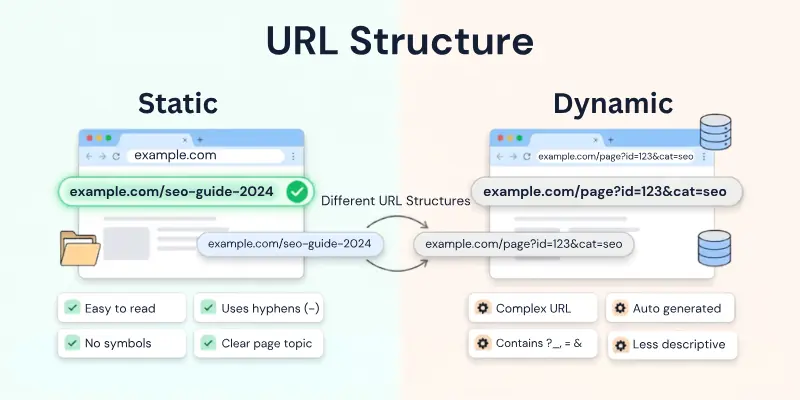
If the URL is too complex, it becomes hard for users to read and trust. Also, search engines prefer URLs that are simple and meaningful. So having a clear structure always helps in better SEO and user experience.
Difference: Static URLs are clean and simple, while dynamic URLs are complex and contain parameters.
Static URLs:
- Simple and easy to read
- Do not contain special characters
- Use hyphens (-) to separate words
- Clearly show page topic
- Example: /seo-guide-2024
Dynamic URLs:
- Complex and hard to read
- Contain symbols like ?, =, &
- Generated automatically
- Do not clearly show content topic
- Example: /page?id=123
2. SEO Friendliness
SEO friendliness means how well a URL helps your page rank on search engines like Google. A good URL should include keywords and be easy for search engines to understand.
If a URL is clean and clear, it gives a better signal to Google about the page content. Complex URLs can confuse search engines and may affect ranking. So choosing the right URL type is very important for SEO success.
Difference: Static URLs are more SEO-friendly, while dynamic URLs are less SEO-friendly.
Static URLs:
- Include clear keywords
- Easy for Google to understand
- Better ranking chances
- Clean and optimized structure
- Preferred in SEO
Dynamic URLs:
- Less keyword clarity
- Harder for search engines
- May affect rankings
- Not fully optimized
- Need extra SEO handling
3. User Experience
User experience means how comfortable and easy it is for users to interact with your website. When users see a URL, they should quickly understand what the page is about. Clean URLs build trust and make users feel safe to click.
On the other hand, complex URLs look confusing and sometimes suspicious. A good user experience always improves engagement and click rates.
Difference: Static URLs are user-friendly, while dynamic URLs are less user-friendly.
Static URLs:
- Easy to read and understand
- Look clean and professional
- Build trust with users
- Easy to remember
- Better click-through rate
Dynamic URLs:
- Hard to read
- Look technical and confusing
- Less trust for users
- Difficult to remember
- Lower click appeal
4. Indexing & Crawling
Indexing and crawling refer to how search engines discover and store your web pages. A good URL helps search engine bots crawl your site easily. If URLs are simple, bots can understand and index them faster.
But complex URLs can create confusion or duplicate pages. This can affect how your pages appear in search results.
Difference: Static URLs are easier to crawl and index, while dynamic URLs can create crawling issues.
Static URLs:
- Easy for bots to crawl
- Faster indexing
- Clear page signals
- Less chance of confusion
- Better SEO performance
Dynamic URLs:
- Can create duplicate pages
- Harder for bots to understand
- May slow indexing
- Need proper control (like noindex)
- Can confuse search engines
5. Usage Purpose
Usage purpose means where and why each type of URL is used. Not every URL type is used for the same reason.
Some are best for main content, while others are used for specific functions. Understanding this helps you use both types in the right place. This makes your website more organized and SEO-friendly.
Difference: Static URLs are used for main content, while dynamic URLs are used for system-based functions.
Static URLs:
- Used for blog posts and pages
- Best for landing pages
- Ideal for SEO content
- Permanent and stable URLs
- Used for ranking pages
Dynamic URLs:
- Used for search results
- Used for filters and sorting
- Used in pagination
- Temporary or system-generated
- Not always meant for ranking pages
6. Keyword Optimization
When we talk about keyword optimization in URLs, we mean how easily we can add our target keywords inside the URL. Keywords in URLs help both users and search engines understand what the page is about.
A well-optimized URL can improve your chances of ranking higher. It also makes your content look more relevant and clear. If your URL has no proper keywords, it becomes harder to tell what the page is about. So this factor is very important in SEO.
Difference: Static URLs allow better keyword optimization, while dynamic URLs have limited keyword control.
Static URLs:
- Easy to include target keywords
- Clear and meaningful URLs
- Better SEO signals
- Helps improve rankings
- Example: /seo-guide-2024
Dynamic URLs:
- Hard to include keywords properly
- Mostly use IDs or parameters
- Less SEO value
- Not descriptive
- Example: /page?id=123
7. URL Length
URL length means how long or short your URL is. Shorter URLs are usually better because they are easy to read and remember. Long and complex URLs can confuse users and search engines.
A clean and short URL improves both user experience and SEO. So it’s always better to keep URLs simple and not too long.
Difference: Static URLs are usually shorter and cleaner, while dynamic URLs are longer and complex.
Static URLs:
- Short and simple
- Easy to read
- Easy to remember
- Clean structure
- Better user experience
Dynamic URLs:
- Long and complex
- Contain extra parameters
- Hard to read
- Not user-friendly
- Can look messy
8. Duplicate Content Risk
Duplicate content means having multiple URLs showing the same content. This can confuse search engines and affect rankings.
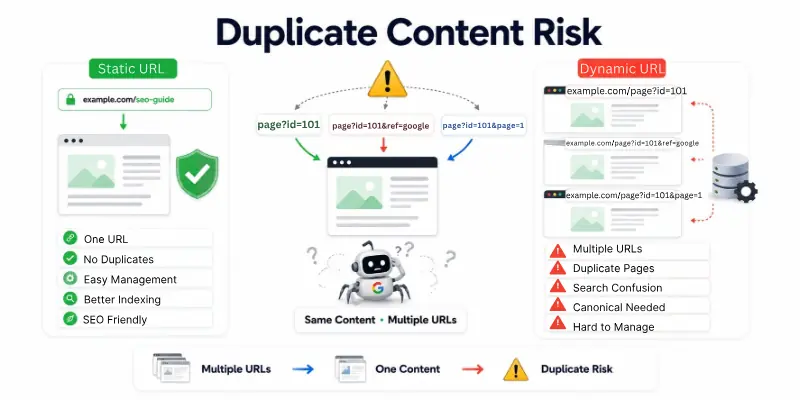
Some URL types increase this risk more than others. It is important to manage URLs properly to avoid duplicate issues. Otherwise, your SEO performance can suffer.
Difference: Static URLs have low duplicate risk, while dynamic URLs have higher duplicate content risk.
Static URLs:
- One clear URL per page
- Less chance of duplication
- Easy to manage
- Better SEO control
- Clear indexing
Dynamic URLs:
- Multiple URLs for same content
- High duplication risk
- Can confuse search engines
- Needs canonical or noindex
- Harder to manage
9. Ease of Sharing
Ease of sharing means how easy it is to copy, share, and remember a URL. A good URL should be simple so users can share it easily on social media or with others.
If a URL is too complex, people may avoid sharing it. Clean URLs also look more trustworthy when shared. This factor is important for user engagement and traffic.
Difference: Static URLs are easy to share, while dynamic URLs are difficult to share.
Static URLs:
- Simple and clean
- Easy to copy and share
- Looks trustworthy
- Easy to remember
- Better for social sharing
Dynamic URLs:
- Long and confusing
- Hard to share
- Looks technical
- Not memorable
- Less user-friendly
10. Control & Customization
Control and customization mean how much control you have over creating and editing your URLs. Some URLs allow full control, while others are automatically generated. Having control helps you optimize URLs better for SEO.
It also helps you maintain a clean and organized website structure. This factor is very useful for long-term SEO planning.
Difference: Static URLs offer full control, while dynamic URLs have limited control.
Static URLs:
- Fully customizable
- Can edit anytime
- SEO-friendly structure
- Better control over keywords
- Easy to manage
Dynamic URLs:
- Auto-generated by system
- Limited control
- Hard to edit manually
- Less SEO flexibility
- Used for technical purposes
Best Practice: When to Use Static vs Dynamic URLs
Guys, now here is something very important you should always keep in mind while working on your website URLs.
Not every URL type is used the same way, and choosing the right one can make a big difference in your SEO results. If you understand where to use each type, your site structure will stay clean and more effective.
- We always prefer to use static URLs for our main website pages because they are clean, simple, and SEO-friendly. They help both users and search engines understand the content easily.
- But we still use dynamic URLs in some cases where we need to control how search engines interact with certain pages. For example, search result pages or filtered pages are often not meant to rank on Google, so dynamic URLs are used for such purposes.
Final Thoughts
In this guide, we have covered both types of URLs in SEO with great detail. Now you clearly understand the difference between static and dynamic URLs and how each one works in real situations.
One important recommendation is to always keep your main content URLs clean, simple, and keyword-focused. Try to use static URLs for blog posts and important pages, and avoid making your URLs too long or complex. Also, manage dynamic URLs properly by using tools like noindex or canonical tags so they don’t create SEO issues.
Guys, that’s it for this guide. I hope this helped you understand everything in a simple way. Don’t forget to check out other blogs on the site as well; you’ll find more useful and practical SEO tips there.
FAQs
Here are some of the most commonly asked questions related to types of URL in SEO: Static vs Dynamic URLs:
The main types of URL in SEO are static URLs and dynamic URLs. Static URLs are simple and clean, while dynamic URLs contain parameters like ?, =, and id. Both URL types are used for different purposes on a website. Understanding these types helps improve SEO structure.
The difference between static and dynamic URL is in their structure and usage. Static URLs are simple and easy to read, while dynamic URLs are complex and include special characters. Static URLs are better for SEO and user experience. Dynamic URLs are mostly used for filters and search pages.
In Static URL vs. Dynamic URL comparison, static URLs are generally better for SEO. They are clean, easy to understand, and include keywords. Dynamic URLs can be harder for search engines to read. That’s why static URLs are preferred for main pages.
Dynamic URL types in SEO are mainly used for search pages, filters, and pagination. They help websites show different results based on user actions. These URLs are generated automatically by the system. They are useful but not always ideal for ranking.
Static URLs are important in URL Types in SEO because they are simple and SEO-friendly. They help search engines understand the page content easily. Users also trust clean URLs more. This improves both ranking and user experience.
Yes, dynamic URLs can affect SEO if not handled properly. They may create duplicate content issues and confusion for search engines. However, with proper setup, they can still be managed well. It is important to control their indexing.
Yes, Google can crawl both URL types in SEO. However, static URLs are easier to crawl and index. Dynamic URLs may require proper settings like robots.txt or canonical tags. Good structure helps better crawling.
URL types impact how users understand your page. Static URLs are clean and easy to read, which builds trust. Dynamic URLs look complex and less user-friendly. Simple URLs improve click-through rates.
Dynamic URLs should be used when you need filters, search results, or pagination. They are helpful for websites with large data or categories. But they should not be used for main content pages. Proper control is important.
To optimize URL Types in SEO, always use short and clean static URLs for main pages. Avoid unnecessary parameters in URLs. Use keywords in your URLs to improve relevance. Also, manage dynamic URLs properly to avoid issues.