What is Search Engine Marketing: How SEM Works & Why It Matters
Published: 8 Sep 2026
You have probably heard people talking about ads on Google, paid traffic, and quick results. But then someone says “this is SEM,” and suddenly it gets confusing. Is it the same as SEO? Is it only about ads? Or is there more to it?
If you are unsure about how businesses actually get instant visibility on search engines, this guide will clear everything for you in the simplest way. I will walk you through what is search engine marketing, how it works, and how you can use it to grow your traffic and sales.
Let’s get started and break it down step by step.
What is Search Engine Marketing?
Search Engine Marketing, also known as SEM, is a digital marketing strategy used to promote websites by increasing their visibility in search engine results through paid advertising.
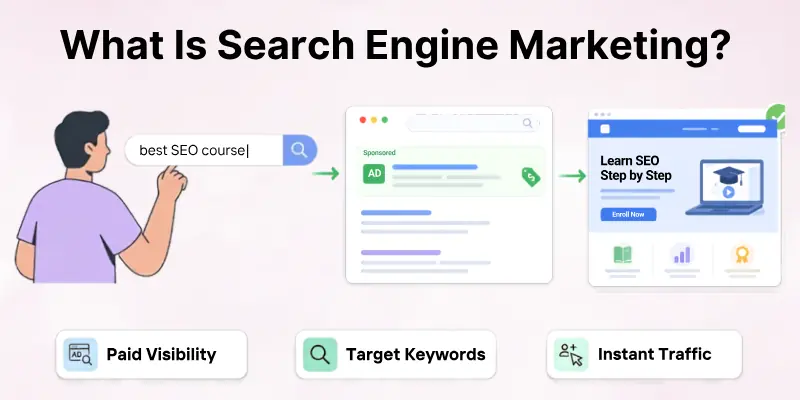
In simple words, SEM means paying search engines like Google to show your website at the top when people search for specific keywords.
It helps businesses get instant traffic instead of waiting for long-term SEO results.
How Search Engine Marketing Works
In this section, we will understand how SEM actually works behind the scenes.
- Keyword Bidding: Advertisers bid on keywords that users search for on search engines.
- Ad Auctions: Search engines run an auction to decide which ads appear and in what order.
- Quality Score: Google checks the quality and relevance of your ads and landing pages.
- Cost Per Click: You pay only when someone clicks on your ad.
- Ad Placement: Ads appear at the top or bottom of search results based on performance.
Why is Search Engine Marketing Important?
In this section, we will explore why SEM is important for businesses today.
- Instant Visibility: SEM helps your website appear on top immediately.
- Targeted Traffic: You can target users based on keywords, location, and behavior.
- High Intent Users: People searching are already interested in your product or service.
- Measurable Results: You can track clicks, conversions, and ROI easily.
- Competitive Advantage: Helps small businesses compete with larger brands.
Key Components of SEM
In this section, we will cover the main elements that make SEM successful.
- Keywords: Keywords are the search terms you target in your ads. They help your ads appear when users search for related products or services. Choosing the right keywords ensures you reach the right audience.
- Ad Copy: Ad copy is the text users see in your ads. It should be clear, engaging, and persuasive to encourage clicks. A strong ad copy can improve your click-through rate and overall performance.
- Landing Pages: Landing pages are where users go after clicking your ad. These pages should match the ad content and provide value to the user. A well-optimized landing page increases conversions.
- Bidding Strategy: Bidding strategy decides how much you are willing to pay for each click. A smart bidding approach helps you control costs while maximizing results. It also affects how often your ad appears.
- Quality Score: Quality Score is a metric used by search engines to evaluate your ads. It depends on factors like ad relevance, keyword match, and landing page quality. A higher score can reduce costs and improve ad ranking.
Types of Search Engine Marketing
In this section, we will explore different types of SEM strategies and how they help businesses grow online.
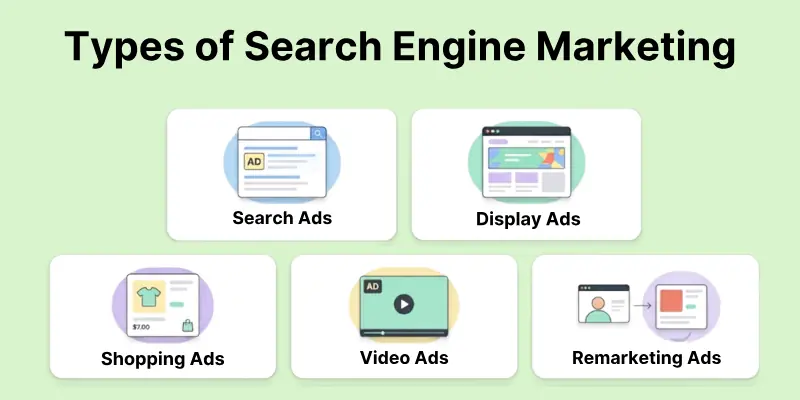
- Search Ads: Search ads are text-based ads that appear on search engine results pages when users search for specific keywords. These ads target high-intent users who are already looking for a solution. They are one of the most effective ways to get quick traffic and leads.
- Display Ads: Display ads are visual ads (images or banners) shown on different websites across the internet. They help increase brand awareness and reach a wider audience. Even if users don’t click immediately, they remember your brand.
- Shopping Ads: Shopping ads show products with images, prices, and store details directly in search results. They are ideal for eCommerce businesses that want to showcase products clearly. These ads help users compare options and make quick purchase decisions.
- Video Ads: Video ads appear on platforms like YouTube and other video networks. They engage users through visuals and storytelling, making them highly effective for branding. Video ads can capture attention better than text or images.
- Remarketing Ads: Remarketing ads target users who have already visited your website. These ads remind them about your product or service and encourage them to return. It is a powerful way to increase conversions and recover lost visitors.
SEM vs SEO
In this section, we will compare SEM with SEO to clear confusion.
- SEM: Paid strategy for instant visibility on search engines.
- SEO: Organic strategy that takes time to rank.
- Cost: SEM requires budget, SEO mainly requires time and effort.
- Speed: SEM gives quick results, SEO is long-term.
- Sustainability: SEO results last longer, SEM stops when you stop paying.
Popular SEM Platforms
In this section, we will look at commonly used SEM platforms.
- Google Ads: The most popular platform for search advertising.
- Microsoft Ads: Advertising platform for Bing search engine.
- YouTube Ads: Video advertising platform owned by Google.
- Amazon Ads: Useful for eCommerce product promotions.
- Social Platforms: Facebook and Instagram also support paid search-like targeting.
Challenges of SEM
In this section, we will discuss common challenges in SEM.
- High Competition: Popular keywords can be expensive.
- Budget Management: Poor planning can waste money quickly.
- Learning Curve: Beginners may find it complex at first.
- Ad Fatigue: Users may ignore repetitive ads.
- Constant Optimization: Campaigns need regular monitoring and updates.
Best Practices for SEM
In this section, we will cover proven strategies to improve your SEM results.
- Use Targeted Keywords: Focus on relevant and high-intent keywords.
- Write Strong Ad Copy: Make your ads clear and compelling.
- Optimize Landing Pages: Ensure fast and relevant pages for better conversions.
- Monitor Performance: Track metrics regularly and improve campaigns.
- A/B Testing: Test different ads to find what works best.
Common SEM Mistakes to Avoid
In this section, we will highlight mistakes you should avoid.
- Targeting Broad Keywords: This can waste budget quickly.
- Ignoring Negative Keywords: Leads to irrelevant clicks.
- Poor Landing Pages: Reduces conversions even with good ads.
- Not Tracking Results: Makes optimization difficult.
- Setting and Forgetting Campaigns: SEM needs regular updates.
How to Get Started with SEM
In this section, we will guide you on how to start SEM effectively, even if you’re a beginner.
1. Create an Account: Start by signing up on a platform like Google Ads. Make sure your account is linked to your business email and payment method. Setting it up properly ensures smooth campaign management.
2. Do Keyword Research: Identify relevant keywords that your target audience is searching for. Use tools like Google Keyword Planner or SEMrush to find high-intent and low-competition keywords. Choosing the right keywords is crucial for your ad’s success.
3. Set Budget: Decide how much you are willing to spend daily or monthly. Start with a small budget if you are new, and adjust as you see results. A proper budget ensures you don’t overspend while testing campaigns.
4. Create Ads: Write clear, engaging, and persuasive ad copy. Include your primary keywords and a strong call-to-action. Well-crafted ads attract more clicks and improve your overall performance.
5. Launch Campaign: Start your campaign and monitor it regularly. Track metrics like clicks, impressions, and conversions. Optimize your ads based on performance to get the best results.
Future of Search Engine Marketing
In this section, we will explore upcoming trends in SEM.
- AI Automation: AI will manage campaigns more efficiently.
- Voice Search Ads: Optimization for voice queries will grow.
- Personalization: Ads will become more user-focused.
- Visual Ads Growth: More focus on video and image ads.
- Data Privacy Changes: New rules will affect targeting strategies.
Conclusion
In this guide, we have covered what search engine marketing is in great detail. We explored how it works, why it matters, and how you can use it to grow your business quickly.
From my experience, SEM is one of the fastest ways to get results, but only if you use it wisely. Start small, test your campaigns, and focus on learning rather than spending too much at once. If you combine SEM with a strong SEO strategy, you can build both short-term and long-term success.
Goodbye and best of luck with your marketing journey.
FAQs
Here are the most commonly asked questions related to what is search engine marketing:
Search engine marketing (SEM) is a paid way to promote your website on search engines. It helps your site appear at the top when users search for specific keywords. You only pay when someone clicks your ad. SEM is a fast way to get traffic and reach potential customers.
No, SEM and SEO are different. SEM focuses on paid ads, while SEO improves your site to rank organically. Both increase visibility, but SEM gives quicker results, and SEO works over the long term. Many businesses use both together for the best results.
The cost of SEM depends on the keywords and competition in your industry. Some keywords are cheaper, while high-demand keywords cost more. You can set a daily or monthly budget to control spending. With careful planning, even small budgets can give good results.
Yes, beginners can start SEM easily with the right guidance. Platforms like Google Ads have user-friendly tools and tutorials. By learning the basics, you can create effective campaigns and avoid common mistakes. Starting small helps you understand the process without overspending.
SEM can bring results almost instantly. Once your campaign is live, your ads can appear in search results, and you can get clicks and traffic within hours. However, it takes time to optimize campaigns for better performance and conversions. Regular monitoring ensures your ads perform well.
CPC means “cost per click.” It is the amount you pay each time someone clicks your ad. A lower CPC means you get more clicks for the same budget. Optimizing keywords and ad quality can reduce CPC and improve campaign efficiency.
Yes, SEM works very well for small businesses. It helps you target local customers and compete with larger companies. You can start with a small budget and only pay for actual clicks. This makes SEM cost-effective and scalable.
You measure SEM success using metrics like clicks, impressions, click-through rate (CTR), and conversions. Tools like Google Ads and Analytics show these metrics clearly. Tracking performance helps you improve ads and get better results over time.