How to Make Money with SEO? 15 Proven Ways That Actually Work
Published: 24 Aug 2026
You learn SEO, understand keywords, rankings, traffic, backlinks, and technical SEO. But after learning all these things, one important question comes to your mind:
How do you actually make money with SEO?
Many beginners stay stuck at this point. They know how SEO works, but they do not know how to turn their skills into income.
The good thing is that SEO is not only a job skill. You can use it in many different ways. You can work for clients, build your own websites, sell leads, help local businesses, grow online stores, offer consulting, or even create your own digital products.
In this guide, I will explain practical ways you can earn money using SEO. I will also explain which methods are easier for beginners and which ones need more experience.
So, get in deep and move on with me.
How to Make Money with SEO
There is no single way to earn from SEO. Some people sell their SEO skills. Some build websites. Some work with businesses. Others use SEO to generate traffic and then turn that traffic into sales, leads, commissions, or advertising income.
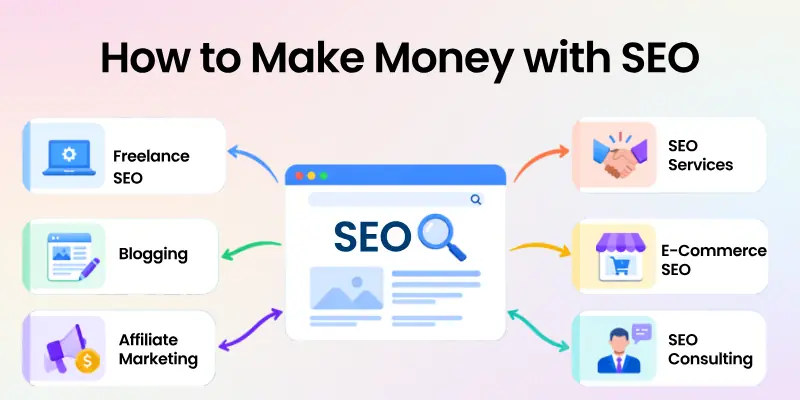
Here are 15 ways you can make money with SEO:
- Freelance SEO Services
- Blogging and Niche Websites
- Affiliate Marketing
- Sell SEO Services to Businesses
- Build and Flip Websites
- YouTube SEO
- E-Commerce SEO
- Local SEO Services
- SEO Consulting
- Create and Sell SEO Courses
- Build Local Lead Generation Websites
- Offer White-Label SEO Services
- Sell SEO Audits and Technical SEO Services
- Google Merchant Center Optimization
- Create and Sell SEO Digital Products
Let us cover all in detail.
1. Freelance SEO Services
Freelancing is one of the easiest ways to start earning after learning SEO. In this method, you provide SEO services to clients and charge them for your work.
You do not need your own agency in the beginning. You can start alone and work with one or two clients. For example, a client may hire you to improve website pages, find keywords, fix SEO problems, or create an SEO plan.
You can offer services such as:
- Keyword Research: Find keywords customers are searching for.
- On-Page SEO: Improve titles, headings, internal links, content, and other page elements.
- SEO Audits: Find technical and content problems on websites.
- Local SEO: Help local businesses improve their visibility.
- Content Optimization: Improve existing pages instead of always creating new ones.
- Search Console Analysis: Find traffic, indexing, and query opportunities.
You can find clients through freelance marketplaces, professional networks, social media, direct outreach, referrals, or your own website.
How to Start
- Pick two or three SEO services first.
- Practice them on your own website.
- Prepare a small portfolio.
- Contact businesses that actually need your service.
- Show the problem before selling the solution.
- Collect results and testimonials.
- Increase your rates as your skills improve.
My recommendation: Start with freelancing if you are a beginner. It gives you real SEO experience and teaches you how businesses actually use SEO.
2. Blogging and Niche Websites
You can also use SEO to grow your own website. Instead of working for a client, you become the owner of the website.
You choose a topic, publish useful content, attract visitors through search engines, and then turn that traffic into income. For example, you may build a website about:
- Pets
- Home improvement
- Software
- Travel
- Education
- Careers
- Gardening
- Technology
You can monetize the website through:
- Display ads.
- Affiliate links.
- Your own services.
- Digital products.
- Sponsored opportunities.
- Lead generation.
However, blogging is not a quick-income method. You need time to publish useful content, build trust, improve pages, and grow traffic.
Google‘s current guidance still focuses on helpful, reliable content created for people. It warns against creating large amounts of content mainly to manipulate rankings.
How to Start
- Choose a clear niche.
- Understand what people search for.
- Create genuinely useful articles.
- Build strong internal links.
- Update old content when needed.
- Monitor performance through Search Console.
- Add monetization after you start receiving useful traffic.
My recommendation: Blogging is slower than freelancing, but you are building an asset that belongs to you.
3. Affiliate Marketing
Affiliate marketing means you promote another company’s product or service and earn a commission when someone buys through your affiliate link. SEO can bring people to your affiliate pages without paying for every click.
For example, someone may search: Best laptops for graphic designers
You can publish a useful comparison that helps the user choose the right laptop.
If the visitor buys through your affiliate link, you may receive a commission. Good affiliate content can include:
- Product reviews.
- Product comparisons.
- Best product lists.
- Buying guides.
- Alternatives.
- Tutorials.
- Problem-solving articles.
But do not create thin pages only to place affiliate links. Your content should add real value.
Google recommends creating original, useful content instead of simply summarizing what other websites already say.
How to Start
- Choose a niche you understand.
- Join suitable affiliate programs.
- Find commercial and buyer-intent keywords.
- Write useful reviews and comparisons.
- Explain advantages and disadvantages honestly.
- Improve pages based on Search Console data.
- Track which pages produce sales.
My recommendation: Affiliate marketing works best when you combine SEO with a useful niche website instead of creating pages only for commissions.
4. Sell SEO Services to Businesses
Freelancing and selling SEO directly to businesses are similar, but the business model can be different.
Instead of completing one small project, you can offer ongoing SEO services. For example, you may manage SEO for:
- Dentists.
- Lawyers.
- AC repair companies.
- Cleaning companies.
- Real estate businesses.
- Contractors.
- Restaurants.
- Clinics.
- Online stores.
You can charge businesses monthly for continued SEO work.
Your package may include:
- Keyword research.
- Website optimization.
- Content improvements.
- Technical SEO.
- Local SEO.
- Search Console monitoring.
- Monthly reporting.
- Competitor research.
Recurring clients can make your income more stable than depending only on one-time projects.
How to Start
- Choose one business niche.
- Study common SEO problems in that niche.
- Find businesses with weak websites or poor search visibility.
- Explain their problems in simple language.
- Offer a clear package.
- Report the work you complete.
- Focus on business results, not only ranking screenshots.
My recommendation: Start with small and local businesses because it is often easier to understand their problems and speak directly with decision-makers.
5. Build and Flip Websites
Website flipping works like buying, improving, and selling an online asset. You build or purchase a website, improve it through SEO, increase its traffic or revenue, and then sell it.
A website with stable traffic, useful content, clean SEO, and proven income can be more attractive to buyers than a new website with no history.
You can improve a website through:
- Better keyword targeting.
- Updating old pages.
- Technical SEO fixes.
- Better internal linking.
- Stronger content.
- Improved user experience.
- Better monetization.
How It Works
- Build or buy a website.
- Improve its SEO.
- Increase useful traffic.
- Add a monetization method.
- Keep proper traffic and income records.
- Sell when the website becomes valuable enough.
My recommendation: Learn SEO properly before trying website flipping. You are investing time or money into an asset, so mistakes can cost you.
6. YouTube SEO
YouTube also has a search and discovery system. You can use search research to create videos around topics people want to watch. You may earn through:
- YouTube advertising.
- Affiliate marketing.
- Sponsorships.
- Your own services.
- Digital products.
- Courses.
- Leads.
However, one part of old YouTube SEO advice needs an important correction.
Do not depend heavily on video tags.
YouTube currently says the title, thumbnail, and description are more important for discovery, while tags usually play only a minimal role except when they help with common misspellings.
Focus On
- Video Topic: Create videos people actually want to watch.
- Title: Make the topic clear and attractive.
- Thumbnail: Give users a strong reason to click.
- Description: Explain clearly what the video covers and use relevant words naturally.
- Viewer Satisfaction: Create a video that actually delivers what the title promises.
- Analytics: Study which videos attract and keep viewers.
My recommendation: If you are comfortable speaking or creating videos, combine YouTube with your website. One topic can bring visitors from both Google Search and YouTube.
7. E-Commerce SEO
E-commerce SEO helps online stores attract people searching for products. Instead of paying for every visitor through advertising, you improve your store so product and category pages can attract organic traffic.
You can provide e-commerce SEO as a service or use it to grow your own store.
Important areas include:
- Product page SEO.
- Category page SEO.
- Product titles.
- Product descriptions.
- Internal linking.
- Product structured data.
- Images.
- Website speed.
- Mobile usability.
- Merchant Center.
- Search Console.
Example
Suppose an online store sells leather jackets.
Instead of targeting only: leather jackets
you may find more specific searches such as:
- men’s brown leather jacket
- vintage leather biker jacket
- black leather trucker jacket
These searches may match different product and category pages.
My recommendation: E-commerce SEO is a strong skill because store owners can connect SEO work directly with products and sales.
8. Local SEO Services
Local SEO helps businesses appear when people search for services in a particular area. For example:
- dentist near me
- plumber in Houston
- AC repair Riyadh
- cleaning company Manchester
- lawyer in Dallas
Many local businesses need help managing their website and Google Business Profile. Google says local results mainly depend on relevance, distance, and prominence.
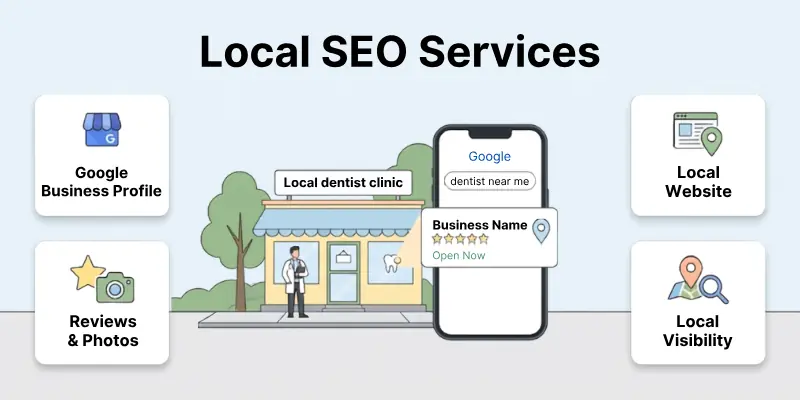
You cannot control the searcher’s distance, but you can help a business improve the other areas.
Local SEO Work Can Include
- Complete the Google Business Profile correctly.
- Choose accurate business information.
- Improve local website pages.
- Earn genuine customer reviews.
- Add useful photos.
- Keep opening hours updated.
- Improve website links and local authority.
- Create useful service and location information.
- Track local search performance.
Google also clearly says there is no way to pay Google for a better organic local ranking.
My recommendation: Local SEO remains one of the best areas for beginners who want service-based clients because you can clearly show businesses what needs improvement.
9. SEO Consulting
SEO consulting means businesses pay you mainly for your knowledge, strategy, and guidance. Instead of completing every SEO task yourself, you tell the company what it should do and why.
For example, you may:
- Audit its website.
- Study competitors.
- Find traffic opportunities.
- Create a content plan.
- Review technical SEO.
- Create an internal linking plan.
- Train the content team.
- Guide developers.
- Review Search Console data.
- Help management set SEO priorities.
Consulting normally requires more experience because businesses expect you to make important decisions.
How to Start
- Build strong practical experience first.
- Learn how to explain SEO in simple language.
- Create repeatable audit processes.
- Show previous results.
- Sell strategy sessions or monthly consulting.
- Move toward larger clients as your experience improves.
My recommendation: Do not start by calling yourself a high-level SEO consultant after completing one course. First solve real SEO problems.
10. Create and Sell SEO Courses
Once you have practical SEO knowledge, you can teach other people. You can create:
- Beginner SEO courses.
- Local SEO training.
- Technical SEO courses.
- Keyword research courses.
- Search Console training.
- E-commerce SEO courses.
- YouTube SEO courses.
You can earn through course sales or use a course to support another business. But your course should teach what actually works.
SEO changes.
Google updates its systems, interfaces, documentation, and policies. That means you also need to update your course regularly.
How to Start
- Choose one clear topic.
- Create a proper syllabus.
- Use real examples.
- Record simple lessons.
- Add exercises.
- Provide templates where useful.
- Update lessons when major changes happen.
My recommendation: Create a course after you have practical experience. Students can easily notice when someone only repeats information without actually doing SEO.
11. Build Local Lead Generation Websites
This method is different from doing SEO directly for a client. You build your own website around a local service.
For example: roof repair in Dallas
You create a useful website, rank it for relevant searches, generate genuine enquiries, and then work with a local business that wants those leads.
You may earn through:
- A monthly fee.
- A fee for each qualified lead.
- A revenue-sharing agreement.
Example
Suppose you build a useful website around: emergency plumbing in a particular city
People find the website through Google and contact the business through your lead system. You can then sell legitimate leads to a plumbing company.
Important Point
Do not create hundreds of fake location pages with almost the same text.
Google says creating many pages mainly to manipulate rankings can fall under scaled content abuse. Your website should provide real information and value.
How to Start
- Pick one local service.
- Research genuine local demand.
- Build a proper website.
- Publish useful service information.
- Generate real enquiries.
- Find a reliable business that can handle the leads.
- Track calls and forms properly.
My recommendation: This method can become powerful because you own the traffic source, but build a genuine local resource instead of a spammy rank-and-rent website.
12. Offer White-Label SEO Services
White-label SEO means another agency sells SEO to its clients, but you complete some or all of the SEO work behind the scenes.
For example: A web design agency may have 20 clients but no SEO specialist. Instead of hiring a full internal SEO department, they may work with you.
You may provide:
- Keyword research.
- SEO audits.
- On-page SEO.
- Technical SEO.
- Content briefs.
- Local SEO.
- Search Console reports.
- Competitor research.
The agency manages the client relationship while you handle the SEO work.
Why This Model Is Different
You do not need to find a new end client every month. One agency relationship may bring several projects.
How to Start
- Contact web design and marketing agencies.
- Show clearly which SEO tasks you can handle.
- Create simple wholesale pricing.
- Deliver work on time.
- Keep reports clear.
- Protect the agency’s client relationship.
My recommendation: This is a very good option if you enjoy SEO work but do not enjoy constant sales calls.
13. Sell SEO Audits and Technical SEO Services
You do not always need a monthly SEO client. You can sell a one-time SEO audit. A business pays you to identify what is wrong and what it should fix. An audit may cover:
- Crawling.
- Indexing.
- Internal links.
- Canonical problems.
- Redirects.
- Duplicate pages.
- Sitemap problems.
- Robots.txt.
- Page experience.
- Structured data.
- Content issues.
- Search Console problems.
You can then sell the implementation separately.
For example:
- SEO Audit: One fee
- Fixing the problems: Another fee
- Monthly monitoring: Optional ongoing fee
This creates several income opportunities from one service.
How to Start
- Create your own audit checklist.
- Learn Search Console properly.
- Understand crawling and indexing.
- Explain each problem in simple language.
- Give clear priorities.
- Separate urgent problems from minor issues.
My recommendation: Technical audits can become a high-value service once you learn how websites actually work.
14. Google Merchant Center and Free Listing Optimization
This is a useful 2026 opportunity for people who work with online stores.
Google Merchant Center allows eligible product listings to appear across several Google surfaces.
Google’s current documentation says free product listings can appear across places such as Google Search, Maps, Gemini, YouTube, Shopping, Images, and Lens.
This creates a specialized service you can offer to e-commerce businesses.
You can help stores with:
- Merchant Center setup.
- Product data.
- Product titles.
- Product descriptions.
- Images.
- Product identifiers.
- Pricing information.
- Availability.
- Feed errors.
- Product disapprovals.
- Free listings.
Google also recommends improving product information and clearly showing the product’s useful details and value.
How You Can Earn
You can charge for:
- Initial Merchant Center setup.
- Feed optimization.
- Monthly product monitoring.
- Product disapproval fixes.
- E-commerce SEO plus Merchant Center management.
My recommendation: If you already know e-commerce SEO, learn Merchant Center as well. It gives you another service that directly connects SEO with products.
15. Create and Sell SEO Digital Products
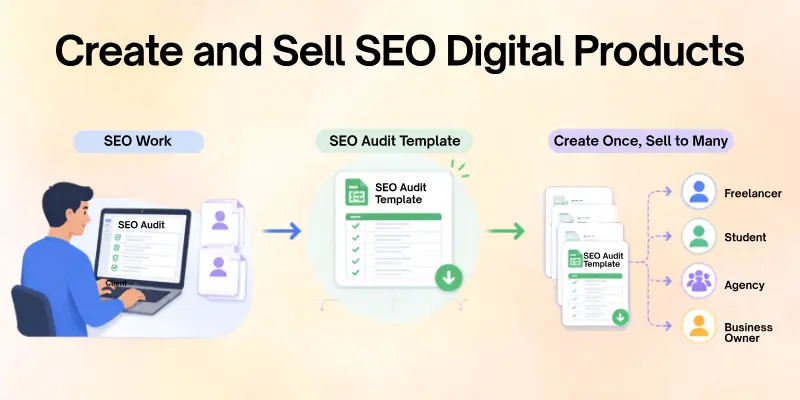
You do not always need to sell your time. You can turn your SEO knowledge into digital products. For example, you can create:
- SEO audit templates.
- Keyword research sheets.
- Content brief templates.
- SEO checklists.
- Local SEO checklists.
- Reporting dashboards.
- Search Console templates.
- Internal linking sheets.
- SOPs.
- Notion SEO systems.
- Spreadsheet tools.
You create the product once and can sell it to many people. However, you still need marketing and customer support. So do not think of digital products as completely automatic income.
How to Start
Think about a problem you repeatedly solve.
For example: If you spend one hour preparing the same SEO audit sheet for every client, turn that sheet into a clean template.
Then sell it to:
- Freelancers.
- Students.
- Small agencies.
- Business owners.
- Content writers.
Combine It with SEO
This is where your SEO skills become useful again.
Suppose you sell an: SEO audit checklist
You can create useful content around searches such as:
- how to do an SEO audit
- SEO audit checklist
- technical SEO audit template
Your content brings potential buyers to your digital product.
My recommendation: This is one of the best ways to turn your knowledge into an asset instead of selling only your working hours.
Which SEO Income Method Should You Choose?
You should not start all 15 methods at once. Choose according to your current situation.
If You Are a Complete Beginner
Start with:
- Freelance SEO.
- On-page SEO.
- Local SEO.
- Simple SEO audits.
These methods help you get practical experience.
If You Already Have Some Experience
Try:
- Monthly SEO services.
- E-commerce SEO.
- White-label SEO.
- Technical audits.
- Local lead generation.
If You Want to Build Your Own Assets
Consider:
- Blogging.
- Affiliate marketing.
- Website flipping.
- Lead generation websites.
- Digital SEO products.
If You Have Strong Experience
Move toward:
- SEO consulting.
- Advanced technical SEO.
- Training.
- Courses.
- Larger e-commerce projects.
How Much Money Can You Make with SEO?
There is no fixed amount.
Your income depends on things such as:
- Your SEO skills.
- Your experience.
- Your location.
- Your clients.
- Your niche.
- The service you sell.
- Your sales ability.
- The results you can produce.
- Whether you work for yourself or someone else.
Do not focus too much on screenshots where someone claims to make thousands of dollars in a few days.
Focus on becoming useful. If you can solve an important business problem, you can charge for that solution.
Mistakes to Avoid When Trying to Make Money with SEO
Making money with SEO does not mean taking every shortcut you find online. Avoid these common mistakes:
- Selling Results You Cannot Guarantee: Do not promise a number-one ranking.
- Keyword Stuffing: Write naturally instead of repeating keywords unnaturally.
- Buying Hundreds of Bad Links: Focus on useful and genuine link opportunities.
- Publishing Thousands of Weak Pages: Google specifically warns against scaled content created mainly to manipulate rankings.
- Copying Competitors: Learn from competitors but create something useful of your own.
- Depending Only on Tools: SEO tools help you, but tools do not replace thinking.
- Trying Every Business Model: Choose one method and learn it properly.
- Ignoring Search Console: Use Google’s own data to understand what happens to your website.
- Stopping After One Month: SEO normally requires continuous learning and improvement.
Google’s Search Essentials recommends focusing on useful content and a good experience for people instead of tactics designed mainly to manipulate Google Search.
Final Thoughts
In this guide, we have covered how to make money with SEO in detail. You now know that SEO income is not limited to getting a job or becoming a freelancer.
You can use SEO to:
- Work with clients.
- Grow businesses.
- Build websites.
- Generate leads.
- Sell products.
- Grow online stores.
- Build YouTube channels.
- Offer consulting.
- Work with agencies.
- Sell audits.
- Create courses.
- Sell digital products.
From my personal experience, I recommend starting with one simple method. If you are new, start with freelancing or local SEO because real clients teach you things that courses cannot.
Once you understand how SEO works on real websites, you can move toward your own assets such as blogs, affiliate sites, lead generation websites, or digital products.
- Do not chase quick money.
- First build a skill that solves a real problem.
- Then learn how to sell that skill.
- After that, build systems and assets around it.
- That is a much stronger way to build long-term income with SEO.
Goodbye and keep growing.
FAQs
Here are some of the most commonly asked questions related to how to make money with SEO:
Yes. Beginners can start with simple SEO services such as keyword research, on-page SEO, content optimization, local SEO, or basic audits. Start with small projects and improve your skills through real work.
It depends on the method. Freelancing can produce income sooner because a client pays you for your work. Building a blog, affiliate website, or lead-generation site usually takes longer because you first need useful traffic.
SEO can be used in many ways. You can work for a company, become a freelancer, build an agency, consult businesses, create websites, or use SEO to grow your own products.
You can start learning and practising SEO with relatively low costs. However, you will still need basic resources such as a computer, internet access, and somewhere to practise. Paid tools can help later, but you do not need every expensive SEO tool when starting.
There is no one method that is best for everyone. For beginners, freelancing and local SEO are good starting points. If you want to build your own long-term asset, blogging, affiliate marketing, lead generation, or digital products may suit you better.
Yes. Websites, affiliate content, e-commerce stores, lead-generation sites, and digital products can continue producing income after you build them. However, they still need monitoring, updates, and maintenance.
The basic concepts are not difficult. The harder part is applying them correctly to real websites. You improve much faster when you practise instead of only watching courses. You can go with our SEO course too!
There is no fixed amount. Earnings depend on your skills, clients, niche, business model, experience, and ability to produce useful results.
You do not need strong coding skills for basic SEO. However, understanding HTML and basic website technology becomes very useful when you move into technical SEO.
Yes. Many people start SEO alongside a job, study, or another business. You can begin with a small client or your own website and expand later.
Yes. You can provide local SEO services to businesses, manage Google Business Profiles, improve local website pages, or build genuine local lead-generation websites. Google says local visibility mainly depends on relevance, distance, and prominence.
Yes. You can build blogs, affiliate websites, e-commerce stores, lead-generation websites, YouTube channels, digital products, or websites that you later sell.
Yes, but avoid outdated advice. YouTube says titles, thumbnails, and descriptions are more important for discovery than tags. Tags normally play only a minimal role.
Yes. An SEO audit can work as a stand-alone service. You can also sell implementation and ongoing monitoring after completing the audit.
For e-commerce businesses, Google Merchant Center and free-listing optimization is a useful specialized service. Google says eligible free product listings can appear across several Google surfaces, including Search, Maps, Gemini, YouTube, Shopping, Images, and Lens.