Domain Authority in SEO: Is It A Google Ranking Factor?
Published: 29 Dec 2025
Wondering what is DA in SEO and how to improve it? If so, you’re in luck! In this article, we’ll break down everything you need to know about this important SEO metric in a concise and easy-to-understand way.
So, without further ado, let’s get started!
What is DA in SEO?
Hey buddy reader! Let’s break down DA in simple terms?
DA stands for Domain Authority, and it’s like the coolness factor of a website. It tells you how trustworthy and important a website is in the big online world. When you’re thinking about starting your blog, DA is your buddy to help you make smarter decisions for better niche research.
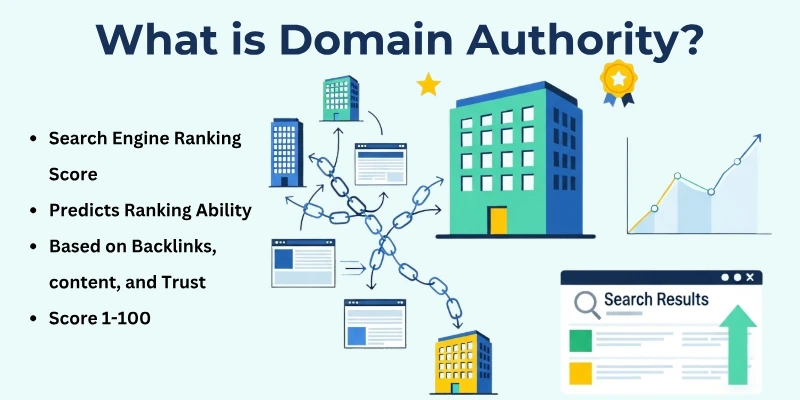
Imagine you’re at a party, and you don’t know anyone. You’d naturally be drawn to the person who seems popular and well-liked, right? That’s a bit like what DA does for websites.
It’s a number from 1 to 100 that shows how popular and respected a website is in the internet world. The higher the DA, the more likely it is that people trust and visit that site.
Why is DA Important in SEO?
Suppose you’re looking for information on how to bake a cake. You go to Google and type in “how to bake a cake.” Google then returns a list of websites that it believes are relevant to your search query.
Assume that two of the websites on the first page of results are very similar. They both have good content, are well-designed, and are mobile-friendly. But there is one significant difference: one website has a higher DA than the other.
Which website do you believe Google is more likely to rank higher in SERPs? You guessed it: the website with the higher DA.
Why is this so?
DA is a measure of how authoritative a website is. Google believes that websites with higher DAs are more authoritative and trustworthy. So, if two websites are otherwise equal, Google is more likely to rank the website with the higher DA higher in SERPs.
NOTE:
Keep in mind that you should not consider DA as a direct ranking factor for Google. Sometimes the websites with low DA’s also got ranked. So, I am again mentioning that your site’s DA is not directly related to your site’s ranking, as it’s just an SEO tool parameter.
How is DA Calculated?
Moz uses its own special algorithm to figure out Domain Authority (DA), which is based on a number of things, such as:
- The quantity and quality of backlinks pointing to the website
- The age of the domain
- The relevance of the backlinks
- The size of the website
- The quality of the website’s content
Moz doesn’t publicly disclose the exact formula for calculating DA, but it has said that it uses a combination of link metrics and other factors to assess the authority of a website.
Here is a simplified explanation of how DA is calculated:
- Moz first identifies the root domains that link to the website.
- Moz then assigns a score to each root domain based on its own authority.
- Moz then calculates the total number of backlinks from each root domain to the website.
- Moz then uses a proprietary algorithm to combine the number and quality of backlinks from each root domain to calculate the website’s overall DA score.
The DA scale runs from 1 to 100, with higher scores indicating more authority. A new website will typically start with a DA of 1, while a well-established website with a lot of high-quality backlinks could have a DA of 90 or higher.
Once Again Mentioning!!!!
It’s important to note that DA is not a perfect metric. It doesn’t take into account all of the factors that Google considers when ranking websites. However, it’s still a useful tool for evaluating the authority of a website and tracking its progress over time.
How Can I Check my Site’s DA?
There are two methods for determining your site’s Domain Authority:
- Use the Moz Domain Authority Checker. This is a free tool for determining the DA of any website. Simply enter your website’s URL and click “Check DA.”
- Use the MozBar. This is a free browser extension that provides you with instant access to DA and other SEO metrics for any website you visit.
To check your site’s DA using the Moz Domain Authority Checker, simply follow these steps:
- Go to the Moz Domain Authority Checker website.
- Enter your website’s URL in the search bar.
- Click “Check DA.”
- Moz will then return a DA score for your website.
To check your site’s DA using the MozBar, simply follow these steps:
- Install the MozBar browser extension.
- Navigate to your website.
- Look for the MozBar icon in the top right corner of your browser window.
- Hover your mouse over the MozBar icon.
- A pop-up will appear with your website’s DA score.
What is a Good or Average DA Score?
Well, according to Moz, the folks who created DA, a score of 40-50 is average, while a score of 50-60 is good. Scores above 60 are excellent.
So, what does this all mean?
Basically, a website’s DA score tells you how well it’s likely to do in search engine results pages. It depends on many things, like how many and how good the links are to the website. So, a high DA score means that the site lots of high-quality links from other websites.
NOTE: DA is not the only direct ranking factor used by Google to rank websites. Other factors to consider include the quality of your content and the relevance of your website to the search query.
How Can I Increase my Site’s DA?
There are a number of things you can do to increase your Domain Authority (DA) score.
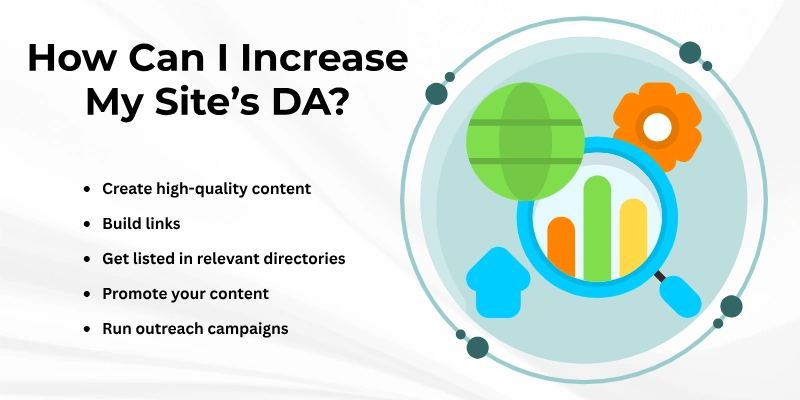
Here are a few tips:
- Create high-quality content that people will want to link to. Doing this is vital in order to enhance one’s DA score. Your content ought to be well-written, informative, and captivating.
- Build links from high-quality websites. Backlinking to your website from other websites conveys to Google that you operate an authoritative and reliable website.
- Get listed in relevant directories. Directories can help you to build links from other websites. Just make sure to choose directories that are high-quality and relevant to your niche.
- Promote your content on social media. When you share your content on social media, it can help to attract attention from other websites and potential link builders.
- Run outreach campaigns. Reach out to other website owners and bloggers in your niche and ask them to link to your content. Be sure to provide them with a valuable reason to do so, such as a guest post opportunity or a featured link on your website.
Why Did my Site’s DA Change?
According to Moz, your Domain Authority (DA) can vary for a variety of reasons. Some of the most popular factors consist of:
- Acquiring new backlinks from authoritative websites: If you obtain a backlink from a high-DA website, your own DA will most likely rise. This is due to the fact that Moz’s algorithm takes into account the DA of the linking websites when calculating DA.
- Losing backlinks: Your DA may go down if you lose a backlink from a trustworthy website. It’s important to remember, though, that not all backlinks are the same. If you lose a backlink from a site that isn’t seen as trustworthy anymore, it might not have a big effect on your DA.
- Changes to the quality of your existing backlinks: Your DA may drop if some of your existing backlinks become less authoritative. This can happen if the websites that link to you lose their DA, or if the backlinks themselves become spammy or irrelevant.
- Algorithm updates: If Google begins to give more weight to backlinks from specific types of websites, your DA may rise or fall accordingly. For example, if Google begins to favour backlinks from social media websites, your DA may rise if you have a strong social media presence.
- Scaling fluctuations: It’s normal for DA scores to fluctuate slightly from time to time. This situation is because Moz’s DA algorithm is constantly being updated and improved. If you see a small fluctuation in your DA score, don’t worry too much. Just keep working on improving your backlink profile and other SEO factors.
Is DA a Page-level or Site-level Metric?
Domain Authority (DA) is a site-level metric, meaning that it measures the strength and authority of an entire website, not just individual pages. This is because DA is calculated based on several factors that are relevant to the entire website, such as the number and quality of backlinks, the age of the domain, and the overall website structure.
Keep in mind that individual pages on a website can also be popular, but the popularity of a page does not necessarily reflect the popularity of the website as a whole. For example, a single blog post on a popular news website may be very popular, but that doesn’t mean that all of the other pages on the website are also popular.
Conclusion
So guys, there you have it! That’s what Domain Authority is in SEO.
Even though DA is a good way to figure out how popular and authoritative a website is as a whole, it is important to remember that it is not a direct ranking factor. Google doesn’t use domain authority to decide where to put a website in the search results.
But it can be a useful tool for SEO professionals. You can see how your SEO efforts affect the authority and popularity of your website by tracking its DA over time. You can also use DA to compare your site to the competition and identify areas for improvement.
FAQs
Here are some of the most commonly asked questions related to what is DA in SEO:
DA, or Domain Authority, is a metric developed by Moz. And in SEO domain authority can be used to:
- Identify and target high-authority websites for link building.
- Track the progress of your link-building efforts over time.
- Benchmark your website against your competitors.
PA, or Page Authority, is another Moz metric that forecasts how likely a specific page will rank in SERPs. It is calculated similarly to DA, but it considers page-specific factors such as the quality of its content and the number and quality of backlinks pointing to it.
Yes, DA can be a useful parameter in niche research. You can gain a better understanding of the competition and the types of content that rank well by identifying high-DA websites in your niche.
Yes, low-DA sites can rank in SERPs. Low-DA sites, on the other hand, have a more difficult time ranking for competitive keywords. To compete with a low-DA site, you must focus on creating high-quality content and building links from high-authority websites.
Google has not explicitly stated that DA is a ranking factor. But, factors that contribute to DA, such as backlinks and high-quality content, are important ranking factors.