What Is a Ranking Factor? Complete Guide for Beginners
Published: 19 Aug 2026
You often hear SEO experts saying things like, “This is a Google ranking factor” or “You need this factor to rank higher”.
But this can easily confuse a beginner. Does Google really have a fixed list of ranking factors? Does every SEO activity directly improve rankings? Are backlinks still important? Does page speed matter? What about E-E-A-T, keywords, mobile SEO, and user experience?
In this guide, I will explain what is a ranking factor…. with great detail. I will not make SEO more difficult than it needs to be. And I’m pretty sure that by the end of this guide, you will understand what ranking factors are, how Google actually ranks pages, which areas deserve your attention in 2026, and which common SEO claims you should stop believing.
Let’s dig in!
What Is a Ranking Factor?
A ranking factor is something that may help a search engine decide which pages should appear for a search and in what order.
However, there is an important point you should understand in 2026. Google normally talks about ranking systems, signals, and factors rather than giving website owners one fixed public list of ranking factors.
Google says its automated ranking systems look at many factors and signals when deciding which results are most relevant and useful for a search. Most of these systems work mainly at page level, although Google also uses some site-wide signals and classifiers.
So instead of thinking: “Google has 200 ranking factors, and I must optimize all 200.”
Think like this: “Google uses many systems and signals to understand my page, its relevance, its usefulness, its quality, its links, and the experience it gives users.”
That is much closer to how Google explains Search today.
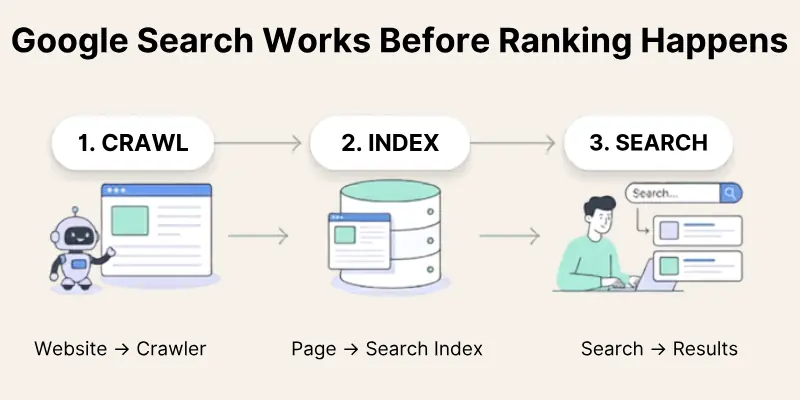
How Google Search Works Before Ranking Happens
Before talking about ranking, you should understand one basic thing.
- Google cannot rank a page properly if it cannot discover and understand that page.
- Google Search normally works through three main stages: crawling, indexing, and serving search results.
- During crawling, Google discovers pages and downloads their content.
- During indexing, Google tries to understand the text, images, videos, and other information on those pages.
- When someone searches, Google then tries to show useful and relevant results from its index.
This means SEO does not start with backlinks or keywords. It starts by making sure Google can access, understand, and index your important pages.
How Google Ranking Systems Work
Google does not use one simple formula. It uses different automated systems that help it understand queries, pages, links, quality, freshness, relevance, spam, and other information.
Most ranking decisions happen at page level. This means one strong page on your website may perform very well while another weak page on the same website may perform poorly.
Google also uses some site-wide information, but having a strong website does not guarantee that every page will rank. In the same way, a few weak pages do not automatically mean every page on the website will fail.
This is important for students because many people think: “My website has authority, so every article will rank.” That is not how you should think about SEO. You still need to make each important page useful, relevant, accessible, and clear.
Why Ranking Signals Matter
Ranking signals matter because they help Google understand which result may help the searcher most. Suppose ten websites publish pages about: “How to start SEO for a new website.”
Google has to decide which pages deserve stronger positions.
It may need to understand which page actually answers the question, which page offers original value, which page is easy to access, how pages across the web link to it, whether the information appears reliable, and whether the page gives users a good overall experience.
Google’s Search Essentials tell website owners to focus especially on helpful content, words that people actually search for, crawlable links, understandable images and other content, and sound technical setup.
The main lesson is simple: Do not optimize for a checklist only. Build pages that Google can understand and people actually want to use.
Main Types of SEO Signals You Should Understand
For learning purposes, I divide the main SEO areas into five simple groups:
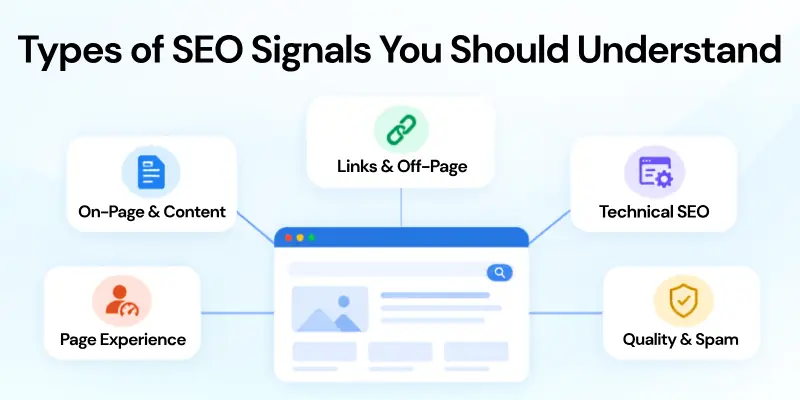
- On-page and content signals
- Technical SEO signals
- Link and off-page signals
- Page experience signals
- Quality and spam-related systems
Google may not officially use these exact classroom categories, but they make SEO much easier for students to understand.
1. On-Page and Content Signals
On-page SEO covers the things you control directly on your page.
1. Helpful Content
Content remains one of the most important areas in SEO. But do not understand “quality content” as simply writing 2,000 or 3,000 words. Google does not have a preferred minimum or maximum word count for ranking.
A 700-word article can be better than a 4,000-word article if it answers the user’s question properly. Google recommends creating content that is useful, original, easy to read, updated when needed, and made mainly for people rather than mainly to attract search traffic.
When you write a page, ask yourself a simple question: “After reading this page, has the visitor learned enough to solve the problem?” If the answer is yes, you are moving in the right direction.
2. Original Value
Do not simply open five competitors, combine their points, change some words, and call it new content.
Google specifically encourages original information, original research, useful analysis, first-hand knowledge, and content that gives people more value than pages that already exist. You do not always need original scientific research.
Original value can also mean your own examples, screenshots, experience, testing, comparison, explanation, process, opinion based on experience, or a clearer answer to a difficult question.
3. Search Intent and Relevance
Your page should answer what the person actually wants.
For example, someone searching: “what is SEO”
probably needs an explanation.
Someone searching: “SEO services in Lahore”
probably wants to hire an SEO company.
Someone searching: “Ahrefs vs Semrush”
probably wants a comparison.
You should understand the purpose behind the query before writing the page. Google uses advanced language-matching systems that can understand related concepts even when your page does not repeat every exact keyword variation.
So do not write like this: “SEO services Pakistan provide best SEO services in Pakistan for people searching SEO Pakistan services.”
That is not optimization. That is keyword stuffing.
4. Keyword Usage
Keywords still help you describe your topic.
Google’s own Search Essentials recommend using words that people would use to search for your content and placing useful terms in important locations such as the page title, main heading, alt text, and link text.
But you do not need to force the same keyword into every paragraph. Use your main topic clearly.
Then write naturally. Google’s language systems can understand related words and concepts without requiring you to repeat the exact query again and again.
5. Keyword Stuffing
Keyword stuffing means repeating keywords unnaturally to manipulate rankings. Google treats this as spam.
For example, creating large blocks of city names, repeating the same service phrase again and again, or filling paragraphs with keywords just to rank can create problems.
Always write for a human reader first.
6. Title Tag
The title is important because it tells users and Google what the page covers. Google may use your HTML title, page headings, and other information when creating the title link that appears in search results.
Write a title that is clear, accurate, useful, and specific to the page. Do not stuff five keyword variations into one title. A title should make sense when a person reads it.
7. Headings
Use headings to organize your content.
H1, H2, and H3 headings make long content easier to understand. However, do not believe that Google requires some magical number of headings.
Google says there is no ideal number of headings, and the exact semantic order of headings is not a special ranking trick. Use headings because they help people understand your page.
8. Meta Description
A meta description is not something you should treat as a direct ranking factor. Its main job is to describe the page and help a searcher understand the result.
Google may sometimes use your meta description for the search snippet, but it can also create the snippet from the page itself. Write a short, clear, unique description that tells the reader what the page offers.
9. Internal Linking
Internal links connect one page of your website with another. They help users discover related content. They also help Google find pages and understand relationships between pages.
Google says links are an important way it discovers new pages. Descriptive anchor text also helps both users and Google understand the destination page.
For example, instead of writing: “Click here.”
You can write: “Read our technical SEO guide.”
The second anchor gives more context.
2. Technical SEO Signals
Technical SEO makes sure Google can properly access, crawl, understand, and index your website.
1. Crawlability
If Google cannot access a page, it may not be able to understand or index it properly.
Check important pages for problems such as accidental robots.txt blocks, broken navigation, poor linking, server errors, or access restrictions.
Your important links should also be crawlable. Google normally expects standard HTML links with an href attribute when discovering linked pages.
2. Indexing
Crawling and indexing are not the same thing.
Google may crawl a URL but decide not to index it. A page needs to be indexed and eligible for Search before it can appear normally in search results.
Even if you follow Google’s guidelines, Google does not guarantee that every page will be crawled, indexed, or shown. This is why Google Search Console should be part of your SEO work.
3. Mobile-First Indexing
Google uses the mobile version of a website’s content for indexing and ranking. Google calls this mobile-first indexing. This means your mobile version should not be a weak copy of your desktop version.
Important text, images, links, headings, and other main information should work properly on mobile.
4. Structured Data
Structured data helps Google understand certain information on your page and can make the page eligible for special search appearances such as rich results.
But structured data does not mean: “Add schema and your ranking automatically goes up.”
Google describes structured data mainly as a way to understand page information and make pages eligible for supported search features. Eligibility does not guarantee that Google will show a rich result.
Use the correct schema for the page. Do not add fake information. The structured data should match what the visitor can actually see on the page.
3. Links and Off-Page SEO
Links still matter in Google Search. Google says it uses links as signals to understand page relevance and to discover new pages. Google also continues to use PageRank as part of its core ranking systems.
However, this does not mean: “More backlinks always equal better rankings.”
Google has strong systems and spam policies for manipulative links.
1. Quality of Links
A useful link normally exists because one website genuinely wants to send readers to another useful resource.
You should focus on earning real links through useful content, research, tools, resources, products, relationships, PR, and genuine promotion. Do not build links only because a spreadsheet tells you that you need 500 backlinks.
2. Link Spam
Google’s spam policies clearly cover manipulative link building.
Buying links for ranking purposes, excessive link exchanges, automated link creation, low-quality directory links, optimized links in large-scale guest posts, spammy forum links, and similar tactics can violate Google’s policies.
Paid or sponsored links can exist, but Google says they should use the proper link qualification, such as rel=”sponsored” or rel=”nofollow” where appropriate.
3. Domain Authority
Be careful when someone says: “Your Domain Authority is 70, so Google trusts your site.”
Domain Authority and similar scores come from third-party SEO tools. They are not Google’s internal ranking scores.
Google warns that third-party SEO tools do not have access to Google’s internal ranking data. Their metrics can still help with SEO analysis, but you should not confuse those numbers with Google’s own ranking systems.
4. Page Experience
Page experience means how comfortable and usable your page feels for visitors. Google advises website owners to look at the complete page experience instead of chasing one score.
A useful page should load properly, work well on mobile, use secure connections, avoid annoying pop-ups, keep the main content easy to see, and avoid advertisements that make the page difficult to use.
1. Core Web Vitals
Core Web Vitals measure important parts of real-world page experience. In 2026, the three main Core Web Vitals are LCP, INP, and CLS.
LCP measures loading performance. Google recommends aiming for LCP within 2.5 seconds. INP measures how quickly the page responds to user interaction. Google recommends aiming for less than 200 milliseconds.
CLS measures unexpected visual movement. Google recommends aiming for less than 0.1. But do not become obsessed with getting a perfect performance score.
Google says Core Web Vitals are used by its ranking systems, but perfect scores do not guarantee top rankings. Relevance and useful content still matter greatly.
2. HTTPS and Mobile Experience
Security and mobile usability remain important for users and overall page experience.
However, Google’s current page-experience guidance makes an important distinction: Core Web Vitals are used by ranking systems, while other page-experience aspects beyond Core Web Vitals do not directly make a page rank higher by themselves.
They still matter because they improve the website for users and support the overall type of experience Google’s systems seek to reward.
5. Quality and Spam Systems
Modern SEO is not only about adding positive signals.
You must also avoid practices that Google’s spam systems try to detect. Google uses several spam detection systems, including SpamBrain, and updates these systems as spam methods change.
1. Scaled Low-Value Content
Publishing hundreds or thousands of weak pages only to attract search traffic can create serious problems.
Google defines scaled content abuse as producing many pages mainly to manipulate rankings rather than help users.
The problem is not simply how the content was produced. The problem is producing large amounts of low-value or unoriginal content mainly for ranking manipulation.
Focus on value, not volume.
Ten strong pages can serve your website better than 1,000 useless pages.
2. Expired Domain Abuse
Buying an expired domain only because it previously had strong signals and then filling it with unrelated low-value commercial content can violate Google’s spam policies.
Google calls this expired domain abuse. Buying an expired domain itself is not the main problem. Using it mainly to manipulate rankings is the problem.
3. Site Reputation Abuse
Another important area in modern SEO is site reputation abuse. This can happen when third-party content gets published on a strong website mainly to take advantage of that website’s existing ranking signals.
For example, an established website about one topic should not rent parts of its website to unrelated third parties simply so those third-party pages can rank more easily.
This is especially important for publishers, large blogs, marketplaces, review websites, and websites accepting third-party commercial content.
Ranking Factors vs Ranking Signals
You will hear both terms in SEO.
Do not spend too much time fighting over the wording. The important point is that Google uses many systems and signals when ranking pages.
A signal is information Google’s systems may use when understanding a page, query, relationship, quality, relevance, or other aspect of Search. A ranking system may use many different signals together.
Google does not give SEOs a complete formula showing exactly how much weight every signal receives. Google also changes and improves these systems over time.
So when someone says:
“This ranking factor has exactly 13% weight.”
Ask for evidence.
Do not believe precise numbers simply because they appear in an SEO tool or blog post.
What About E-E-A-T?
E-E-A-T stands for Experience, Expertise, Authoritativeness, and Trustworthiness.
Many beginners think E-E-A-T is one Google ranking factor. Google clearly says that E-E-A-T itself is not a specific ranking factor.
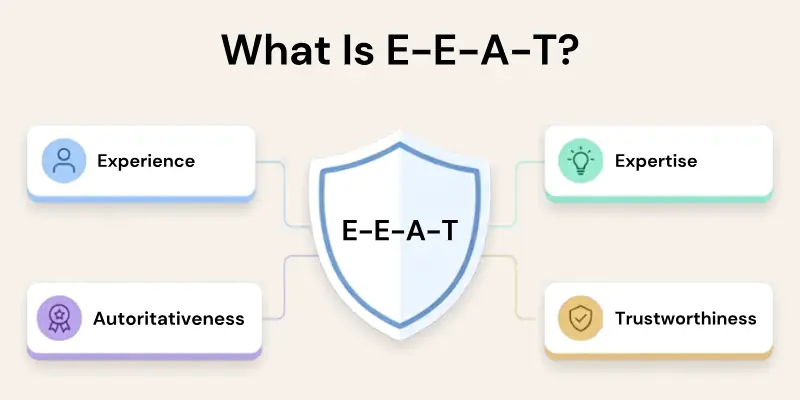
Instead, Google uses a mix of signals that can help identify content showing qualities connected with E-E-A-T. Google gives even more importance to strong trust-related qualities for topics that can seriously affect people’s health, finances, safety, or well-being.
So do not create an “E-E-A-T score” in your mind.
Instead, show readers why they should trust the page.
- Use accurate author information where it makes sense. Explain who created the content.
- Show real experience when the topic needs it.
- Use reliable sources.
- Correct factual mistakes.
Make your website and business information clear.
What About Bounce Rate and Dwell Time?
SEO articles often say: “High bounce rate will reduce your rankings.”
Or: “Long dwell time will automatically improve rankings.”
Be careful with statements like these.
Google’s current public SEO guidance does not tell website owners to improve Google Analytics bounce rate or time-on-page as direct ranking factors.
Instead, Google tells website owners to focus on useful content and a good overall page experience.
A visitor leaving quickly is not always bad.
Imagine someone searches: “What is the capital of Pakistan?”
Your page answers: “Islamabad.”
The visitor gets the answer and leaves. That does not automatically mean your page failed. Always understand the purpose of the page before judging user behaviour.
What About Social Signals?
Social media can bring visitors, attention, brand awareness, discussions, and sometimes natural links.
These benefits can help your marketing. However, you should not teach students that Facebook likes, Instagram followers, or social shares are confirmed direct Google ranking factors.
Google’s Search Essentials tells website owners to tell people about their sites and take part in relevant communities, but this is different from saying that every social like directly increases Google rankings. Use social media because it can help people discover your work. Do not buy fake engagement for SEO.
Freshness and Updating Content
Fresh content does not automatically rank better simply because you changed the publication date.
Google has freshness systems for searches where users would reasonably expect recent information. For example, people searching for breaking news, a new movie, a recent event, or another time-sensitive topic may need fresh results.
But someone searching: “How to tie a tie”
does not necessarily need an article published yesterday. Update content when the information needs updating. Do not change dates only to make an old article look new.
How to Optimize for Ranking Systems in 2026
In this section, we will cover how you can improve your rankings:
- Start with the user.
- Understand what the person is searching for.
- Create a page that answers the question properly.
- Use clear words in your title, heading, content, links, and image descriptions.
- Add something useful instead of copying what already ranks.
- Make sure Google can crawl and index the page.
- Build a clean internal linking structure.
- Earn useful and natural external links.
- Improve Core Web Vitals without sacrificing content quality.
- Make the website work properly on mobile.
- Use HTTPS.
- Use structured data where it genuinely applies.
- Keep important information updated.
- Show who created important content when readers would benefit from knowing.
- Use Search Console to check Google’s own data about your website.
Most importantly, stay away from keyword stuffing, link manipulation, scaled low-value pages, scraped content, misleading pages, and other spam practices. Google’s Search Essentials and spam policies make these principles very clear.
Common Myths About Ranking Factors
In this section, we will clear some common misconceptions:
1. Myth: Google Has a Public List of Exactly 200 Ranking Factors
Do not build your SEO strategy around this claim. Google says its ranking systems look at many factors and signals, but its current documentation does not give website owners one fixed public checklist called “the 200 ranking factors.”
2. Myth: More Keywords Mean Better Rankings
Wrong. Use important words naturally. Keyword stuffing violates Google’s spam policies.
3. Myth: You Need Exact-Match Keywords Everywhere
Wrong. Google’s language matching systems can understand concepts and related terms even when your page does not contain every exact search phrase.
4. Myth: Longer Content Always Ranks Better
Wrong. Google says there is no magical minimum or maximum word count for ranking. Write enough to answer the topic properly. Then stop.
5. Myth: More Backlinks Always Mean Better Rankings
Wrong. Links matter, but manipulative link building can violate Google’s spam policies.
6. Myth: Domain Authority Is a Google Ranking Score
Wrong.
Third-party SEO metrics do not come from Google’s internal ranking data. Use them for comparison if they help you, but do not treat them as Google scores.
7. Myth: E-E-A-T Is One Ranking Factor
Wrong. Google specifically says E-E-A-T itself is not a specific ranking factor.
8. Myth: A Perfect PageSpeed Score Guarantees Rankings
Wrong. Core Web Vitals matter, but Google says strong Core Web Vitals do not guarantee a top position.
9. Myth: SEO Changes Work Immediately
Not always. Google says some changes may appear within hours while others can take several months. It often makes sense to wait a few weeks before judging whether a change helped.
10. Myth: Ranking Positions Stay Fixed
They do not. Search results change as content, systems, competition, user expectations, and the web change. Google also makes broad core updates several times a year.
How Often Do Google Ranking Systems Change?
In this section, we will understand updates and changes.
- Google keeps improving Search.
- Some changes are small.
- Some changes are larger core updates.
Google says it makes significant broad core updates several times each year. These updates do not simply target one website. Their purpose is to improve how Google’s systems provide useful and reliable search results overall.
Do not panic whenever rankings move.
- First check your Search Console data.
- Look at which pages lost traffic.
- Check which queries changed.
- Compare your content with the type of content users now find useful.
- Look for technical issues.
- Then improve the page where real improvement makes sense.
Do not make random changes just because somebody on social media says: “Google changed the algorithm yesterday.”
SEO in 2026 and Google’s New Search Features
Google Search now includes newer search experiences such as AI Overviews and AI Mode.
This has created a new wave of terms such as AEO and GEO. Do not make this more complicated than necessary.
Google’s June 2026 guidance says website owners should continue following normal SEO fundamentals for these search experiences.
A page still needs to meet normal Search technical requirements, be indexed, follow Google’s policies, provide useful content, have good internal links, offer a good page experience, make important information available as text, and use accurate structured data when relevant.
Google also says you do not need a special AI file, special machine-readable file, or special schema markup just to appear in these features.
This gives us one very simple lesson: Good SEO is still good SEO.
Do not chase a new abbreviation every six months. Learn the fundamentals properly.
What Should Beginners Focus on First?
If you are learning SEO, do not start by trying to memorize hundreds of ranking factors.
- First learn how Google crawls and indexes pages.
- Then learn search intent and keyword research.
- After that, learn how to create helpful pages.
- Learn titles, headings, internal links, images, and basic on-page SEO.
- Then learn technical SEO.
- After that, study link building and off-page SEO.
- Learn Search Console properly.
- Finally, study Google’s spam policies so you know which shortcuts can create problems.
If your fundamentals are strong, advanced SEO becomes much easier. And in our SEO course we do take a start from very basic so that every student entering to this seo or blogging world can get these all point clear forever.
Conclusion
In this guide, we have covered what a ranking factor is in great detail. We explored how it works, why it matters, and how you can use it to improve your website performance.
From my experience, the best approach is simple. Do not try to chase every ranking factor. Focus on creating helpful content, improving your website experience, and building trust. That alone can take you very far. Keep learning, keep improving, and you will see results over time.
Goodbye and best of luck with your SEO journey.
FAQs
Here are some of the most commonly asked questions related to what is ranking factor in SEO or blogging:
A ranking factor is something Google’s systems may use when deciding which pages are useful and relevant for a search. Google uses many different factors, signals, and ranking systems rather than one simple formula.
Google says its ranking systems look at many factors and signals, but you should not teach Google’s system as one confirmed public list of exactly 200 ranking factors. Google does not provide website owners with the complete ranking formula.
Google does not give website owners one universal “number one ranking factor.” Different searches can need different signals and systems. However, Google’s beginner SEO guidance strongly emphasizes useful, original, reliable, people-first content.
Yes. Google still uses link analysis systems, and PageRank remains part of its core ranking systems. However, manipulative link building can violate Google’s spam policies.
There is no fixed backlink number required for ranking. Google uses many systems and signals, not links alone. The importance of links can also differ by page, topic, and search.
Google says Core Web Vitals are used by its ranking systems. However, perfect Core Web Vitals scores do not guarantee high rankings because relevance, content, and many other signals also matter.
Yes. Google uses the mobile version of a site’s content for indexing and ranking, so your important content should work properly on mobile. Mobile usability also forms an important part of a good overall page experience.
No. Google says E-E-A-T itself is not one specific ranking factor. Google instead uses different signals that can identify qualities connected with experience, expertise, authority, and trust.
Google’s main concern is not simply whether automation helped create content. Google’s spam policies target scaled content created mainly to manipulate rankings and provide little value. Content should still follow Search Essentials and provide real value to users.
No special technical SEO system is required. Google says the same basic SEO practices continue to apply to AI Overviews and AI Mode. Your page needs normal Search eligibility, useful content, proper crawlability, good internal links, and sound SEO fundamentals.
You should not treat the meta description as a direct ranking factor. It mainly helps describe the page in search results. Google may use it as the snippet, or Google may create a snippet from the page content.
Google does not give website owners a recommended keyword-density percentage. Write naturally, use the important topic terms where they make sense, and avoid keyword stuffing. Google’s systems can understand related terms without exact repetition.
Content length alone does not determine ranking. Google says there is no magical minimum or maximum word count. Write enough to satisfy the reader’s need.
There is no fixed time for every website. Google says some changes may appear within hours, while others may take several months. In many cases, you should allow a few weeks before properly judging a change.
Follow Google Search Essentials. Create useful content for real people, make your pages easy for Google to crawl and understand, use natural language, build useful links, improve the website experience, use Search Console, and avoid techniques designed mainly to manipulate rankings.