ASO vs SEO: Key Differences & How They Work
Published: 3 Sep 2026
Many people confuse App Store Optimization and Search Engine Optimization. Both help people discover digital products online, but they work in different places and follow different rules.
App Store Optimization focuses on improving the visibility of mobile apps inside app stores such as the Google Play Store and Apple App Store. Search Engine Optimization focuses on improving the visibility of websites in search engines like Google, Bing, and Yahoo.
Both strategies aim to increase visibility, attract users, and grow traffic. However, the techniques, ranking factors, and optimization methods differ greatly.
When people compare ASO vs SEO, they usually want to understand how app marketing differs from website marketing. Businesses that run apps need ASO to increase app downloads. Businesses that run websites need SEO to increase organic search traffic. If a company runs both a website and a mobile app, it can benefit from using both strategies together.
So guys, understanding the difference between app store optimization and search engine optimization helps marketers choose the right strategy for their platform.
ASO vs SEO: Key Differences
Both strategies improve online visibility, but they work in different ecosystems. ASO targets app stores, while SEO targets search engines. Each platform uses its own algorithm, ranking signals, and user behavior patterns.
We can compare them based on several important factors. These factors help us understand how each optimization method works.
Here are the main factors we will compare:
- Platform Focus
- Search Intent
- Keyword Strategy
- Ranking Factors
- Content Optimization
- Visual Elements
- User Engagement Signals
- Conversion Goals
- Competition Level
- Optimization Process
Let us cover all these factors in detail.
1. Platform Focus
The first major difference between the two strategies relates to the platform where optimization takes place. App Store Optimization focuses on mobile app marketplaces such as the Apple App Store and Google Play Store.
These platforms list millions of apps, and developers compete for higher rankings within app search results. Users visit these stores when they want to install a new app for entertainment, productivity, gaming, or daily tasks.
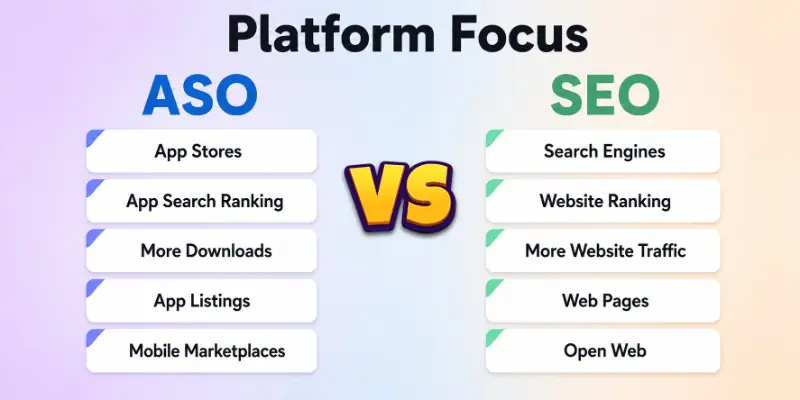
Search Engine Optimization focuses on search engines like Google. These platforms index billions of web pages and help users find information, services, or products online. SEO helps websites appear higher in search results when users type queries.
Because the platforms differ, the optimization methods also differ. App stores rely on app metadata, ratings, and download signals. Search engines rely on content quality, links, and technical performance.
ASO
- Targets app stores such as Google Play and Apple App Store
- Helps apps rank higher in app search results
- Focuses on increasing app downloads
- Optimizes app store listings
- Works within the ecosystem of mobile app marketplaces
SEO
- Targets search engines like Google and Bing
- Helps websites rank higher in search results
- Focuses on increasing website traffic
- Optimizes web pages and site structure
- Works across the open web environment
2. Search Intent
Search intent explains why users perform a search. Users behave differently in app stores compared to search engines. Understanding this behavior helps marketers create better optimization strategies.
App store users usually search with the goal of installing an app. They often type short queries like photo editor, fitness tracker, or language learning. These searches show clear intent because users want an app that solves a specific problem.
Search engine users show wider intent. Some users look for information, while others search for products, services, tutorials, or reviews. SEO must address many types of queries and user needs.
This difference changes how marketers create content and optimize listings.
ASO
- Users search mainly to download apps
- Queries stay short and simple
- Intent focuses on solving a task through an app
- Optimization focuses on visibility and installs
- App description explains features and benefits
SEO
- Users search for information or solutions
- Queries vary from short to long phrases
- Intent includes research, comparison, and purchase
- Optimization focuses on helpful content
- Pages provide detailed explanations or services
3. Keyword Strategy
Keywords play an important role in both strategies. However, the way marketers research and use keywords differs between app stores and search engines.
App Store Optimization uses keywords inside app titles, subtitles, and keyword fields. These fields help app store algorithms understand the purpose of the app. Because app listings contain limited space, marketers choose keywords carefully.
Search Engine Optimization uses keywords across website content. Websites can include keywords in titles, headings, paragraphs, and meta tags. SEO allows deeper keyword targeting because web pages can hold much more content.
The keyword research process also differs. ASO focuses on app related terms, while SEO often targets broader search queries.
ASO
- Uses keywords in app title and subtitle
- Uses keyword fields inside app store listings
- Targets short phrases related to app functions
- Focuses on search terms that drive installs
- Limits keyword usage due to character limits
SEO
- Uses keywords across website pages
- Places keywords in headings and paragraphs
- Targets informational and commercial queries
- Allows long form keyword targeting
- Supports large scale keyword optimization
4. Ranking Factors
Each platform uses its own algorithm to rank results. Understanding these ranking factors helps marketers improve visibility.
App store algorithms focus heavily on app performance signals. These signals include app downloads, ratings, reviews, and retention rate. Apps that receive positive feedback and frequent installs often rank higher.
Search engines rely on a much wider set of signals. These include content relevance, backlinks, page speed, mobile friendliness, and domain authority. Search engines evaluate many factors to determine the quality of a web page.
Because of these differences, ASO strategies focus on improving user feedback and installs, while SEO strategies focus on improving website quality and authority.
ASO
- App title and keywords affect rankings
- Download volume influences visibility
- Positive user ratings improve ranking
- Frequent updates help performance
- App engagement signals affect ranking
SEO
- Content quality plays a major role
- Backlinks increase website authority
- Page speed improves ranking
- Mobile friendliness helps visibility
- User experience affects search performance
5. Content Optimization
Content plays a central role in both strategies, but the format and purpose differ significantly.
In App Store Optimization, content appears mainly in the app title, subtitle, description, and update notes. Developers must explain the app clearly and convince users to install it. The content must remain short and persuasive.
Search Engine Optimization relies on long form content. Websites publish blog posts, guides, tutorials, and product pages. These pages answer user questions and provide valuable information.
Because websites allow more space, SEO content often includes detailed explanations and structured headings.
ASO
- App title communicates the main function
- App description explains key features
- Content remains short and direct
- Updates highlight improvements
- Keywords appear naturally inside the listing
SEO
- Articles provide detailed information
- Blog posts answer user questions
- Content includes headings and sections
- Pages target multiple keywords
- Content builds authority and trust
6. Visual Elements
Visual elements strongly influence app store listings because users quickly judge apps based on appearance.
App stores display icons, screenshots, and preview videos. These visuals show the app interface and highlight key features. Attractive visuals increase the chances that users will install the app.
Websites also use visuals, but search engines prioritize text content more strongly. Images support the content, but they do not usually serve as the primary ranking factor.
Therefore, visual design plays a stronger marketing role in ASO compared to SEO.
ASO
- App icon attracts attention
- Screenshots show app features
- Preview videos demonstrate functionality
- Visual quality increases install rates
- Design influences first impressions
SEO
- Images support written content
- Infographics improve engagement
- Alt text helps search engines understand images
- Visuals enhance readability
- Content remains the main ranking factor
7. User Engagement Signals
User behavior affects both optimization strategies. Platforms measure how users interact with apps and websites.
App stores track installs, uninstall rates, and user retention. Apps that keep users active often rank higher. Positive reviews and ratings also strengthen credibility.
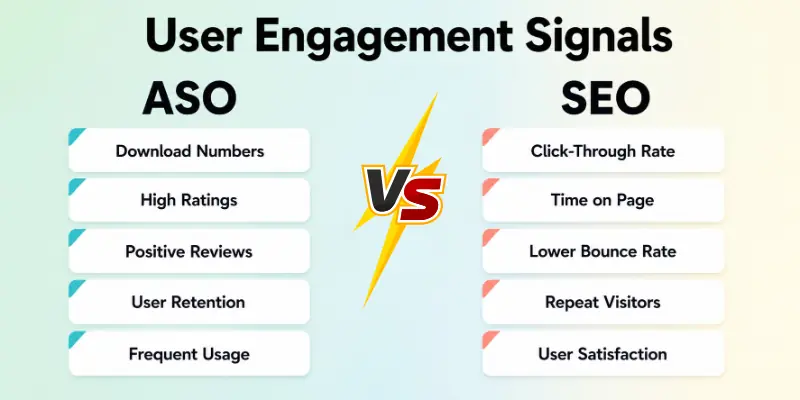
Search engines measure engagement through metrics such as click through rate, time on page, and bounce rate. When users stay longer on a page, search engines see that page as helpful.
Both strategies rely on positive user experience to maintain strong rankings.
ASO
- Download numbers influence ranking
- High ratings build trust
- Positive reviews improve visibility
- Retention rate shows app value
- Frequent usage strengthens performance
SEO
- Click through rate affects ranking signals
- Time spent on page shows content quality
- Lower bounce rate indicates relevance
- Repeat visitors build authority
- User satisfaction improves performance
8. Conversion Goals
Both strategies aim to convert users, but the conversion actions differ.
In app stores, the main goal is to convince users to install the app. Every element of the app listing should encourage downloads. The icon, screenshots, description, and ratings work together to increase conversions.
In search engines, conversion goals vary. Some websites want newsletter signups, product purchases, or contact form submissions. Traffic represents only the first step. Websites must guide users toward a desired action.
This difference shapes how marketers design their optimization strategies.
ASO
- Primary goal focuses on app installs
- App page acts as the conversion point
- Visuals and reviews drive downloads
- Short descriptions explain value quickly
- Conversion happens inside the app store
SEO
- Goals include sales, leads, or subscriptions
- Websites guide users through multiple pages
- Content builds trust before conversion
- Calls to action encourage engagement
- Conversion occurs on the website
9. Competition Level
Competition exists in both app stores and search engines. However, the structure of competition differs.
App stores contain millions of apps, but each category groups similar apps together. Developers mainly compete against apps within the same category.
Search engines contain billions of web pages. Websites compete across industries and topics. Large websites with strong authority often dominate search results.
Because of this scale, SEO competition often requires long term strategies and strong content investment.
ASO
- Competition stays within app categories
- New apps can rank faster with good optimization
- Ratings and installs influence ranking quickly
- Category leaders dominate visibility
- Continuous updates maintain rankings
SEO
- Competition spans the entire web
- Established websites hold strong authority
- Ranking improvements take time
- Content depth influences competitiveness
- Link building strengthens authority
10. Optimization Process
The optimization workflow also differs between these strategies. Each platform requires specific tools and methods.
App Store Optimization focuses on improving app listings, testing icons, and collecting user reviews. Developers also monitor keyword rankings and update app metadata regularly.
Search Engine Optimization involves technical improvements, content creation, and link building. SEO specialists analyze website performance, keyword rankings, and search traffic.
Both strategies require regular monitoring and updates to maintain performance.
ASO
- Optimize app titles and descriptions
- Improve screenshots and visuals
- Encourage positive user reviews
- Track keyword rankings in app stores
- Update listings based on performance
SEO
- Publish high quality content
- Improve technical site performance
- Build backlinks from trusted websites
- Monitor keyword rankings
- Update pages to maintain relevance
ASO vs SEO: Which Strategy Works Best?
Many businesses wonder whether they should focus on one strategy or combine both. The answer depends on the type of product or service they offer.
Companies that build mobile apps must focus on App Store Optimization because users discover apps directly inside app stores. Without strong optimization, an app may remain invisible among millions of competitors.
Websites depend on Search Engine Optimization to attract organic traffic. Search engines serve as the main discovery platform for online information and services.
Some businesses operate both a website and a mobile app. In this case, combining both strategies brings the best results. SEO can drive users to the website, while ASO can attract users inside app marketplaces. Together, they build a stronger digital presence and increase overall visibility.
Final Thoughts
In this guide we have covered the differences between app store optimization and search engine optimization with great detail. Both strategies help digital products reach the right audience, but they operate in different environments. App Store Optimization focuses on increasing app visibility and downloads inside mobile app stores. Search Engine Optimization focuses on improving website visibility in search engine results.
When marketers understand ASO vs SEO, they can build stronger growth strategies for their products. Apps need strong listings, attractive visuals, and positive reviews. Websites need helpful content, technical performance, and authority signals.
I recommend reading the full guide carefully because every section explains an important aspect of these strategies. You should also check the frequently asked questions given below to strengthen your understanding.
FAQs
Here are some of the most commonly asked questions related to differences between app store optimization and search engine optimization:
App Store Optimization improves the visibility of mobile apps inside app stores. It helps apps appear higher in search results when users search for apps. Developers optimize titles, descriptions, and visuals. This process increases app downloads.
Search Engine Optimization improves the visibility of websites in search engines like Google. It helps web pages rank higher for relevant keywords. Businesses use SEO to attract organic traffic. Good SEO also improves user experience.
Businesses need ASO to increase app downloads and visibility. App stores contain millions of apps, so competition stays high. Optimization helps apps appear in relevant searches. It also improves the chances of attracting new users.
SEO helps websites reach people who search for information or services online. Without optimization, a website may not appear in search results. Good SEO increases organic traffic. It also builds credibility and trust.
Yes, many businesses use both strategies together. A company may run a website and also offer a mobile app. SEO attracts users to the website. ASO attracts users inside app stores.
App Store Optimization can sometimes show results faster because apps compete within specific categories. Search Engine Optimization often takes longer because websites compete across the entire web. However, both require continuous improvement. Long term success depends on consistent optimization.
Yes, keywords play an important role in both strategies. App stores use keywords to understand what an app does. Search engines use keywords to understand website content. Proper keyword research improves visibility in both cases.
User reviews strongly influence app rankings and downloads. Positive reviews increase trust among potential users. High ratings also signal quality to the app store algorithm. Developers should encourage satisfied users to leave feedback.
Yes, content plays a major role in SEO because search engines evaluate the quality of web pages. Detailed articles help users find answers to their questions. Good content builds authority and attracts backlinks. This improves ranking performance.
Both strategies require regular updates. Developers should update app listings, visuals, and descriptions based on performance data. Website owners should update content and improve technical performance. Continuous improvement helps maintain strong rankings.




- Be Respectful
- Stay Relevant
- Stay Positive
- True Feedback
- Encourage Discussion
- Avoid Spamming
- No Fake News
- Don't Copy-Paste
- No Personal Attacks
- Be Respectful
- Stay Relevant
- Stay Positive
- True Feedback
- Encourage Discussion
- Avoid Spamming
- No Fake News
- Don't Copy-Paste
- No Personal Attacks
