What is the Difference Between SEO vs SEM? Complete Guide
Published: 1 Sep 2026
Digital marketing uses many strategies to help businesses appear online. Two of the most important strategies are Search Engine Optimization and Search Engine Marketing.
Many beginners confuse these two terms because both focus on search engines and both help businesses reach people who search online. However, these strategies work in different ways and follow different approaches.
Search Engine Optimization focuses on improving a website so that it ranks higher in organic search results. It helps websites attract free traffic from search engines like Google, Bing, and Yahoo. Businesses use SEO to increase visibility without paying for each click.
Search Engine Marketing focuses on paid advertising in search engines. Businesses run ads that appear at the top of search results when users search for specific keywords. Companies pay for each click on these ads.
In this guide we will understand what is the difference between SEO and SEM and help businesses choose the right strategy for their goals.
So guys, without wasting time, let’s dig in!
Difference between SEO and SEM?
Both SEO and SEM help websites appear in search engines. However, they differ in cost, strategy, speed, and results. SEO focuses on organic search results while SEM focuses on paid advertisements.
We can understand the differences clearly by comparing both strategies across several important factors.
Here are the main factors we will compare:
- Cost structure
- Traffic source
- Time to see results
- Click through behavior
- Long term value
- Keyword strategy
- Competition level
- Control and flexibility
- Sustainability
- Marketing goals
Let us explore all these factors in detail.
1. Cost Structure
The biggest difference between SEO and SEM relates to cost. SEO focuses on organic traffic, which means businesses do not pay search engines for each visitor. Instead, they invest time and effort in improving their website. This includes creating helpful content, improving technical performance, and building website authority.
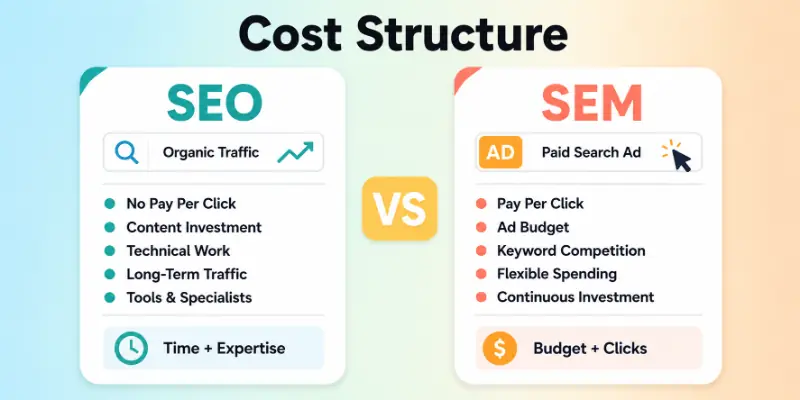
SEM works on a paid advertising model. Businesses create search ads and bid on keywords. When users click the advertisement, the advertiser pays a certain amount to the search engine. This payment system is called pay per click advertising.
Because of this difference, companies must plan their budgets differently for both strategies.
SEO
- Businesses do not pay for each click
- Investment focuses on content creation
- Technical improvements require time and expertise
- Long term effort brings consistent traffic
- Costs mainly involve tools and specialists
SEM
- Businesses pay for every click on the ad
- Advertising budgets control campaign scale
- Cost depends on keyword competition
- Companies can increase or decrease spending quickly
- Paid campaigns require continuous investment
2. Traffic Source
Another key difference involves where the traffic comes from in search results. SEO traffic comes from organic search listings. These listings appear below the paid advertisements on most search engine result pages.
SEM traffic comes from sponsored advertisements. These ads usually appear at the top or bottom of search results. Search engines label them as sponsored or advertisement.
Users may click both organic results and ads, but their behavior often differs depending on their search intent.
SEO
- Traffic comes from organic search results
- Websites rank based on relevance and quality
- No payment required for each visitor
- Users often trust organic listings more
- Traffic grows gradually over time
SEM
- Traffic comes from paid advertisements
- Ads appear above organic search results
- Businesses pay when users click the ad
- Campaigns target specific keywords
- Traffic appears immediately after launching ads
3. Time to See Results
Speed of results represents another important difference between the two strategies. SEO usually takes time before websites start ranking higher in search results. Search engines need time to crawl the site, evaluate content quality, and build trust signals.
SEM delivers faster results because ads appear soon after campaigns launch. Businesses can start receiving traffic within hours after activating their ads.
Because of this speed difference, marketers often choose SEM when they need quick visibility.
SEO
- Requires time to build rankings
- Content must gain trust and authority
- Results improve gradually over months
- Long term strategy brings stable growth
- Consistent effort improves rankings
SEM
- Delivers immediate visibility
- Ads appear quickly after launch
- Traffic begins as soon as users click ads
- Campaign performance changes instantly
- Results depend on advertising budget
4. Click Through Behavior
User behavior also differs between organic search results and paid advertisements. Many users trust organic search results because they appear naturally based on relevance. These users believe that organic listings provide helpful and trustworthy information.
Paid advertisements attract users who want quick solutions. Some users click ads when they search for products or services because they expect to find commercial offers.
Understanding this behavior helps marketers design effective campaigns.
SEO
- Users often trust organic results
- Organic listings attract research focused users
- Content helps answer user questions
- Clicks increase with higher rankings
- Trust builds through consistent visibility
SEM
- Ads attract users ready to buy
- Sponsored listings target commercial searches
- Advertisers control ad messages
- Strong offers increase clicks
- Landing pages convert traffic quickly
5. Long Term Value
Long term value represents one of the strongest advantages of SEO. When a website achieves strong rankings, it can continue attracting traffic without paying for each click. A well optimized page may rank for months or even years.
SEM provides value only while campaigns remain active. Once a company stops paying for advertisements, the traffic stops immediately. This means paid campaigns require continuous investment.
Because of this difference, many companies invest in SEO to build sustainable growth.
SEO
- Provides long term organic traffic
- High rankings generate ongoing visibility
- Content continues attracting visitors over time
- Investment builds lasting authority
- Traffic remains even without ad spending
SEM
- Works only during active campaigns
- Traffic stops when ads stop running
- Continuous budget required
- Short term visibility improves quickly
- Campaigns support promotional events
6. Keyword Strategy
Both SEO and SEM depend on keyword research, but the strategy behind keyword selection differs. SEO focuses on keywords that users search for when they need information, solutions, or services.
SEM focuses heavily on commercial keywords because advertisers want clicks that convert into sales or leads. Paid campaigns often target keywords with high buying intent.
This difference shapes how marketers plan keyword targeting.
SEO
- Targets informational and commercial keywords
- Focuses on long term search demand
- Content answers user questions
- Keywords appear naturally in pages
- Research helps identify valuable topics
SEM
- Targets keywords with purchase intent
- Advertisers bid on competitive keywords
- Ads appear for specific search queries
- Campaigns adjust keyword targeting easily
- Keyword performance affects ad cost
7. Competition Level
Competition plays a major role in both strategies. However, the type of competition differs.
SEO competition depends on the strength of competing websites. Websites with strong authority, quality content, and many backlinks often dominate search results.
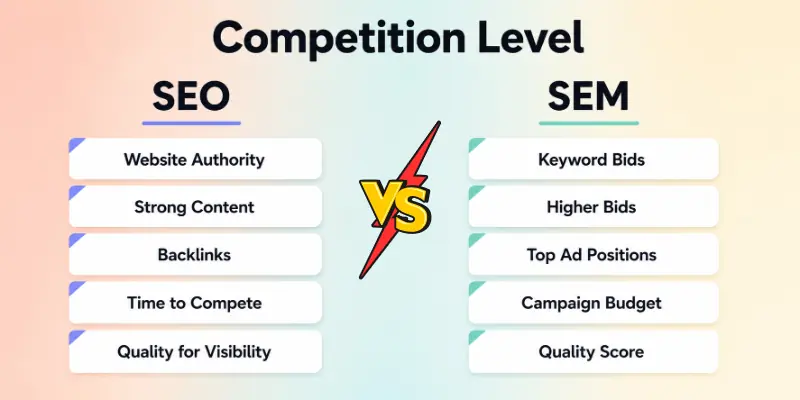
SEM competition depends on bidding power. Advertisers compete by placing bids on keywords. Businesses that bid higher amounts may gain better ad positions.
This creates a different competitive environment for both strategies.
SEO
- Competition depends on website authority
- Strong content improves ranking potential
- Backlinks strengthen website credibility
- New websites need time to compete
- Quality content helps gain visibility
SEM
- Competition depends on keyword bids
- Higher bids may improve ad placement
- Advertisers compete for top positions
- Budget affects campaign reach
- Quality score also affects ranking
8. Control and Flexibility
SEM offers greater control over campaigns because advertisers can adjust settings quickly. Marketers can change ad copy, budgets, and targeting options at any time. This flexibility allows businesses to test different strategies.
SEO requires longer adjustments. Changes in content or technical optimization take time before search engines recognize them.
Because of this difference, SEM often suits businesses that want quick testing and campaign adjustments.
SEO
- Changes take time to affect rankings
- Search engines re evaluate content gradually
- Long term improvements build authority
- Strategy focuses on stability
- Optimization requires patience
SEM
- Campaign settings change instantly
- Advertisers adjust budgets quickly
- Ads can target specific audiences
- Performance data appears quickly
- Testing improves campaign results
9. Sustainability
Sustainability represents another major difference between these strategies. SEO supports sustainable digital growth because it builds long term authority and trust with search engines.
SEM focuses on immediate exposure but requires ongoing investment. Businesses must maintain ad budgets to keep traffic flowing.
Many companies use SEO for long term sustainability while using SEM for short term marketing campaigns.
SEO
- Builds long lasting online visibility
- Strong content attracts ongoing traffic
- Website authority grows over time
- Sustainable strategy for digital growth
- Organic rankings provide stable traffic
SEM
- Requires continuous advertising budgets
- Traffic stops without active campaigns
- Short term visibility increases quickly
- Works well for promotions or product launches
- Campaign success depends on budget
SEO vs SEM: Which One Should You Choose?
Businesses often wonder whether they should focus on SEO or SEM. The answer depends on business goals, budget, and marketing timeline.
SEO works best for companies that want long term growth and steady traffic from search engines. It builds authority and helps websites gain trust with users. Businesses that invest in high quality content often benefit greatly from SEO.
SEM works best for businesses that want quick visibility and immediate results. Paid advertising allows companies to reach potential customers instantly. It also works well for seasonal campaigns, promotions, or product launches.
Many successful companies combine both strategies. SEM provides immediate traffic while SEO builds long-term organic growth. Together they create a balanced search marketing strategy that increases visibility and conversions.
Final Thoughts
In this guide we have explained what is the difference between SEO and SEM in great detail. Both strategies help businesses reach users through search engines, but they operate in different ways. SEO focuses on improving website visibility in organic search results, while SEM focuses on paid advertisements that appear in search engine results.
The best approach often involves using both strategies together. SEO supports long-term growth, while SEM drives quick traffic when businesses need it most.
I recommend reading the entire guide carefully to understand every difference clearly. You should also review the frequently asked questions below to strengthen your understanding.
FAQs
Here are some of the most commonly asked questions related to SEO and SEM:
Many marketers consider SEO a part of search engine marketing because both focus on search engines. However, people often use SEM to refer specifically to paid search advertising. SEO focuses on organic traffic while SEM focuses on paid campaigns.
SEM usually brings faster results because ads appear soon after campaigns start. SEO takes time because search engines need to evaluate website quality. However, SEO provides long term benefits.
SEO does not require payment for each click, so it can be cheaper over time. However, it still requires investment in content creation and optimization. SEM requires ongoing payments for advertising.
Yes, many businesses combine both strategies. SEM drives quick traffic and supports promotions. SEO builds long term visibility and organic traffic.
Yes, both SEO and SEM rely on keyword research. Keywords help businesses understand what users search for online. Marketers optimize content or ads based on these keywords.
Beginners often start with SEO because it builds strong foundations for online visibility. However, small SEM campaigns can also help generate quick traffic while learning SEO.
SEO usually takes several months before noticeable improvements appear. Search engines need time to crawl and evaluate new content. Consistent optimization improves results gradually.
Companies invest in SEM because it provides quick visibility in search engines. Paid campaigns allow businesses to target specific keywords and audiences. This strategy helps generate leads and sales quickly.