What Is the PESO Model? Simple and Detailed Guide
Published: 10 Aug 2026
You guys are here because you want to know what is the PESO model, right? Maybe you have seen this term in marketing, PR, social media, or content marketing, but you are still not completely sure what it means.
The good thing is that the PESO model is not difficult once we break it into simple parts. I will guide you with the practical thinking you would expect from a marketer with 25 years of field experience, so I will focus on how this model actually works in real marketing, not only on textbook definitions.
In this guide, I will explain what the PESO model means, where it came from, why marketers use it, how its four parts work together, how to build a PESO strategy, how to measure it, and what mistakes I recommend you avoid.
Let’s dive in!
What Is the PESO Model?
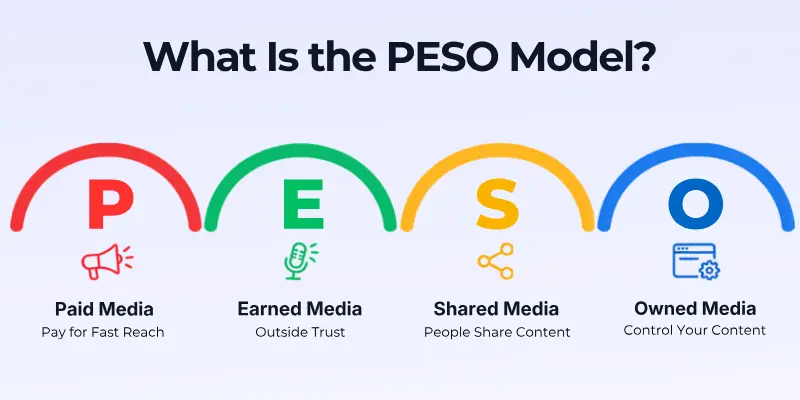
PESO stands for Paid, Earned, Shared, and Owned media. These four types of media make up the PESO model and give us a simple way to organize marketing and communication activities.
I like to think of PESO as one marketing system instead of four separate marketing channels. The real value comes when Paid, Earned, Shared, and Owned media support each other. The official PESO Model also describes it as an integrated marketing and communications system.
Here is what each letter means:
- P means Paid Media: I pay money to place my message in front of an audience.
- E means Earned Media: Other people, websites, customers, or media outlets talk about my brand.
- S means Shared Media: My brand and audience share, discuss, comment on, and spread content.
- O means Owned Media: I create and control my own content and communication channels.
Let me make it even easier.
- If I run a Google Ad, I use Paid Media.
- If a news website mentions my company, I get Earned Media.
- If customers share my post on LinkedIn, I get Shared Media.
- If I publish a guide on my website, I use Owned Media.
The four areas do different jobs.
- Paid media gives me fast reach.
- Earned media gives me outside trust.
- Shared media gives me conversations and reach through people.
- Owned media gives me control over my message and content.
- Paid media can send visitors to owned media.
- Shared media can spread owned content.
- Earned media can build trust around the same content.
- All four can support one business goal.
For example, imagine I publish a useful guide on my website.
- First, I publish the guide on my website. → Owned Media
- Then, I promote it through an advertisement. → Paid Media
- People start sharing it on social media. → Shared Media
- A blogger finds the guide useful and links to it. → Earned Media
Now one piece of content works through all four parts of PESO.
This is how I prefer to use the model.
I do not create four completely separate marketing plans. I connect them so that one activity creates more value for another activity.
Who Created the PESO Model?
Before using a marketing model, I always like to know where it came from. It gives us a better idea of why the model exists and what problem it originally tried to solve.
The PESO Model was created by marketing and communications professional Gini Dietrich and officially introduced in 2014 with her book Spin Sucks. She had already been using parts of the process with agency clients before giving it a formal name.
Here is its brief history:
- Gini Dietrich and her agency had already been combining different media types with clients before 2014.
- The process did not originally have a formal name.
- Dietrich started putting the process into a clearer system while working on her book.
- Her publisher encouraged her to give the process a name.
- The name PESO came from Paid, Earned, Shared, and Owned media.
- The PESO Model officially launched in 2014 with the publication of Spin Sucks.
- The model originally gave marketers and communication professionals a clearer way to connect different media types.
- The framework continued to change as digital marketing, social media, search, and communication changed.
- Today, the official PESO Model presents it as an integrated operating system rather than four disconnected tactics.
One thing I find important here is that the four media types themselves did not suddenly appear in 2014.
The real idea behind the PESO Model was to bring them together in a useful and repeatable system.
Why Is the PESO Model Important in Marketing?
Marketing does not happen in one place anymore. A customer may find us through an ad, visit our website, read a review, check our social media, and then ask someone else about our business before making a decision.
That is why I like the PESO model. It helps me connect these different customer touchpoints instead of treating every channel as a separate job.
Here is why the PESO model matters:
- It gives marketing a clear structure: I can organize different activities under four simple media groups.
- It reduces dependence on one channel: I do not need to depend only on ads, SEO, PR, or social media.
- It combines fast and long-term marketing: Paid media can work quickly while owned and earned media can build value over time.
- It improves brand visibility: Different media types can introduce the same brand to different audiences.
- It helps build trust: Earned media, reviews, useful content, and customer conversations can support credibility.
- It improves content distribution: I do not simply publish content and wait for people to find it.
- It supports the customer journey: Different media types can support people at different stages of buying.
- It connects PR and marketing: PR, advertising, social media, and content do not need to work separately.
- It makes good content work harder: One article can become social posts, advertisements, PR material, and more.
- It gives me more marketing options: If one channel becomes weak, I still have other ways to reach customers.
- It helps create a stronger brand: People see the same message through several trusted places.
- It supports better measurement: I can connect each marketing activity with a clear goal.
- It encourages teamwork: Content, PR, social, SEO, and advertising teams can support one plan.
I also use PESO because customer trust rarely comes from one message.
For example:
- An advertisement may create awareness.
- My website may answer questions.
- A customer review may reduce doubt.
- A social post may show that the brand stays active.
- A media mention may add more trust.
- An email may finally bring the customer back to buy.
That full journey is much stronger than depending on one ad.
How Do the Four Parts of the PESO Model Work Together?
This is the part I want you to understand properly. Simply having Paid, Earned, Shared, and Owned activities does not automatically mean you have a strong PESO strategy.
The real strength comes from integration. Each part should push, support, or strengthen another part instead of working alone.
I normally explain the working process like this:
- Step 1 – Start with a useful business goal: First, I decide whether I want leads, sales, awareness, traffic, bookings, or another clear result.
- Step 2 – Create strong owned content: I build a useful page, guide, case study, video, report, or offer that gives people a reason to pay attention.
- Step 3 – Share the content: I take useful parts of that content and share them through the social platforms my audience actually uses.
- Step 4 – Watch the response: I look at which topics, posts, ideas, or messages get the strongest reaction.
- Step 5 – Use paid media to increase reach: I put advertising money behind content, offers, or messages that already show good potential.
- Step 6 – Create earned media opportunities: I give journalists, bloggers, industry websites, customers, and partners something useful or interesting to discuss.
- Step 7 – Bring people back to owned media: Ads, social posts, and outside mentions should guide interested people toward my website, landing page, email list, or another strong business asset.
- Step 8 – Turn attention into action: I use strong calls to action to turn traffic into leads, enquiries, bookings, subscribers, or customers.
- Step 9 – Use customer activity again: Reviews, comments, questions, and customer stories can create new earned and shared media opportunities.
- Step 10 – Repeat what works: I measure the results and put more effort into the combinations that produce real business value.
Here is a simple example.
- I write an original marketing research report. → Owned
- I turn the main findings into LinkedIn posts. → Shared
- One LinkedIn post performs very well. → Shared
- I promote that post to business owners. → Paid
- An industry publication notices my research. → Earned
- The publication links back to my report. → Earned + Owned
- New visitors arrive on my website. → Owned
- Some join my email list. → Owned
- I later send them useful emails and an offer. → Owned
- Some become customers. → Business result
That is what I call a real PESO flow.
One activity starts helping another.
Main Benefits of the PESO Model
I have always preferred marketing systems that give businesses more than one way to reach customers. PESO does this very well because it does not force us to put all our money and attention into one channel.
When we use the four parts correctly, the benefits can go far beyond simple website traffic.
Here are the main benefits:
- Better marketing balance: I do not depend completely on one platform.
- More brand visibility: People can discover the brand through several channels.
- Stronger credibility: Earned media and outside mentions can support what the company says about itself.
- More control: Owned media gives me a place where I control the main message.
- Faster reach: Paid media lets me reach selected audiences quickly.
- Better engagement: Shared media creates conversations instead of one-way communication.
- Long-term marketing value: Useful owned content can continue working after I publish it.
- Better content use: I can turn one strong content idea into many marketing assets.
- Better customer experience: Customers can find useful information at several stages of their journey.
- Lower channel risk: One platform change does not destroy my entire marketing system.
- More useful data: Paid, shared, earned, and owned activity gives me different types of customer information.
- Better teamwork: Different marketing functions can work around one common goal.
- More chances to earn trust: Customers can see reviews, content, conversations, and outside mentions before they buy.
- Better lead generation: Several channels can guide people toward the same conversion point.
- Stronger brand memory: Seeing a brand in several places can make it easier for customers to remember it.
My favorite benefit is balance.
I do not want a business that disappears the moment its advertising budget stops.
Disadvantages of the PESO Model
The PESO model offers many benefits, but I would never tell you that it solves every marketing problem. Like any strategy, it needs planning, time, people, and regular measurement.
The biggest problems normally appear when businesses try to use all four parts without having enough resources or a clear goal.
Here are the main disadvantages:
- It can take time: Building good owned, shared, and earned media does not happen overnight.
- It needs regular work: A PESO strategy needs content, promotion, communication, and measurement.
- It can become complicated: Managing several channels at once can confuse a small team.
- It may need several skills: Content writing, advertising, PR, social media, SEO, and analytics require different skills.
- Earned media is difficult to control: I cannot force journalists, customers, or websites to talk positively about a brand.
- Shared media can change quickly: Social platforms can change algorithms, formats, and reach.
- Paid media costs money: Good advertising still needs a budget.
- Measurement can become difficult: One customer may touch several channels before buying.
- Media types sometimes overlap: One activity may fit into more than one part of PESO.
- Small teams may spread themselves too thin: Trying to use every platform often reduces quality.
- Results do not arrive at the same speed: Paid media may work quickly while earned and owned media may take longer.
- Poor integration wastes effort: Four separate campaigns do not automatically create one good PESO strategy.
My advice is simple. Do not try to do everything at once. Start with the most useful channels for your audience and grow from there.
Common PESO Model Mistakes
Most PESO problems do not happen because the model is bad. They happen because marketers use it like a checklist and forget that all four areas should support one clear strategy.
I have seen businesses spend a lot of money and time simply because they started doing things before deciding why they were doing them.
Here are the mistakes I recommend avoiding:
- Running only paid ads: Traffic often disappears when the advertising budget stops.
- Ignoring owned media: Sending expensive traffic to a weak website wastes money.
- Creating content without promotion: Even great content needs a clear distribution plan.
- Posting everywhere: Your business does not need to join every social platform.
- Ignoring the real audience: Choose channels based on customers, not trends.
- Chasing followers instead of customers: A large following means little if nobody buys.
- Measuring only likes: Likes alone do not tell me whether marketing creates business value.
- Ignoring reviews: Customer opinions can strongly influence new buyers.
- Using poor landing pages: Good advertising cannot save a confusing sales page.
- Keeping teams separate: PR, content, social, SEO, and advertising should share information.
- Using different messages everywhere: A brand should stay clear and consistent.
- Expecting earned media immediately: Relationships and credibility take time.
- Publishing weak content too often: I prefer useful content over constant low-value posting.
- Copying competitors: What works for one company may not fit another audience.
- Forgetting the business goal: Every activity should support a real result.
Before I approve a marketing activity, I like to ask:
- Why are we doing this?
- Who do we want to reach?
- What should that person do next?
- Which PESO area does this support?
- How will we measure success?
These five questions can remove a lot of wasted work.
How to Build a PESO Marketing Strategy
Here is the process I recommend:
- Step 1 – Set your main goal: Decide whether you need leads, sales, bookings, traffic, awareness, subscribers, or another clear result.
- Step 2 – Define your audience: Know who you want to reach before choosing marketing channels.
- Step 3 – Study customer problems: Understand what questions, worries, and needs your customers have.
- Step 4 – Review your current marketing: Check your website, social accounts, ads, reviews, email list, PR, and content.
- Step 5 – Find the biggest gaps: Identify which important PESO areas are weak or missing.
- Step 6 – Strengthen owned media: Make sure your website, landing pages, content, and offers give people useful information.
- Step 7 – Choose shared channels: Focus on social platforms where your real customers spend time.
- Step 8 – Plan useful content: Create information that solves real customer problems.
- Step 9 – Choose paid channels: Use advertising where it gives you a clear way to reach the right people.
- Step 10 – Build earned opportunities: Work on reviews, partnerships, media outreach, expert comments, research, and useful stories.
- Step 11 – Connect all four areas: Make sure paid, earned, shared, and owned media send people toward the same goal.
- Step 12 – Add clear calls to action: Tell people exactly what you want them to do next.
- Step 13 – Track performance: Measure the results from each area.
- Step 14 – Compare cost and value: Look at which activities create leads, sales, traffic, trust, or other useful results.
- Step 15 – Improve the system: Stop weak activities and increase effort around what works.
I always recommend starting simple.
A clear four-channel plan beats a complicated 20-channel plan that nobody can manage.
How to Measure PESO Model Results
Marketing only becomes useful when I can connect activity with a result. That does not mean every result must be a direct sale, but I still need to know whether each part of my PESO strategy does its job.
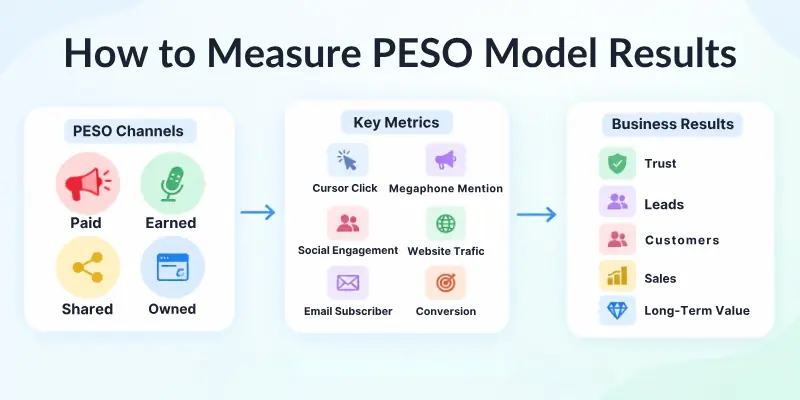
I measure each media type differently because Paid, Earned, Shared, and Owned media have different purposes.
For Paid Media, I look at:
- Advertising spend.
- Cost per click.
- Click-through rate.
- Cost per lead.
- Conversion rate.
- Cost per customer.
- Sales from ads.
- Return on ad spend.
For Earned Media, I look at:
- Media mentions.
- Brand mentions.
- Customer reviews.
- Quality backlinks.
- Referral traffic.
- Public relations coverage.
- Mentions from industry experts.
- Branded searches.
For Shared Media, I look at:
- Shares.
- Comments.
- Saves.
- Useful engagement.
- Social reach.
- Website visits from social media.
- Community activity.
- Leads from social media.
- Customer-created content.
For Owned Media, I look at:
- Website traffic.
- Organic traffic.
- Email subscribers.
- Page conversions.
- Leads.
- Bookings.
- Sales.
- Returning visitors.
- Content performance.
- Customer enquiries.
Then I bring the numbers together.
- Which channels bring the right people?
- Which channels create trust?
- Which content gets attention?
- Which traffic becomes leads?
- Which leads become customers?
- Which activity costs too much?
- Which activity gives us long-term value?
I do not get excited simply because a dashboard shows big numbers. If marketing does not support a useful business result, I want to know why.
Which Part of the PESO Model Is Most Important?
People often ask me which PESO channel matters most. I understand why they ask, but I do not think one answer fits every business.
The most important part depends on the company, audience, budget, market, and goal. Still, I normally give owned media special attention because it gives the other media types a strong place to send people.
Here is how I look at each part:
- Paid Media matters when I need speed: I can quickly reach people who may not know the brand.
- Earned Media matters when I need credibility: Other voices can support the reputation of the business.
- Shared Media matters when I need conversations: It helps the brand stay connected with people.
- Owned Media matters when I need control: It gives me a place to publish, educate, convert, and build long-term value.
For many businesses, I start by checking owned media first.
- Is the website good?
- Are the service pages clear?
- Can customers easily contact us?
- Do we answer important questions?
- Do we have useful content?
- Do we have a clear offer?
If the answer is no, I usually fix those problems before sending thousands of paid visitors to the website.
The official PESO guidance has also long placed strong importance on owned media as the foundation of an integrated program.
So, if you ask me to choose only one starting point, I usually choose Owned Media.
But if you ask me what creates the strongest complete strategy, my answer is:
All four working together.
My Recommended PESO Model Order for a New Business
For a new business, I normally start with Owned Media because I first want a strong place where customers can learn about the company, understand the offer, and take action. I build a clear website, useful service or product pages, strong calls to action, helpful content, and an email list where possible.
After that, I add Shared Media and focus only on the platforms where my real customers spend time. Once I know which messages and content get attention, I use Paid Media to increase reach and bring the right people toward the business.
At the same time, I slowly build Earned Media through genuine reviews, partnerships, useful research, media relationships, expert comments, and good customer experiences. I do not follow P-E-S-O simply because that is the spelling of the model. I build the channels in the order that gives the business the strongest foundation and then connect them into one system.
My Personal Recommendations for Using the PESO Model
My biggest recommendation is to stop thinking about PESO as four boxes that you need to tick. Think about it as one customer journey. I like to create something useful through owned media, share it where the right people spend time, use paid media to increase the reach of strong messages, and build enough value and trust that other people naturally want to mention or recommend the brand.
I also recommend keeping things simple at the beginning. Do not open accounts on every platform, run every type of advertisement, or publish content every day just because other marketers tell you to. Understand your audience first. Build strong owned assets, choose the right social channels, test paid campaigns carefully, and give customers and industry people a real reason to talk about you.
Most importantly, track leads, customers, revenue, enquiries, and other business results. Attention is useful, but attention without a business purpose does not build a strong marketing system.
Final Thoughts
In this guide, we have covered what is the PESO model in a detailed but simple way. We looked at what PESO stands for, its history, why it matters, how the four media types work together, its benefits, its disadvantages, common mistakes, strategy building, and measurement.
If there is only one thing I want you to remember, remember this: PESO works best when Paid, Earned, Shared, and Owned media support each other. Do not treat them like four completely separate marketing jobs.
- Build a strong place you own.
- Create useful information.
- Share it with the right people.
- Promote what works.
- Earn trust from customers and outside voices.
- Then measure everything and improve it.
That is the simple idea behind a good PESO strategy.
And with that, we have reached the end of the main guide. Before you go, check the FAQs below because I have answered some of the most common questions people ask about the PESO model.
Frequently Asked Questions
Here are some of the most commonly asked questions related to what is the PESO model. I have kept the answers very simple so you can quickly understand the main points.
PESO stands for Paid, Earned, Shared, and Owned media. These are four different ways a business can reach and communicate with people. A strong PESO strategy connects all four instead of using them completely separately.
Imagine I publish a useful article on my company website. That article is owned media.
I can then use it in different ways:
- I promote it with Facebook Ads. → Paid
- People share it on LinkedIn. → Shared
- Another website links to it. → Earned
- Visitors return to my website to read it. → Owned
This simple example shows how one piece of content can move through all four parts.
Paid media means I pay money to reach an audience. Google Ads, Facebook Ads, LinkedIn Ads, sponsored articles, and paid influencer campaigns are common examples. I normally use paid media when I want faster reach, traffic, leads, or awareness.
Earned media is attention that comes from other people or organizations rather than directly from the company. Customer reviews, media coverage, recommendations, backlinks, and industry mentions are good examples. I value earned media because an outside voice can add more trust to the brand.
Shared media mainly covers social conversations and content that moves between people. Common examples include:
- Social media shares.
- Comments.
- Customer posts.
- Community discussions.
- User-generated content.
I use shared media to create conversations and keep people connected with the brand.
Owned media includes content and channels that the company controls. A website, blog, email list, landing page, case study, guide, and company newsletter are common examples. I normally treat owned media as an important foundation because I have much more control over the message and customer experience.
Yes, and it does not need to be complicated. A small business may run one Google Ads campaign, ask customers for genuine reviews, post useful information on one social platform, and build useful pages on its website. That already gives the business activity across Paid, Earned, Shared, and Owned media.
Yes, because businesses still need different ways to create visibility, trust, conversation, and control. The platforms may change, but these basic marketing needs remain. The modern PESO Model also continues to focus on connecting the four media types instead of running disconnected tactics.