What is Inbound Marketing? Strategies, Tools & Examples
Published: 13 Aug 2026
Have you ever noticed how some businesses keep getting customers without constantly chasing them?
They do not depend only on cold calls, random emails, or expensive ads. Instead, they create useful content, answer real customer questions, show up when people search for solutions, and build trust before asking for a sale.
That is the basic idea behind inbound marketing.
Inbound marketing helps people discover your business naturally. You give potential customers useful information when they need it, help them understand their problem, and guide them toward the right solution. This approach works because most customers now want to research before they buy. They compare options, read blog posts, watch videos, check reviews, visit social media pages, and look for answers online.
A strong inbound marketing strategy puts your business in front of these people at the right time.
In this guide, you will learn what is inbound marketing, how it works, which strategies businesses use, what tools can help, and how you can build an effective inbound marketing approach.
What is Inbound Marketing?
Inbound marketing is a strategy that attracts potential customers by giving them useful, relevant, and helpful content instead of constantly pushing sales messages toward them.
Traditional marketing often interrupts people with advertisements, cold calls, promotional messages, or emails they did not ask for.
Inbound marketing takes a different approach. It gives people a reason to come to your business.
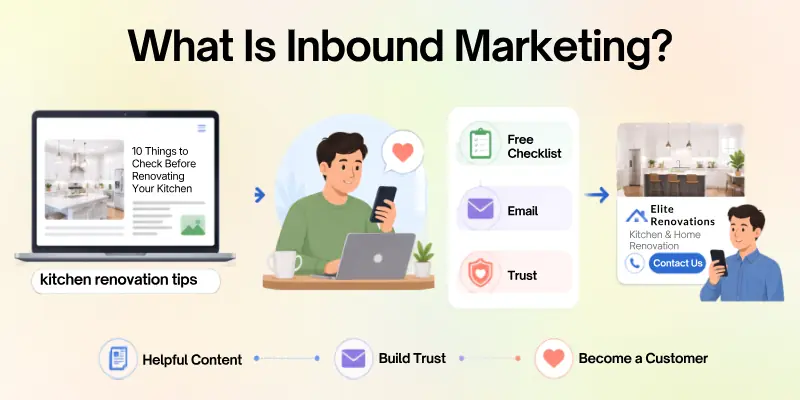
You answer their questions. You solve small problems. You educate them. You help them compare their choices. Over time, this useful interaction builds trust and makes it easier for people to choose your business when they are ready to buy.
Businesses normally use several channels together, including:
- Content marketing
- Search engine optimization
- Social media
- Email marketing
- Landing pages
- Lead nurturing
- Customer relationship management
The goal goes beyond making one sale. Good inbound marketing helps a business build stronger customer relationships and create steady growth over time.
Simple Example of Inbound Marketing
Imagine you run a home renovation company. Instead of only running advertisements that say, “Hire us for your kitchen renovation,” you publish a useful article called:
“10 Things to Check Before Renovating Your Kitchen”
A homeowner searches Google for kitchen renovation advice and finds your article.
They read it and discover helpful information. At the end of the article, you offer a free kitchen planning checklist in exchange for their email address.
A few days later, you send them another useful email about renovation costs.
Later, when that homeowner decides to hire a contractor, your company already feels familiar and trustworthy.
That entire process is inbound marketing.
Why Inbound Marketing Matters
Inbound marketing matters because customers do not want businesses to constantly interrupt them.
People usually want to research a product or service on their own. They search online, compare businesses, read reviews, ask questions, and study different options before making a decision.
Inbound marketing allows your business to become part of that research process. Instead of saying, “Buy from us,” at every opportunity, you first show customers that you understand their problems and can help solve them.
This approach can bring better leads, strengthen your reputation, and create long-term customer relationships.
Inbound Marketing vs. Outbound Marketing
Inbound and outbound marketing both try to generate customers, but they approach the customer in very different ways.
Inbound marketing attracts people through useful information, while outbound marketing sends promotional messages directly to an audience.
Here is a simple way to understand the difference.
Key Differences
The biggest difference comes down to whether the customer finds the business or the business interrupts the customer.
- Approach: Inbound pulls interested people toward your business, while outbound pushes a message toward an audience.
- Content: Inbound focuses heavily on education and value, while outbound usually focuses more directly on promotion.
- Channels: Inbound uses blogs, SEO, social media, email, guides, and similar channels. Outbound uses methods such as cold calls, television ads, print ads, and direct promotions.
- Targeting: Inbound often reaches people who already show interest in a topic. Outbound can reach people whether they currently have interest or not.
- Cost: Inbound content can continue generating results after publication, while many outbound campaigns require continuous spending.
- Engagement: Inbound encourages people to interact with the business voluntarily.
- Trust: Inbound builds trust gradually through useful information.
- Results: Outbound can sometimes generate faster short-term attention, while inbound usually focuses more on sustainable results.
Neither approach automatically works for every business.
Many companies use both.
For example, a company may publish helpful SEO content for long-term traffic while also running paid campaigns to promote an important product launch.
The right mix depends on your audience, budget, industry, goals, and sales cycle.
Core Principles of Inbound Marketing
Inbound marketing follows three main stages:
Attract, Engage, and Delight.
Each stage supports a different part of the customer journey.
The goal is simple: first bring the right people to your business, then help them move toward a decision, and finally give customers enough value to keep them happy after the sale.
The Inbound Marketing Methodology
Let us look at each stage in more detail.
1. Attract
The first stage focuses on bringing the right audience to your business.
Getting thousands of visitors means very little if none of them needs your product or service.
You want people who have a genuine problem, need, question, or interest that connects with what your business offers. Your job at this stage is to understand what those people search for and create content that helps them.
Tactics to Attract Visitors
Businesses can use several methods to attract relevant visitors.
- Search Engine Optimization: Create and optimize pages around topics your audience searches for.
- Content Marketing: Publish blog posts, guides, videos, eBooks, case studies, and other useful resources.
- Social Media Marketing: Share valuable content and communicate with people on platforms where your audience spends time.
- Video Marketing: Explain difficult topics, demonstrate products, or answer common questions through video.
- Paid Campaigns: Use targeted advertising when you want to reach a specific audience faster.
- Guest Content: Contribute useful content to relevant websites or industry publications to reach new audiences.
Expert Tip: Do not create content only because a keyword gets high search volume. Focus on topics that connect with the problems your real customers want to solve.
2. Engage
Attracting someone to your website is only the beginning. Once they arrive, you need to give them a reason to stay, learn more, and take another step.
Engagement means helping visitors according to their current needs.
A first-time visitor may only want basic information. Another person may already understand the problem and want to compare solutions. Someone else may be ready to request a quote.
Your marketing should support each of these situations.
Ways to Engage Potential Customers
Good engagement makes it easier for people to continue their journey without feeling pressured.
- Email Marketing: Send useful follow-ups, educational content, product information, or offers based on customer interests.
- Lead Magnets: Give visitors useful resources such as checklists, templates, guides, or eBooks in exchange for contact information.
- Landing Pages: Create focused pages that explain one offer and guide visitors toward a clear action.
- Calls to Action: Tell visitors what useful step they can take next.
- Live Chat: Answer questions quickly when visitors need help.
- Contact Forms: Make it easy for qualified prospects to request information, consultations, quotes, or demonstrations.
- Case Studies: Show how your business helped real customers solve similar problems.
Pro Tip: Personalization works best when it feels useful. Use what you know about a prospect to give them more relevant information instead of simply inserting their name everywhere.
3. Delight
Inbound marketing does not end when someone makes a purchase.
The customer experience after the sale can influence repeat business, reviews, referrals, and long-term loyalty.
A satisfied customer can become one of your best marketing channels. Continue helping customers after they buy. Show them how to get better results from your product or service. Answer their questions and make support easy to access.
Ways to Delight Customers
Customer delight comes from useful support, clear communication, and a consistent experience.
- Follow-Up Emails: Share instructions, tips, tutorials, updates, and other useful information after a purchase.
- Customer Support: Give customers clear ways to get help when they need it.
- Educational Content: Create tutorials, FAQs, webinars, guides, and videos that help customers get better results.
- Customer Feedback: Ask customers what worked well and what you could improve.
- Reviews and Testimonials: Invite satisfied customers to share their experience.
- Referral Programs: Reward or encourage customers who recommend your business to others.
- Social Engagement: Continue answering questions and interacting with customers on social media.
Pro Tip: A customer who receives great support may tell other people about your business without you asking. That word-of-mouth growth can become one of your strongest inbound channels.
Key Strategies for Inbound Marketing
Inbound marketing does not depend on one single tactic. The best results usually come when several channels support each other.
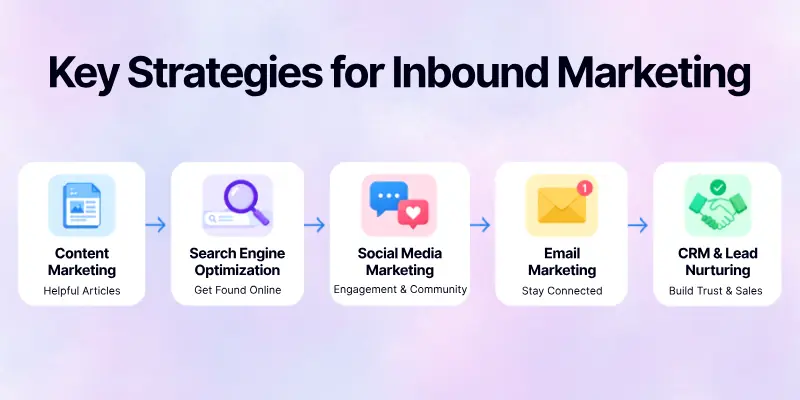
Here are the main strategies businesses use.
1. Content Marketing
Content sits at the heart of inbound marketing.
Your content gives people a reason to discover your business and spend time learning from you. It allows you to answer questions before a customer contacts your sales team.
Good content should solve a real problem or explain something your audience genuinely wants to understand.
Do not publish articles simply to fill your website. Each piece of content should have a purpose and serve a specific audience need.
Over time, a strong content library can bring search traffic, generate leads, support sales conversations, and strengthen your reputation.
Types of Content
Different content formats can support customers at different stages of their journey.
- Blog Posts: Answer questions and attract people searching for information.
- Videos: Explain topics, demonstrate products, share tutorials, or host interviews.
- Infographics: Turn complex information into an easier visual format.
- eBooks and Guides: Explain a topic in depth and help generate leads.
- Case Studies: Show how your product or service created a real result.
- Whitepapers: Give professional audiences detailed information about complex subjects.
- Checklists: Help users complete a task or make a decision.
- Templates: Give people a practical resource they can use immediately.
- Webinars: Educate an audience while creating opportunities for direct interaction.
2. Search Engine Optimization
SEO helps the right people find your content through search engines.
People search online every day for answers, products, services, prices, comparisons, and solutions. SEO helps your pages appear when those searches relate to your business.
Good SEO starts with understanding search intent. Ask what the person really wants when they type a particular search.
Then create a useful page that answers that need clearly.
You also need to keep your website technically healthy so search engines can find, understand, and index your pages properly.
SEO Tactics
A balanced SEO strategy covers the content, technical health, and authority of your website.
- Keyword Research: Find the words and questions your audience uses when searching.
- On-Page SEO: Improve titles, headings, content, internal links, images, and meta descriptions.
- Technical SEO: Improve website speed, mobile usability, crawling, indexation, and site structure.
- Off-Page SEO: Earn relevant links and mentions from trustworthy websites.
- Internal Linking: Connect related pages so visitors and search engines can discover more useful content.
- Content Updates: Refresh older pages when information becomes outdated or incomplete.
3. Social Media Marketing
Social media gives businesses a direct way to reach, educate, and communicate with their audience.
You can use social platforms to share your content, answer questions, join useful conversations, and show the people behind your business.
However, posting every day without a clear purpose does not create a strong inbound strategy.
Choose platforms where your audience actually spends time. Then create content that fits the way people use those platforms.
Pay attention to conversations, comments, and questions. They can tell you a lot about what your customers care about.
Social Media Tactics
A good social strategy focuses on useful communication rather than constant promotion.
- Share useful website content regularly.
- Answer comments and messages.
- Turn common customer questions into short posts.
- Share educational tips and insights.
- Use videos to explain products or topics.
- Show real customer stories when appropriate.
- Work with relevant creators or industry experts.
- Use paid promotion when you want to increase the reach of important content.
4. Email Marketing
Email marketing helps you stay connected with people after they visit your website.
Someone may like your business but still need time before making a purchase. Email gives you a way to continue the conversation without expecting them to return to your website on their own.
Strong email marketing focuses on relevance.
Send people information that matches their interests and stage in the buying process. Avoid sending the same promotional message to everyone.
A useful email can educate, answer a question, introduce another resource, share an offer, or remind a prospect about a logical next step.
Email Marketing Best Practices
Simple, useful emails often perform better than messages packed with unnecessary information.
- Segment Your List: Group subscribers according to interests, behavior, location, customer type, or buying stage.
- Create Follow-Up Sequences: Send a planned series of useful messages over time.
- Personalize Content: Use customer information to make emails more relevant.
- Write Clear Subject Lines: Tell readers what they can expect from the email.
- Focus on One Main Action: Avoid confusing readers with too many competing requests.
- Track Results: Monitor opens, clicks, responses, conversions, and unsubscribes.
- Improve Over Time: Test different messages and learn what your audience responds to.
5. Lead Nurturing and CRM
Not every lead becomes a customer immediately.
Some people need more information. Others need to compare options, discuss the purchase internally, wait for a budget, or solve another issue before moving forward.
Lead nurturing helps you stay connected during that process.
A customer relationship management system, or CRM, helps your team keep important information in one place. It can record conversations, lead sources, sales activity, interests, and follow-up tasks.
This information allows marketing and sales teams to communicate more effectively.
Lead Nurturing Practices
A clear nurturing process helps your team follow up without treating every lead in exactly the same way.
- Organize Lead Information: Keep contact details and interaction history in one place.
- Create Follow-Up Workflows: Send useful content according to a lead’s actions or interests.
- Score Leads: Identify prospects who show stronger buying intent.
- Personalize Communication: Match messages with the lead’s needs and stage.
- Track Conversations: Keep records so your team knows what happened previously.
- Connect Sales and Marketing: Share useful lead information between both teams.
Benefits of Inbound Marketing
Inbound marketing can support both short-term marketing goals and long-term business growth.
The exact results depend on your strategy, industry, competition, content quality, and consistency, but businesses often value inbound marketing for the following reasons.
Main Benefits
These benefits explain why many businesses make inbound marketing part of their long-term growth strategy.
- Higher-Quality Leads: You attract people who already show interest in topics related to your business.
- More Organic Traffic: Search-optimized content can bring people to your website without paying for every click.
- Stronger Trust: Helpful information shows customers that your business understands their needs.
- Better Brand Authority: Consistently useful content can strengthen your reputation in the market.
- Long-Term Value: A good piece of content can continue producing traffic and leads after you publish it.
- Lower Dependence on Paid Ads: Organic channels can create another source of customers alongside advertising.
- Better Customer Relationships: Useful communication keeps prospects and customers connected.
- More Sales Support: Sales teams can use articles, case studies, videos, and guides to answer prospect questions.
- Better Customer Retention: Helpful post-sale communication gives customers more reasons to stay.
- Measurable Performance: Digital tools allow you to measure traffic, leads, conversions, and customer behavior.
Common Inbound Marketing Mistakes
Inbound marketing can produce strong results, but poor execution can waste time and money.
Most problems do not happen because inbound marketing itself fails. They happen because businesses publish without a strategy, target the wrong audience, stop too early, or fail to measure results.
Mistakes to Avoid
Understanding these common mistakes can help you build a stronger and more focused strategy.
- Choosing Quantity Over Quality: Publishing many weak articles will not help if they provide little value to the reader.
- Ignoring Your Audience: Content will struggle when it focuses on what the company wants to say instead of what customers want to know.
- Targeting the Wrong Keywords: High search volume means little when the search has no connection to your customers.
- Writing Without Search Intent: A page may fail when it does not answer the reason behind a person’s search.
- Ignoring the Buyer Journey: Different prospects need different information at different stages.
- Publishing Without Promotion: Good content still needs distribution through search, social media, email, or other channels.
- Ignoring SEO: Even useful content can remain difficult to find when pages lack basic optimization.
- Using Too Many Sales Messages: Constant promotion can damage the trust that inbound marketing tries to build.
- Ignoring Measurement: You cannot improve your strategy when you do not know what produces results.
- Expecting Instant Results: Organic growth often requires consistent work over time.
- Neglecting Existing Customers: Inbound marketing should continue after the sale.
- Creating Content Without a Goal: Every major piece of content should support a clear audience need or business objective.
Tools for Inbound Marketing
The right tools can make inbound marketing easier to manage.
They help teams research topics, create content, send emails, manage leads, track website activity, and measure campaign performance. You do not need every tool available. Choose tools that solve the problems your team actually has.
Recommended Tools
Here are several commonly used types of inbound marketing tools:
- HubSpot: Helps businesses manage CRM, marketing, leads, email, forms, sales activity, and customer relationships.
- Semrush: Supports keyword research, SEO analysis, competitor research, and content planning.
- Ahrefs: Helps with keyword research, backlink analysis, competitor research, and SEO monitoring.
- Mailchimp: Helps businesses manage email lists, campaigns, and automated email journeys.
- ActiveCampaign: Supports email marketing, segmentation, automation, and customer communication.
- Canva: Helps teams create graphics, presentations, social posts, and other visual content.
- Adobe Express: Provides tools for creating simple marketing graphics and visual assets.
- Google Analytics: Helps businesses understand website traffic, visitor behavior, and conversions.
- Google Search Console: Shows how a website performs in Google Search and highlights search visibility issues.
Do not choose a tool simply because other marketers use it.
Start with your strategy. Then select tools that make that strategy easier to execute.
Future of Inbound Marketing
Inbound marketing continues to change because customer habits, search behavior, privacy expectations, and technology keep changing.
However, the basic principle will remain the same: businesses that understand their customers and provide genuine value will have a stronger chance of earning attention and trust.
Important Trends
The following trends will continue shaping how businesses attract and engage customers.
- Smarter Personalization: Businesses will use customer data more carefully to show people content that matches their interests and needs.
- More Interactive Content: Quizzes, calculators, polls, assessments, and interactive tools will give audiences more ways to engage.
- Conversational Search: Marketers will create content around natural questions and everyday language.
- Greater Focus on Customer Experience: Businesses will pay more attention to the full experience before and after a sale.
- Better Channel Integration: Websites, email, social media, sales teams, and customer support will work together more closely.
- More Video Content: Short and long videos will continue helping businesses educate customers quickly.
- First-Party Customer Data: Businesses will place more value on information customers choose to share directly with them.
- Original Expertise: Real examples, experience, research, opinions, and case studies will become more valuable than generic content.
- Helpful Tools and Resources: Calculators, templates, checklists, and free utilities can become powerful ways to attract qualified visitors.
- Stronger Community Building: Brands will focus more on building groups of customers and followers who actively participate in discussions.
How to Start an Inbound Marketing Strategy
You do not need to launch every inbound channel at once. Start with the basics and build from there.
Step 1: Understand Your Audience
Find out who your ideal customers are.
Ask:
- What problems do they face?
- What questions do they ask?
- What influences their decisions?
- What do they search for online?
- What stops them from buying?
- What information do they need before contacting a business?
Talk to customers, salespeople, support staff, and other people who interact with your market. Real customer conversations often give you better content ideas than guesswork.
Step 2: Study the Customer Journey
Think about what customers need at each stage. Someone who has just discovered a problem needs different information from someone comparing three suppliers. Create content for different levels of awareness.
Step 3: Choose Your Main Channels
Do not spread a small team across ten platforms. Choose the channels most likely to reach your audience. For many businesses, a strong starting combination might include:
- Website content
- SEO
- One or two social platforms
Expand once you can manage these channels consistently.
Step 4: Create Useful Content
Build content around real customer questions and problems. Before creating anything, ask:
“Will this genuinely help the person reading it?”
If the answer is no, improve the idea before publishing.
Step 5: Create Clear Conversion Paths
Traffic alone does not create business growth. Give interested visitors a logical next step. That could include:
- Downloading a guide
- Joining an email list
- Requesting a quote
- Booking a consultation
- Starting a trial
- Viewing a product
- Contacting your team
Make each next step clear and relevant.
Step 6: Nurture Your Leads
Do not disappear after someone downloads a resource or fills out a form. Continue helping them through email, useful content, sales follow-ups, or relevant offers.
Step 7: Measure the Results
Track the numbers that connect with your business goals. Useful measurements can include:
- Organic website traffic
- Search rankings
- Leads generated
- Conversion rate
- Email engagement
- Cost per lead
- Sales-qualified leads
- Customer acquisition
- Repeat customers
- Revenue from inbound channels
Step 8: Improve What Works
Inbound marketing gets stronger when you learn from real results. Update good content. Improve weak landing pages. Remove unnecessary steps. Create more content around topics that generate qualified leads. Stop spending time on activities that produce little value.
Conclusion
In this guide we have covered all about what is inbound marketing in great detail. Inbound marketing is a customer-first, content-driven approach that attracts, engages, and delights audiences.
By using content marketing, SEO, social media, email campaigns, and lead nurturing, businesses can generate long-term growth and sustainable ROI.
Expert Tip: Start with creating valuable content that addresses your audience’s pain points, and integrate it across multiple channels. Monitor results consistently and adapt strategies to improve performance over time.
FAQs About Inbound Marketing
Here are some common questions people ask about what is inbound marketing:
Inbound marketing attracts customers by giving them useful content and experiences. Instead of constantly interrupting people with promotional messages, you help them find answers and solutions. This approach builds trust and encourages people to contact your business when they are ready.
Inbound marketing usually follows three stages: Attract, Engage, and Delight. First, you attract the right audience through useful content and relevant channels. Next, you engage potential customers and help them make decisions. Finally, you continue supporting customers after the sale.
Inbound marketing attracts people through valuable information, while outbound marketing sends promotional messages directly to an audience. Examples of inbound marketing include SEO, blogs, guides, and educational email campaigns. Examples of outbound marketing include cold calls and traditional advertisements.
Common examples include blog posts, SEO pages, videos, webinars, eBooks, checklists, case studies, email newsletters, social media content, and free tools. Each format helps people discover or understand a business without relying only on direct advertising.
Content gives people a reason to discover your business. It answers questions, explains problems, shows your expertise, and supports prospects during the buying process. Without useful content, many inbound marketing channels have little to offer the audience.
There is no fixed timeline for every business. Results depend on your industry, competition, website authority, content quality, resources, and strategy. Some activities can generate leads quickly, while SEO and content growth often need consistent work over several months.
Yes. Small businesses can use inbound marketing to compete by focusing on specific customer problems and creating useful content around them. They do not need to use every marketing channel. A focused strategy can work well even with a small team and budget.
Businesses often use tools such as HubSpot for CRM and marketing management, Semrush or Ahrefs for SEO research, Mailchimp or ActiveCampaign for email marketing, Canva for visual content, and Google Analytics for website measurement.
Choose tools according to your needs instead of trying to use everything at once.
The three main stages are Attract, Engage, and Delight.
Attract brings the right audience to your business. Engage helps prospects understand their options and move toward a decision. Delight focuses on providing a strong customer experience after the sale.
Yes. SEO plays an important role in inbound marketing because it helps people discover useful content while searching for answers online. SEO works best when you combine good optimization with genuinely useful content.
Yes. Businesses can use social media to share helpful information, answer questions, communicate with potential customers, and direct people toward useful resources. Social media becomes more effective when you treat it as a relationship-building channel instead of using it only for promotion.
Email can support inbound marketing when people willingly join your list and receive relevant, useful communication. For example, a person may download a guide and then receive related educational emails. Unwanted mass emails fit much more closely with an outbound approach.
A good strategy starts with a clear understanding of the customer. It targets real problems, uses useful content, creates simple conversion paths, follows up with leads, supports customers after purchase, and measures results so the business can keep improving.
Inbound marketing will continue moving toward more personalized experiences, interactive content, natural search behavior, video, stronger customer communities, and better coordination across marketing and sales channels.
The tools will continue changing, but one principle will remain important: businesses need to create information and experiences that customers genuinely find useful.