Single Page vs Multi-Page Websites: Which One is Better for SEO?
Published: 8 Jul 2026
Guys, when you plan to build a website, one common confusion is whether to go with a single-page website or a multi-page website. A single-page website keeps all content on one page, while a multi-page website has different pages for different topics. Many people don’t know which one is better for SEO, user experience, and business goals.
So guys in this guide, I will clearly explain the difference between single page vs multi page websites in very simple English.
Let’s dive in!
Single Page vs Multi Page Websites: Key Differences
Here are the factors on which we will be comparing both types of websites:
- Website Structure
- SEO Performance
- User Experience
- Loading Speed
- Content Depth
- Navigation Style
- Conversion Rate
- Mobile Friendliness
- Scalability
- Use Case
Now let us cover all these factors in detail so you can clearly understand which type of website is best for your needs.
1. Website Structure
From my experience handling both single-page and multi-page websites, structure is the first thing that changes everything. Website structure simply means how your content is organized and presented to users.
In a single-page website, everything is placed on one page and users scroll to explore different sections. In a multi-page website, content is divided into different pages like home, about, services, and blog. This makes it easier to manage large content in a structured way.
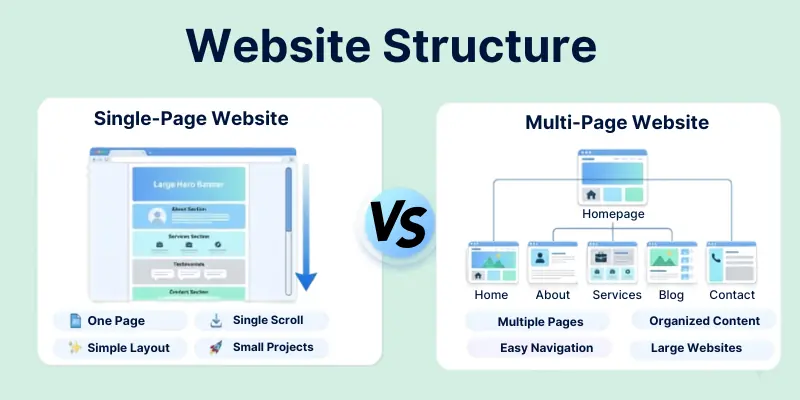
A clean structure helps users understand your site better and also helps search engines crawl it easily. So choosing the right structure depends on how much content you have and how you want users to navigate it.
Difference: Single-page websites have all content on one page, while multi-page websites divide content into multiple pages.
Single Page Website:
- One page layout
- All sections in one scroll
- Simple and minimal structure
- Easy to build for small projects
Multi-Page Website:
- Multiple separate pages
- Clear content division
- Organized structure
- Better for large websites
2. SEO Performance
Working on both types of websites, I’ve seen a big difference in SEO results. SEO performance depends on how well your site can target keywords and rank on Google. Single-page websites have limited space, so you can only target a few keywords.
Multi-page websites allow you to target many keywords on different pages. This gives you more chances to rank for multiple search queries. Also, search engines prefer structured content with clear pages. So if your goal is strong SEO growth, structure plays a big role.
Difference: Single-page websites have limited SEO scope, while multi-page websites offer better SEO opportunities.
Single Page Website:
- Limited keyword targeting
- Harder to rank for many topics
- Basic SEO setup
- Less content for optimization
Multi-Page Website:
- Multiple keyword targeting
- Better ranking chances
- Strong SEO structure
- More optimization options
3. User Experience
As someone managing both types of sites, user experience really depends on the purpose of the website. User experience means how easy and smooth it is for visitors to use your site. Single-page websites are simple and users just scroll to find information. This feels fast and smooth, especially on mobile.
Multi-page websites offer navigation menus and allow users to explore different pages. This is better when you have a lot of content to show. So both can give good experience, but in different ways.
Difference: Single-page websites offer simple scrolling experience, while multi-page websites provide detailed navigation.
Single Page Website:
- Easy scrolling
- Simple layout
- Quick access to info
- Best for small content
Multi-Page Website:
- Menu-based navigation
- Better content access
- More detailed browsing
- Best for large websites
4. Loading Speed
From practical work, loading speed behaves differently in both types. Loading speed means how fast your website opens and responds. In a single-page website, everything loads at once when the page opens.
This can be fast if the content is small, but slow if the page is heavy. In a multi-page website, each page loads separately. This keeps each page lighter and faster. Speed is important because slow websites lose users quickly. So you need to manage content size carefully.
Difference: Single-page websites load everything at once, while multi-page websites load content page by page.
Single Page Website:
- One-time loading
- Can become heavy
- Smooth scrolling after load
- Speed depends on content size
Multi-Page Website:
- Loads per page
- Faster individual pages
- Better for large content
- More controlled performance
5. Content Depth
Handling real projects, I’ve seen that content depth is where multi-page websites win clearly. Content depth means how much detailed information you can provide. In a single-page website, you are limited to short sections because everything is on one page. In a multi-page website, you can create separate pages for each topic. This allows you to go deep into details and provide more value.
More content also helps in better SEO and user engagement. So if your goal is to build authority, content depth matters a lot.
Difference: Single-page websites have limited content depth, while multi-page websites allow detailed content.
Single Page Website:
- Limited information
- Short sections
- Best for simple content
- Less detailed
Multi-Page Website:
- Detailed content
- Multiple topics covered
- Better for blogs and businesses
- High content flexibility
6. Navigation Style
From my experience handling both single-page and multi-page websites, navigation style really changes how users move on your site. Navigation means how users go from one section or page to another. In a single-page website, users mostly scroll or use menu links that jump to sections.
In a multi-page website, users click on menus to open different pages. This makes navigation more detailed and structured. Good navigation helps users find information quickly without confusion. So choosing the right style depends on your content and user needs.
Difference: Single-page websites use scroll-based navigation, while multi-page websites use page-based navigation.
Single Page Website:
- Scroll-based navigation
- Section jumping with menu
- Simple and fast
- Less complex
Multi-Page Website:
- Menu-based navigation
- Multiple pages to explore
- More organized
- Better for large content
7. Conversion Rate
While working on both types of websites, I’ve noticed conversion rate depends a lot on how focused the content is. Conversion rate means how many users take action like buying, signing up, or contacting you. Single-page websites are more focused, so users are guided step-by-step to one goal.
Multi-page websites provide more information, which helps users make better decisions. Both can convert well, but the approach is different. It depends on your business goal.
Difference: Single-page websites focus on one conversion goal, while multi-page websites support multiple conversion paths.
Single Page Website:
- One clear goal
- High focus on action
- Good for landing pages
- Quick decisions
Multi-Page Website:
- Multiple conversion options
- More detailed info
- Better for complex decisions
- Longer user journey
8. Mobile Friendliness
From practical use, mobile friendliness is important for both types today. Mobile friendliness means how well your site works on phones. Single-page websites are usually mobile-friendly because users just scroll.
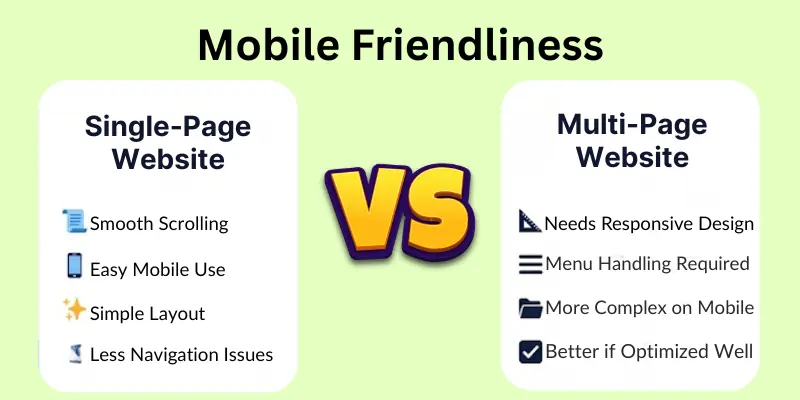
Multi-page websites can also be mobile-friendly but need proper design. If not optimized, navigation can become difficult on small screens. So both need responsive design, but single-page feels more natural on mobile.
Difference: Single-page websites are naturally mobile-friendly, while multi-page websites need proper mobile optimization.
Single Page Website:
- Smooth scrolling
- Easy mobile use
- Simple layout
- Less navigation issues
Multi-Page Website:
- Needs responsive design
- Menu handling required
- More complex on mobile
- Better if optimized well
9. Scalability
Handling real projects, scalability is where big decisions happen. Scalability means how easily you can grow your website in the future. Single-page websites are hard to scale because everything is on one page.
Multi-page websites are easy to expand because you can keep adding new pages. This is very important if you plan long-term growth. So always think ahead before choosing.
Difference: Single-page websites are hard to scale, while multi-page websites are highly scalable.
Single Page Website:
- Limited growth
- Hard to add more content
- Becomes heavy over time
- Not ideal for expansion
Multi-Page Website:
- Easy to expand
- Add new pages anytime
- Better for long-term growth
- Flexible structure
10. Use Case
From my own work, I always decide based on the use case first. Use case means where and why you are using the website. Single-page websites are best for simple projects where you don’t need much content.
Multi-page websites are best for businesses, blogs, and large websites. Choosing the wrong type can limit your growth. So always match your website type with your goal.
Difference: Single-page websites are best for simple use, while multi-page websites are best for complex and growing projects.
Single Page Website:
- Portfolio websites
- Landing pages
- Small business sites
- Event pages
Multi-Page Website:
- Blogs and content sites
- E-commerce websites
- Company websites
- Large business platforms
Which is Better for SEO: Single Page or Multi Page Website?
Guys, this is the most common question I get while working on websites. From my experience, SEO performance depends on how well you can target keywords and structure your content.
Single-page websites are simple but limited in SEO, while multi-page websites give you more opportunities to rank. If your goal is long-term growth and traffic, structure matters a lot.
- Multi-page websites are better for SEO because they target multiple keywords
- Single-page websites have limited SEO scope and ranking options
- Multi-page sites allow better internal linking
- Single-page sites are good only for small or focused content
- Multi-page websites help build authority over time
How to Choose Between Single Page and Multi Page Website
Guys, choosing the right type depends on your goal, not just design. I always decide this based on project size, content, and future plans.
If you choose wrong, it can limit your growth later. So think smart before starting your website.
- Choose single-page if you have small content or a simple project
- Choose multi-page if you want long-term SEO growth
- Use single-page for landing pages or portfolios
- Use multi-page for blogs, businesses, or e-commerce
- Go with multi-page if you plan to scale in future
Final Thoughts
In this guide, we have covered the difference between single page vs multi-page websites in a simple and clear way. Now you can understand when to use each type based on your goals, content, and SEO needs.
From my experience, single-page websites are good for small and simple projects, while multi-page websites are better for long-term growth and strong SEO. If you want better rankings, more traffic, and scalability, multi-page websites are usually the smarter choice.
So guys, always choose based on your purpose and future plan. And if you still have any confusion, just drop a comment and I’ll guide you there.
FAQs
Here are some of the most frequently asked questions related to single page vs multi page websites:
Single page website vs multi page website means comparing two different website structures. A single page website has all content on one page. A multi page website has different pages for different topics. Both are used based on project needs.
Single page website vs multi page depends on your goal. If you want a simple and quick website, single page is good. If you want SEO and growth, multi page is better. Multi page websites give more ranking opportunities.
In single page vs multi page website, multi page websites are better for SEO. They allow you to target multiple keywords. Single page websites have limited SEO options. That’s why multi page is preferred for ranking.
You should use a single page website when your content is small. It is best for portfolios, landing pages, or simple business sites. It is easy to manage and quick to build. It also gives a smooth user experience.
You should use a multi page website when you have a lot of content. It is best for blogs, businesses, and e-commerce sites. It helps organize content better. It also supports long-term SEO growth.
Yes, single page vs multi page website affects user experience. Single page websites are easy to scroll and simple to use. Multi page websites give more navigation options. Both can work well if designed properly.
A single page website can feel faster because it loads once. But if it has too much content, it can become slow. Multi page websites load page by page, which keeps them lighter. Speed depends on design and content size.
Yes, a single page website can rank on Google. But it is limited to a few keywords only. It is harder to compete with multi page websites. Proper optimization is still needed.
Yes, choosing between single page vs multi page website is important for growth. A wrong choice can limit your results. Multi page websites support scaling and SEO. Single page is better for small goals.
Yes, you can convert a single page website into a multi page website later. Many businesses start small and expand with time. It may require redesign and restructuring. Planning early can save effort.