Types of Traffic in Website: Simple Guide for Beginners
Published: 3 Aug 2026
Every website needs visitors to grow, but people reach websites through different sources. Some come from Google, while others arrive through ads, social media, emails, videos, AI tools, or links on other websites. These sources are known as the types of traffic in website.
So guys, understanding website traffic helps you know where visitors come from and which marketing method works best. In 2026, Google Analytics also tracks traffic from AI assistants such as ChatGPT, Gemini, Claude, Copilot, DeepSeek, and Grok.
This guide explains the main website traffic types in simple English for bloggers, students, business owners, and SEO beginners.
Let’s dive in!
Types of Traffic in Website
Website traffic means the people who visit your website. A traffic type tells you how those people reached your website.
Google Analytics normally uses the source, medium, campaign, and channel group to explain where website visitors come from.
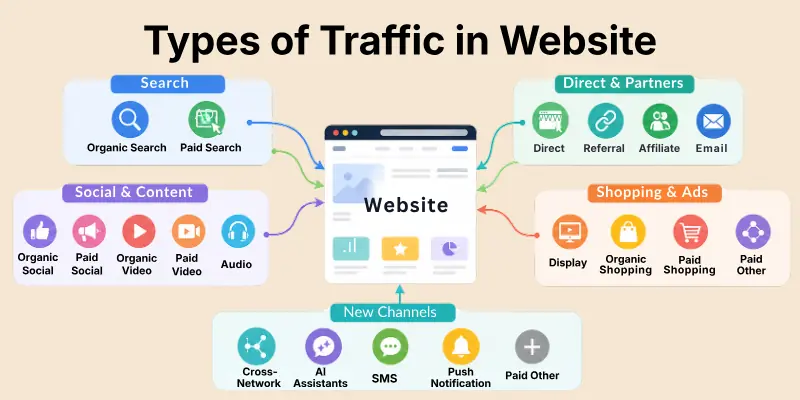
For example, the source may be Google, the medium may be organic, and the channel may appear as Organic Search. The main types of traffic in websites, updated according to the common Google Analytics 4 traffic channels used in 2026:
- Organic Search Traffic
- Paid Search Traffic
- Direct Traffic
- Referral Traffic
- Organic Social Traffic
- Paid Social Traffic
- Email Traffic
- Display Traffic
- Affiliate Traffic
- Organic Video Traffic
- Paid Video Traffic
- Organic Shopping Traffic
- Paid Shopping Traffic
- Cross-Network Traffic
- AI Assistants Traffic
- Audio Traffic
- SMS Traffic
- Mobile Push Notification Traffic
- Paid Other Traffic
Now, let us cover all these website traffic sources in detail.
1. Organic Search Traffic
Organic search traffic means visitors who find your website through unpaid search results. A person may search for something on Google, Bing, Yahoo, or another search engine. When that person clicks your normal search result, your website receives organic traffic.
For example, a person searches “best mobile phones under $500.” Your blog appears in the search results. The person clicks your article. This visit becomes organic search traffic.
You do not pay for each organic click. However, you normally need good content, proper SEO, useful information, and patience to earn this traffic. Google describes Organic Search as traffic coming through non-ad links in search results. It also includes clicks from Google AI Overviews and AI Mode. Necessary information:
- Main source: Organic traffic comes from unpaid search engine results.
- Common platforms: Google, Bing, Yahoo, Baidu, Yandex, and other search engines can send organic website traffic.
- Cost: You do not pay the search engine for each click.
- Main method: Search engine optimization helps you increase organic traffic.
- Content requirement: You need helpful, clear, original, and properly structured content.
- Keyword role: Relevant keywords help search engines understand the topic of your page.
- Time required: Organic SEO traffic usually takes time to grow.
- Main benefit: It can bring regular and targeted visitors for a long period.
- Main challenge: Search rankings can change because of competition, content quality, technical problems, or search engine updates.
- Best for: Organic search works well for blogs, business websites, service pages, online stores, and informational websites.
- How to increase it: Publish useful content, improve page speed, use proper headings, add internal links, earn trusted backlinks, and answer user questions.
- How to track it: Open the Traffic Acquisition report in Google Analytics and check the Organic Search channel.
- Important tool: Google Search Console shows search clicks, impressions, search queries, and click-through rate before a user enters your website. Tip: Do not write only for search engines. Solve the reader’s problem first.
Organic search traffic remains one of the most valuable traffic sources for bloggers because useful articles can continue bringing visitors without paying for every click.
2. Paid Search Traffic
Paid search traffic means visitors who reach your website by clicking a paid advertisement on a search engine.
For example, a company runs a Google Ads campaign for the keyword “AC repair in Riyadh.” A user searches that phrase and clicks the sponsored result. That visit becomes paid search traffic.
Google Analytics places visitors from search engine advertisements under the Paid Search channel. Necessary information:
- Main source: Paid search traffic comes from advertisements shown on search engines.
- Common platforms: Google Ads, Microsoft Advertising, Baidu Ads, and other search advertising platforms can send this traffic.
- Cost: You normally pay for clicks, impressions, or conversions.
- Common model: Pay-per-click means you pay when someone clicks your advertisement.
- Speed: Paid search can start sending website visitors soon after you launch the campaign.
- Targeting: You can target keywords, countries, cities, devices, languages, age groups, or audience interests.
- Main benefit: It can bring fast and highly targeted visitors.
- Main challenge: Traffic may stop when you stop spending money.
- Best for: Paid search works well for product sales, service leads, course registrations, bookings, and limited-time offers.
- Landing page need: The advertisement should send visitors to a page that matches their search.
- Quality requirement: A strong advertisement alone cannot produce good results if the landing page looks weak or confusing.
- How to improve it: Choose relevant keywords, write clear advertisements, remove poor keywords, improve landing pages, and track conversions.
- How to track it: Check the Paid Search channel in the Google Analytics Traffic Acquisition report.
- Important metric: Cost per conversion tells you how much money you spend to receive one sale, lead, or other desired action.
- Expert tip: Do not send every advertisement to the homepage. Send users to the most relevant service or product page.
Paid search traffic works quickly, but you must manage the budget carefully. Always compare advertising cost with the income or leads generated by the campaign.
3. Direct Traffic
Direct traffic means Google Analytics cannot find a clear source that sent the visitor to your website.
A person may type your website address directly into the browser. The person may also use a saved bookmark. In some cases, Google Analytics may count a visit as direct when tracking information becomes missing.
For example, a visitor types example.com into Chrome and opens the website. This visit normally appears as Direct traffic.
Google Analytics describes direct traffic as visits from a saved link or from people entering the website URL. It may also appear when referral or campaign information is missing. Necessary information:
- Main source: Direct traffic does not show a clear referring website or campaign.
- Common example: A user types your domain name directly into the browser.
- Bookmark visits: People who open your website through a bookmark may appear as direct visitors.
- Brand connection: Strong brands often receive more direct website traffic because people remember their names.
- Offline links: Links inside some PDF files, Word documents, or offline materials may appear as direct traffic.
- Missing tags: Email, social media, or advertising links without proper tracking tags can wrongly appear as direct traffic.
- Redirect problem: Some redirects can remove source information.
- URL shorteners: Certain shortened links may also remove referral details.
- Ad blockers: Some ad blockers can stop tracking information and cause direct attribution.
- Main benefit: True direct traffic often shows brand awareness and returning visitors.
- Main challenge: Not every direct visit truly comes from someone typing the URL.
- How to improve tracking: Add UTM tracking parameters to emails, advertisements, social posts, PDFs, and promotional links.
- How to track it: Check the Direct channel or the (direct) / (none) source and medium in Google Analytics.
- Expert tip: A sudden rise in direct traffic may show strong brand interest, but it may also show a tracking problem.
Direct traffic can be valuable, but you should not treat every direct visit as a loyal customer. First, check whether your campaign links contain proper tracking information.
4. Referral Traffic
Referral traffic means visitors who reach your website by clicking a non-paid link on another website or app.
For example, another blogger mentions your article and adds a link to it. A reader clicks that link and visits your website. Google Analytics counts this visit as referral traffic.
Google Analytics describes Referral as traffic from non-ad links placed on websites, blogs, news sites, or apps. Necessary information:
- Main source: Referral traffic comes from links on other websites or apps.
- Common examples: Blogs, online newspapers, business directories, forums, review websites, and partner websites can send referral visitors.
- Cost: Natural referral traffic may be free.
- Quality: A trusted and relevant website can send highly interested visitors.
- Backlink value: A good referral link may also support SEO when it comes from a trusted website.
- Main benefit: Referral traffic introduces your website to a new audience.
- Main challenge: Low-quality websites may send useless, spammy, or fake traffic.
- Relationship building: Networking with bloggers, publishers, businesses, and industry experts can increase referrals.
- Guest posting: A useful guest article can send readers to your website through an author or content link.
- Directories: Relevant business directories can send local referral traffic.
- How to increase it: Publish link-worthy resources, create original studies, offer expert comments, write guest posts, and build real industry relationships.
- How to track it: Check the Referral channel and the referring domain in Google Analytics.
- Unwanted referrals: Payment gateways or your own connected domains can sometimes appear as referrals and create incorrect reporting.
- Expert tip: Focus on referral quality, not only the number of referring websites.
One strong referral from a respected industry website can produce more value than hundreds of weak links from unrelated websites.
5. Organic Social Traffic
Organic social traffic means visitors who come from unpaid posts or links on social media platforms. For example, you share a blog post on Facebook. A follower clicks the link without seeing a paid advertisement. This visit becomes organic social traffic.
Google Analytics places non-ad traffic from social platforms under Organic Social. Necessary information:
- Main source: Organic social traffic comes from unpaid social media activity.
- Common platforms: Facebook, Instagram, LinkedIn, Pinterest, X, Reddit, and other social networks can send organic visitors.
- Cost: You do not pay for each organic social click.
- Content formats: Posts, stories, profile links, comments, groups, and shared content can send this traffic.
- Main benefit: Social media helps you build a community and communicate directly with people.
- Main challenge: Organic reach may remain low, especially on highly competitive platforms.
- Content need: Useful, interesting, visual, emotional, or educational posts often receive more attention.
- Consistency: Regular posting helps people remember your brand.
- Engagement: Comments, shares, saves, and reactions can improve content reach.
- Best for: Organic social works well for personal brands, bloggers, coaches, restaurants, fashion businesses, and visual products.
- How to increase it: Share useful tips, ask questions, join relevant discussions, post short videos, and respond to followers.
- How to track it: Check Organic Social in Google Analytics.
- Tracking tip: Add UTM tags to social media links so that you can identify each platform and campaign clearly.
- Expert tip: Do not post only links. Give useful information inside the social post and then guide the reader to your website.
Organic social traffic becomes stronger when people trust your voice. Build relationships instead of posting only promotional messages.
6. Paid Social Traffic
Paid social traffic means visitors who reach your website through advertisements on social media platforms. For example, a business runs a Facebook advertisement for a digital marketing course. A person clicks the advertisement and visits the course page. This visit becomes paid social traffic.
Google Analytics places visits from social media ads under the Paid Social channel. Necessary information:
- Main source: Paid social traffic comes from advertisements on social networks.
- Common platforms: Facebook Ads, Instagram Ads, LinkedIn Ads, Pinterest Ads, TikTok Ads, and X Ads can send paid social visitors.
- Cost: The advertiser pays for clicks, impressions, video views, leads, or conversions.
- Targeting: You can target users according to location, age, interests, job title, behavior, and previous website visits.
- Main benefit: Paid social helps you reach a selected audience quickly.
- Main challenge: Poor targeting can waste the advertising budget.
- Creative need: Strong images, videos, headlines, and calls to action can improve results.
- Landing page need: Your landing page should continue the same message shown in the advertisement.
- Retargeting: You can show advertisements to people who previously visited your website.
- Best for: Paid social works well for awareness, lead generation, course sales, ecommerce, events, and local services.
- How to improve it: Test different audiences, images, videos, headlines, offers, and landing pages.
- How to track it: Check Paid Social in Google Analytics and compare it with the advertising platform report.
- Important metric: Return on ad spend shows how much income you receive for the amount spent on advertisements.
- Expert tip: Do not judge a campaign only by clicks. Check leads, sales, and profit.
Paid social traffic can produce strong results when you combine the correct audience with a clear offer and a trustworthy landing page.
7. Email Traffic
Email traffic means visitors who reach your website by clicking a link inside an email.
For example, you send a weekly newsletter containing a link to your latest blog article. A subscriber clicks the link. That visit becomes email traffic.
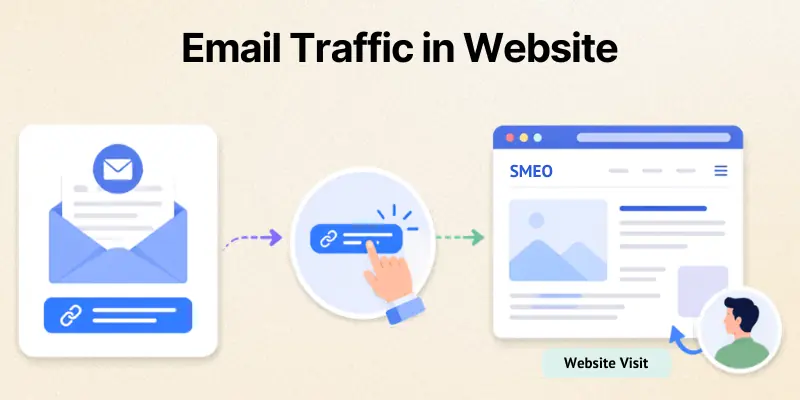
Google Analytics places properly identified visits from email links under the Email channel. Necessary information:
- Main source: Email traffic comes from newsletters, promotional emails, welcome emails, and other email campaigns.
- Audience type: Most email visitors already know your brand or have joined your mailing list.
- Main benefit: Email lets you communicate directly with your audience.
- Ownership: You control your mailing list more than you control followers on a social media platform.
- Common uses: Businesses use email for new articles, product offers, reminders, updates, and abandoned-cart messages.
- Personalization: You can send different messages to different subscriber groups.
- Subject line: A clear and attractive subject line can improve email opens.
- Call to action: Each email should guide readers toward a clear next step.
- Mobile need: Emails should work properly on mobile devices.
- Main challenge: Poor emails may enter spam folders or cause people to unsubscribe.
- How to increase it: Build an honest subscriber list, offer useful information, send emails regularly, and avoid unnecessary messages.
- How to track it: Add UTM parameters to every email link and check the Email channel in Google Analytics.
- Important metrics: Open rate, click rate, conversion rate, unsubscribe rate, and revenue per email can show campaign performance.
- Expert tip: Send useful emails, not only sales messages. People stay subscribed when they receive real value.
Email traffic often produces good conversions because subscribers have already shown interest in your content, brand, service, or product.
8. Display Traffic
Display traffic means visitors who reach your website through visual advertisements shown on websites or apps. These advertisements may include banners, images, animated graphics, or other visual ad formats.
For example, a person reads a news website and sees your banner advertisement. The person clicks it and enters your website. This becomes display traffic.
Google Analytics identifies visits from display advertisements under the Display channel.Necessary information:
- Main source: Display traffic comes from visual advertisements shown across websites and apps.
- Common formats: Banner ads, image ads, responsive ads, interstitial ads, and animated ads can send display traffic.
- Common platforms: Google Display Network and other advertising networks manage display campaigns.
- Cost: You may pay for clicks, impressions, or conversions.
- Main purpose: Businesses often use display ads for brand awareness and retargeting.
- Visual importance: A clear and professional design can attract more attention.
- Message need: The advertisement should explain the offer quickly.
- Targeting: You can target websites, topics, interests, locations, audiences, and previous visitors.
- Main benefit: Display campaigns can reach a large number of people.
- Main challenge: Many users ignore banner advertisements.
- Retargeting value: Display ads can remind previous visitors about a product or service.
- How to improve it: Use simple designs, short messages, clear calls to action, and relevant landing pages.
- How to track it: Check the Display channel in Google Analytics and use campaign tags.
- Expert tip: Avoid adding too much text to a banner. The user should understand the main message within a few seconds.
Display traffic supports awareness, but you should monitor its quality. A campaign with many clicks but no useful actions may need better targeting.
9. Affiliate Traffic
Affiliate traffic means visitors who reach your website through links shared by an affiliate partner.
An affiliate promotes another company’s product or service. The affiliate may receive a commission when a visitor buys something, registers, or completes another required action.
For example, a blogger reviews a hosting company and adds a special affiliate link. A reader clicks that link and enters the hosting website. This becomes affiliate traffic.
Google Analytics defines Affiliates as visitors arriving through links placed on affiliate websites. Necessary information:
- Main source: Affiliate traffic comes from promotional partners.
- Common publishers: Bloggers, YouTubers, influencers, review websites, and coupon websites may act as affiliates.
- Tracking link: Each affiliate normally receives a special link or code.
- Payment model: The company may pay for a sale, lead, registration, or another completed action.
- Main benefit: Businesses may pay only after receiving a result.
- Affiliate benefit: The publisher earns money by recommending relevant products.
- Trust factor: Honest recommendations often perform better than aggressive promotion.
- Main challenge: Poor affiliates may make false claims or use spammy methods.
- Program need: A business needs clear commission rules, payment terms, and tracking systems.
- Content types: Product reviews, comparisons, tutorials, and buying guides can send affiliate visitors.
- How to increase it: Work with trusted publishers whose audiences match your business.
- How to track it: Use unique affiliate links, affiliate software, and the Affiliates channel in Google Analytics.
- Important metric: Conversion rate shows how many affiliate visitors complete the required action.
- Expert tip: Choose quality partners. One trusted affiliate can produce better results than many unrelated publishers.
Affiliate traffic works best when the promoter understands the product and explains it honestly to the right audience.
10. Organic Video Traffic
Organic video traffic means visitors who reach your website by clicking unpaid links on video platforms.
For example, you upload a YouTube tutorial and add your website link in the description. A viewer clicks the link. This visit becomes organic video traffic.
Google Analytics places non-ad traffic from video platforms such as YouTube, TikTok, or Vimeo under Organic Video. Necessary information:
- Main source: Organic video traffic comes from unpaid video content.
- Common platforms: YouTube, TikTok, Vimeo, and other video websites can send visitors.
- Link locations: Visitors may click links in descriptions, profiles, comments, cards, or end screens.
- Cost: You do not pay the video platform for each organic click.
- Main benefit: Video helps people understand a topic, product, or process clearly.
- Trust value: Viewers can see your knowledge, communication style, and personality.
- Search value: Helpful videos may appear in video search results for a long time.
- Main challenge: Video production can require planning, recording, editing, and regular publishing.
- Content ideas: Tutorials, product reviews, demonstrations, interviews, and case studies can generate traffic.
- Call to action: Tell viewers clearly why they should visit the website.
- How to increase it: Create useful videos, use searchable titles, write clear descriptions, add links, and answer viewer questions.
- How to track it: Check Organic Video in Google Analytics and add UTM tags to video links.
- Important metric: Check watch time, link clicks, engaged sessions, and conversions.
- Expert tip: Do not hide the website link under a long description. Place it where viewers can find it easily.
Organic video traffic can grow slowly, but a useful video may continue sending visitors for months or years.
11. Paid Video Traffic
Paid video traffic means visitors who click advertisements shown on video platforms.
For example, a company runs a YouTube video advertisement. A viewer clicks the call-to-action button and visits the company’s website. This becomes paid video traffic.
Google Analytics categorizes traffic from ads on platforms such as YouTube, TikTok, or Vimeo as Paid Video. Necessary information:
- Main source: Paid video traffic comes from video advertisements.
- Common platforms: YouTube Ads, TikTok Ads, and other video advertising platforms can send this traffic.
- Ad formats: Skippable ads, non-skippable ads, in-feed video ads, and short video ads can generate visits.
- Cost: You may pay for views, clicks, impressions, or conversions.
- Main benefit: Video ads can explain a message with sound, movement, text, and visuals.
- Opening seconds: The first few seconds should quickly capture attention.
- Targeting: Advertisers can target users by interests, location, behavior, demographics, and search history.
- Main challenge: Weak videos can use the budget without producing useful results.
- Landing page: The website page should continue the same promise made in the video.
- Best for: Paid video works well for awareness, demonstrations, courses, apps, products, and special campaigns.
- How to improve it: Use a strong hook, show the main benefit, provide proof, and include a clear call to action.
- How to track it: Check Paid Video in Google Analytics and compare the results with the video advertising platform.
- Important metric: Measure completed views, website visits, leads, sales, and cost per conversion.
- Expert tip: Do not make the introduction too long. Show the problem or benefit immediately.
Paid video traffic can build both awareness and conversions, but the video message must remain simple and focused.
12. Organic Shopping Traffic
Organic shopping traffic means visitors who click unpaid product listings on shopping websites or shopping search features.
For example, an online store adds its products to a free shopping listing. A user sees a product, clicks it, and visits the store. This becomes organic shopping traffic.
Google Analytics describes Organic Shopping as traffic from non-ad links on shopping sites and free shopping listings. Necessary information:
- Main source: Organic shopping traffic comes from unpaid product listings.
- Common sources: Shopping search features, marketplaces, merchant listings, and product discovery platforms can send this traffic.
- Cost: The store does not pay for each organic listing click.
- Product data: Correct titles, prices, images, availability, and descriptions help users understand the product.
- Main benefit: Visitors often arrive with buying interest.
- Main challenge: Incorrect or missing product information can reduce visibility and trust.
- Image quality: Clear product images can improve clicks.
- Price accuracy: The price shown in the listing should match the price on the website.
- Availability: The website should clearly show whether the product remains in stock.
- Reviews: Genuine product reviews can support buyer confidence.
- How to increase it: Improve product feeds, use clear titles, add complete details, and keep stock information updated.
- How to track it: Check Organic Shopping in Google Analytics.
- Important metric: Measure product views, add-to-cart actions, purchases, and revenue.
- Expert tip: Write product titles for real buyers. Avoid adding unnecessary keywords that make the title confusing.
Organic shopping traffic can bring strong ecommerce results because many visitors already want to compare or purchase a product.
13. Paid Shopping Traffic
Paid shopping traffic means visitors who reach an online store through paid product advertisements. These advertisements normally show a product image, title, price, store name, or offer.
For example, a person searches for running shoes and clicks a sponsored product listing. The visit becomes paid shopping traffic.
Google Analytics places traffic from paid shopping advertisements under Paid Shopping. Necessary information:
- Main source: Paid shopping traffic comes from sponsored product listings.
- Common platforms: Search engines, shopping websites, marketplaces, and retail advertising platforms can send it.
- Cost: The business pays for clicks, impressions, or conversions.
- Product feed: The campaign uses product details such as titles, prices, images, and availability.
- Buying intent: People clicking shopping advertisements often show clear product interest.
- Main benefit: The advertisement shows important product information before the click.
- Main challenge: High competition can increase advertising costs.
- Price factor: Users may compare your price with other sellers before clicking.
- Landing page: The advertisement should open the exact product page.
- Stock accuracy: Do not advertise products that are unavailable.
- How to improve it: Use clear images, correct product data, competitive pricing, and strong product pages.
- How to track it: Check Paid Shopping in Google Analytics and connect the store with the advertising platform.
- Important metric: Measure cost per sale, conversion rate, revenue, and return on advertising spend.
- Expert tip: Remove products that receive expensive clicks but produce no sales.
Paid shopping traffic can produce direct sales, but accurate product data and careful budget control remain necessary.
14. Cross-Network Traffic
Cross-network traffic means visitors who come from one advertising campaign that runs across several advertising networks.
A single campaign may show advertisements in search results, video platforms, display websites, maps, shopping areas, or other placements.
For example, Google Performance Max can show advertisements across different Google properties. Google Analytics may place traffic from this type of campaign under Cross-network. Necessary information:
- Main source: Cross-network traffic comes from advertisements running across more than one network.
- Common campaigns: Performance Max and some automated campaigns can produce this traffic.
- Possible placements: Advertisements may appear on Search, YouTube, Display, Maps, Gmail, Discover, or shopping areas.
- Automation: The advertising system may automatically choose placements and audiences.
- Main benefit: One campaign can reach users at different points in their buying journey.
- Main challenge: It may become difficult to know which exact placement produced each result.
- Creative need: The campaign may require text, images, logos, product data, and videos.
- Conversion data: Correct conversion tracking helps the advertising system learn.
- Budget need: The campaign needs enough data and budget to optimize properly.
- Audience signals: Relevant audience information can guide campaign learning.
- How to improve it: Provide strong creative assets, accurate conversion data, clear goals, and high-quality landing pages.
- How to track it: Check Cross-network in Google Analytics and review campaign-level performance.
- Important metric: Measure conversions, conversion value, customer acquisition cost, and return on advertising spend.
- Expert tip: Do not depend only on the total conversion number. Also review lead quality and actual sales.
Cross-network traffic can reach a wide audience, but businesses should still check whether the campaign brings real customers.
15. AI Assistants Traffic
AI Assistants traffic means visitors who reach your website by clicking a link inside an AI assistant or chatbot.
For example, a person asks ChatGPT for a useful guide. ChatGPT mentions your website as a source. The person clicks the link and visits your page. This becomes AI Assistants traffic.
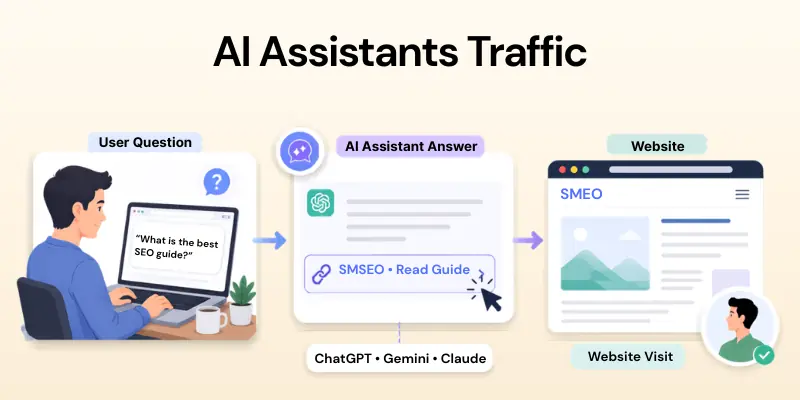
In May 2026, Google Analytics introduced a dedicated AI Assistants channel. It can identify clicks from recognized tools such as ChatGPT, Gemini, Claude, Copilot, DeepSeek, and Grok. Google Analytics uses the ai-assistant medium for recognized AI assistant referrals. own AI Overviews and AI Mode remain part of Organic Search rather than the AI Assistants channel. Necessary information:
- Main source: AI traffic comes from links shown in AI-generated answers.
- Common platforms: ChatGPT, Gemini, Claude, Microsoft Copilot, Perplexity, DeepSeek, and Grok may send AI visitors.
- New importance: AI tools now help people discover websites, products, guides, brands, and services.
- Click requirement: Google Analytics records a visit only when a real user clicks the link and opens the website.
- Bot difference: AI crawling or reading a page does not always create a normal website visit in Google Analytics.
- Main benefit: AI assistants can send highly specific visitors who already asked a detailed question.
- Main challenge: An AI answer may mention your information without sending a click.
- Content need: Clear facts, simple explanations, original examples, useful tables, expert insights, and direct answers can improve content usefulness.
- Brand mention: A clear brand name and author identity can help readers understand who created the information.
- Question-based content: Pages that answer real and specific questions may gain stronger visibility across search and AI discovery systems.
- Accuracy: Outdated or unclear information may reduce the usefulness of the page.
- How to increase it: Publish trusted, complete, well-structured, and easy-to-understand content.
- How to track it: Check the AI Assistants channel in the GA4 Traffic Acquisition report.
- Important metric: Measure AI-referred sessions, engagement, signups, leads, sales, and assisted conversions.
- Expert tip: Do not create separate weak articles for every small question. Build complete resources that answer the main question and its related questions.
AI Assistants traffic has become an important website traffic source in 2026. Bloggers should now write for people, search engines, and AI discovery systems without reducing content quality.
16. Audio Traffic
Audio traffic means visitors who reach a website through advertisements or links on audio platforms.
For example, a person listens to a podcast and clicks a linked advertisement in the podcast app. That visit may appear as Audio traffic.
Google Analytics defines Audio as a channel that brings visitors through advertisements on audio platforms, including podcast platforms. Necessary information:
- Main source: Audio traffic usually comes from advertisements on audio platforms.
- Common platforms: Podcast apps, music-streaming services, and digital radio platforms can send audio visitors.
- Ad formats: Spoken advertisements, recorded promotions, host-read messages, and audio banners may generate clicks.
- Cost: Advertisers may pay for impressions, listens, clicks, or campaign packages.
- Main benefit: Audio can reach people while they travel, exercise, work, or relax.
- Trust value: A recommendation from a trusted podcast host may strongly influence listeners.
- Main challenge: Listeners cannot always click immediately while listening.
- Memorable URL: A short and simple website address can help listeners remember it.
- Special offer: A unique discount code can help measure podcast or audio campaign performance.
- Landing page: A special campaign page makes the visitor journey clearer.
- How to improve it: Use a simple message, repeat the brand name, explain the benefit, and give one clear action.
- How to track it: Add campaign tags to clickable links and check the Audio channel in Google Analytics.
- Important metric: Measure website visits, code usage, leads, subscriptions, and sales.
- Expert tip: Do not give listeners several actions at the same time. Give them one simple next step.
Audio traffic may not suit every business, but it can work well when the audience closely matches the offer.
17. SMS Traffic
SMS traffic means visitors who reach a website by clicking a link inside a text message.
For example, a store sends a text message about a weekend discount. A customer clicks the link and enters the store’s website. This becomes SMS traffic.
Google Analytics identifies properly tagged visits from text messages under the SMS channel. Necessary information:
- Main source: SMS traffic comes from links placed in mobile text messages.
- Common uses: Businesses use SMS for offers, reminders, booking updates, delivery information, and account alerts.
- Audience permission: Businesses should send marketing messages only to people who gave permission where required.
- Message length: SMS messages should remain short and clear.
- Link need: A short and trustworthy link saves space and looks cleaner.
- Main benefit: People often notice text messages quickly.
- Main challenge: Too many messages can annoy users.
- Timing: Send messages at a suitable time for the audience.
- Call to action: Tell the reader exactly what to do, such as “Book now” or “View your order.”
- Mobile page: The landing page must work properly on smartphones.
- How to improve it: Personalize the message, provide clear value, and avoid unnecessary messages.
- How to track it: Use UTM parameters and check the SMS channel in Google Analytics.
- Important metric: Measure link clicks, bookings, purchases, opt-outs, and conversions.
- Expert tip: Never hide the main purpose of the message. The reader should understand it immediately.
SMS traffic can generate quick actions, but businesses should respect user permission and avoid sending too many messages.
18. Mobile Push Notification Traffic
Mobile push notification traffic means visitors who open a website or app through a notification sent to their mobile device.
A push notification may appear even when the person is not actively using the app.
For example, a news app sends a notification about a breaking story. The user taps it and opens the article. This becomes Mobile Push Notification traffic.
Google Analytics uses the Mobile Push Notifications channel for visits from mobile-device messages or notifications. Necessary information:
- Main source: This traffic comes from mobile push messages.
- Permission: Users normally need to allow notifications first.
- Common uses: Websites and apps use push messages for news, reminders, offers, updates, and abandoned carts.
- Speed: Push notifications can bring users back quickly.
- Main benefit: They can reach users without requiring them to open an email or social media app.
- Main challenge: Too many notifications may cause users to disable them.
- Message size: The notification should use a short title and short message.
- Personalization: Relevant notifications perform better than general messages.
- Timing: The message should arrive when the user can take action.
- Deep links: A notification should open the exact page connected to the message.
- How to improve it: Segment users, send useful alerts, choose suitable timing, and limit frequency.
- How to track it: Check Mobile Push Notifications in Google Analytics and use correct campaign information.
- Important metric: Measure open rate, return visits, conversions, and notification opt-outs.
- Expert tip: Send a notification because it helps the user, not only because you want another click.
Push traffic can bring previous users back, but it works only when notifications remain relevant and respectful.
19. Paid Other Traffic
Paid Other traffic means visitors who come from a paid advertisement that Google Analytics cannot place under Paid Search, Paid Social, Paid Shopping, Paid Video, Display, or another more specific paid channel.
For example, a business uses a special paid campaign format and tags the link as paid traffic. If it does not match another channel rule, Google Analytics may place it under Paid Other.
Google Analytics uses Paid Other for advertisement traffic that does not match its more specific paid channel categories. Necessary information:
- Main source: Paid Other comes from paid campaigns outside the main paid channel definitions.
- Possible examples: Sponsored placements, unusual advertising networks, custom campaigns, and some paid partnerships may appear here.
- Cost: The business pays for the campaign or placement.
- Main benefit: It allows advertisers to measure paid promotion outside common advertising platforms.
- Main challenge: A large Paid Other number may make campaign analysis unclear.
- Tagging issue: Incorrect UTM values may send traffic into Paid Other.
- Campaign naming: Clear campaign names help you understand the original promotion.
- Medium value: The medium should accurately describe the advertising method.
- Landing page: The campaign should send visitors to a relevant page.
- How to improve tracking: Create clear UTM rules and use the same naming style across the whole team.
- How to track it: Check Paid Other and then review the source, medium, and campaign details.
- Important metric: Measure cost, conversions, lead quality, sales, and return on investment.
- Custom grouping: Businesses can create custom channel groups in Google Analytics when they need their own traffic categories. rt tip:** When Paid Other grows suddenly, check your campaign tags before making a marketing decision.
Paid Other does not always mean poor traffic. It often means that your paid campaign does not fit another standard channel or needs clearer tracking.
What Is Unassigned Traffic?
Unassigned is not a normal marketing traffic source. It is a reporting category in Google Analytics.
Google Analytics places traffic under Unassigned when the source and medium information does not match any channel rule. Your team may add an incorrect UTM medium to a campaign link. Google Analytics may not understand the value, so it puts those visits under Unassigned.
Necessary information:
- Meaning: Google Analytics could not place the traffic in a standard channel.
- Common cause: Incorrect, unusual, or missing campaign tags often create Unassigned traffic.
- Main problem: It prevents you from understanding the true traffic source.
- How to fix it: Review your source, medium, and campaign naming rules.
- Tracking need: Use the same UTM format across social, email, affiliate, and paid campaigns.
- Expert tip: Do not ignore a large amount of Unassigned traffic. It usually requires a tracking review.
How to Check Types of Website Traffic in Google Analytics
Google Analytics 4 provides a Traffic Acquisition report that shows where new and returning visitors come from. hese simple steps:
- Open your Google Analytics account.
- Select the correct website property.
- Open the Reports section.
- Open Acquisition.
- Select Traffic Acquisition.
- Choose Session default channel group as the main dimension.
- Review Organic Search, Direct, Referral, Social, Email, AI Assistants, and other channels.
- Add Session source/medium when you need more details.
- Check engagement, key events, leads, sales, and revenue for each traffic source.
- Compare the current date range with the previous period.
Google Analytics shows what visitors do after they enter your website. Google Search Console focuses on what happens in Google Search before the click, including impressions, search queries, clicks, and click-through rate. Using both tools gives you a clearer view of organic traffic performance. tant Website Traffic Metrics to Check
Receiving traffic is not the final goal. You should also check what visitors do after entering the website.
Here are the main metrics:
- Users: The number of people who visit your website.
- Sessions: The number of visiting periods started by users.
- Views: The number of pages or screens people view.
- Engagement Rate: The percentage of sessions in which users meaningfully interact with your website.
- Average Engagement Time: The average time users actively spend on your website.
- Key Events: Important actions such as form submissions, registrations, calls, downloads, or purchases.
- Conversion Rate: The percentage of visitors who complete a desired action.
- Revenue: The money generated through website activity.
- Landing Pages: The first pages users open when they enter your website.
- Traffic Source: The specific platform, website, or location that sent the visitor.
- Traffic Medium: The general method, such as organic, paid, referral, social, or email.
A traffic source with fewer visitors may still produce more sales. Therefore, do not choose the best traffic source by visitor numbers alone.
Which Type of Website Traffic Is Best?
There is no single best type of website traffic for every website. The right traffic source depends on your goal, budget, audience, business model, and available time.
- Organic Search works well for long-term blog growth.
- Paid Search can generate quick service leads.
- Organic Social helps build a community.
- Paid Social helps businesses reach selected audiences.
- Email works well for returning visitors and existing customers.
- Referral traffic can bring authority and trusted visitors.
- Video traffic helps explain topics and products visually.
- Shopping traffic works well for ecommerce websites.
- AI Assistants traffic supports discovery through modern AI platforms.
- Direct traffic can show strong brand awareness.
A healthy website should not depend completely on one traffic source. A search engine update, advertising cost increase, platform change, or account problem can reduce traffic suddenly.
In my experience, the best approach is to build a balanced traffic system. Use SEO for long-term growth, email for audience ownership, social media for relationships, and paid campaigns when you need faster results.
Final Note
In this detailed guide, we covered the main types of traffic in website, including organic search, paid search, direct, referral, social, email, display, affiliate, video, shopping, cross-network, AI assistants, audio, SMS, push notification, and other paid traffic.
As a blogging and content-writing expert, my personal advice is simple: never focus only on bringing more people to your website. Bring the right people, help them clearly, and guide them toward a useful action.
Study your traffic sources in Google Analytics. Find the channels that bring real engagement and conversions. Improve those channels step by step. This simple habit can help you turn website traffic into readers, subscribers, leads, customers, and long-term business growth.
FAQs
Here are some of the most commonly asked questions related to types of traffic in website:
The main types of traffic in website include organic, direct, referral, paid, social, email, and video traffic. Each type shows how a visitor reaches your website. You can check these traffic sources in Google Analytics.
Website traffic means the number of people who visit a website. Visitors may come from search engines, social media, ads, emails, or other websites. More useful traffic can help a website gain leads, sales, and readers.
Organic traffic comes from unpaid search engine results. A visitor searches for something on Google and clicks your normal website link. Good SEO and helpful content can increase organic website traffic.
Direct traffic happens when a visitor types your website address into the browser. It can also come from saved bookmarks or links without tracking details. Strong brands usually receive more direct traffic.
Referral traffic comes from links placed on other websites. A visitor clicks that link and enters your website. Guest posts, business directories, and trusted blogs can send referral traffic.
Paid traffic comes from online advertisements. Businesses pay platforms such as Google, Facebook, or Instagram to send visitors to their websites. Paid traffic can bring quick results, but it stops when the advertising budget ends.
Social traffic comes from social media platforms. Visitors may click your website link on Facebook, Instagram, LinkedIn, Pinterest, or another network. Regular and useful posts can increase social media traffic.
Organic traffic often works best for long-term website growth. Paid traffic can give faster results, while email and social traffic help you reach existing followers. The best traffic type depends on your website goals and budget.
You can check website traffic sources through Google Analytics. Open the Traffic Acquisition report to see organic, direct, referral, paid, social, and other traffic channels. This report also shows how visitors interact with your website.
Create useful content that answers real user questions. Improve SEO, share your content on social media, build quality links, and use email marketing. You can also run paid ads when you need faster website traffic.



- Be Respectful
- Stay Relevant
- Stay Positive
- True Feedback
- Encourage Discussion
- Avoid Spamming
- No Fake News
- Don't Copy-Paste
- No Personal Attacks
- Be Respectful
- Stay Relevant
- Stay Positive
- True Feedback
- Encourage Discussion
- Avoid Spamming
- No Fake News
- Don't Copy-Paste
- No Personal Attacks
