Types of Links (Internal, Inbound, Outbound): Complete SEO Guide
Published: 26 Mar 2026
When people start learning SEO, they often focus only on keywords and content. But one of the most powerful ranking factors is something many beginners overlook. That factor is linking.
Search engines use links to understand how pages are connected, which content is important, and which websites are trustworthy. If you understand how links work, you can improve your rankings, increase website traffic, and create a better experience for users.
This is why learning about types of links is extremely important for anyone who manages a website, blog, or online business.
In simple words, links act like pathways that connect one page to another. These pathways help both users and search engines discover new information. A well-structured linking strategy can improve your site’s visibility in search engines and also guide visitors to the right content on your website.
In this guide, we will explain the most important types of links, how they work, and how you can use them to improve your SEO performance.
Types of Links
Before we dive into the detailed explanations, it is important to understand the main categories of links used in SEO.
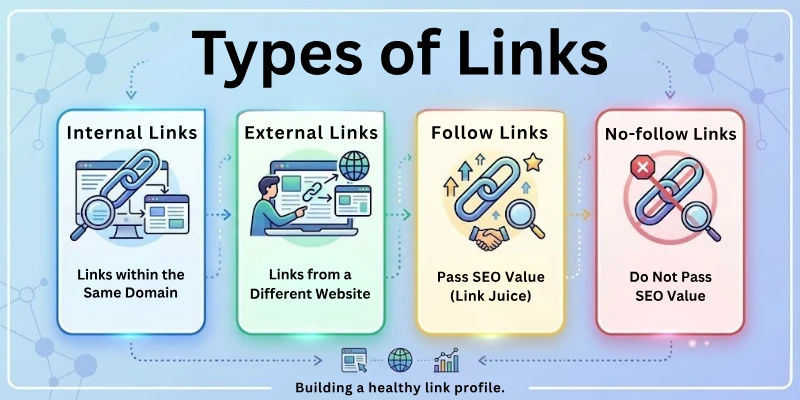
Below are the main link types you should know.
- Internal Link
- Inbound Link
- Outbound Link
Now let us explore each link type in detail.
1. Internal Link
Internal links are links that connect one page of your website to another page within the same website.
For example, if you write an article about SEO tools and inside that article you link to another post on your website about keyword research, that connection is called an internal link.
Internal linking is one of the easiest and most effective SEO strategies because you fully control it. You decide which pages link to each other and how the structure of your website is organized.
Search engines like Google use internal links to crawl websites and understand the structure of the content. When pages are properly linked together, search engines can discover them faster and index them more efficiently.
Another important benefit of internal links is that they help distribute authority across your website. If one page receives strong backlinks from other websites, internal linking allows some of that authority to pass to other pages.
This means you can boost the ranking potential of important pages simply by linking to them from other relevant pages.
Internal links also improve the user experience. When readers find helpful links within an article, they are more likely to explore additional content on your website.
This increases engagement and keeps visitors on your site for a longer time.
Why Internal Links Matter
There are several important reasons why internal links are essential for SEO.
- First, they help search engines discover new pages on your website.
- Second, they create a logical structure that makes your website easier to understand.
- Third, they help distribute ranking power across multiple pages.
Finally, they guide visitors to useful information and encourage them to explore more content.
Best Practices for Internal Linking
To get the most benefit from internal links, it is important to follow a few best practices.
Before creating internal links, you should always think about the user journey and how readers will move through your content.
Here are some important tips.
- Link to relevant pages that provide additional value
- Use descriptive anchor text instead of generic words
- Avoid adding too many links in a single paragraph
- Link to your most important pages regularly
- Keep your website structure organized and logical
From personal experience as an SEO content writer, I strongly recommend building a strong internal linking structure from the beginning. Many websites ignore this step and later struggle to organize their content properly.
If you plan your internal links carefully, your website becomes easier for both users and search engines to navigate.
2. Inbound Link
Inbound links are links that come from another website and point to your website. These are also commonly called backlinks.
For example, if another blog writes an article and includes a link to your website as a reference or recommendation, that link is an inbound link.
Inbound links are one of the most powerful ranking signals used by search engines. When reputable websites link to your content, search engines treat it as a sign that your content is trustworthy and valuable.
Think of inbound links as votes of confidence from other websites.
The more high quality backlinks you have, the stronger your website’s authority becomes.
However, not all inbound links are equal. Links from trusted and relevant websites are much more valuable than links from low quality or spammy sites.
Search engines analyze several factors to determine the value of an inbound link.
These factors include the authority of the linking website, the relevance of the content, and the context of the link.
Why Inbound Links Are Important
Inbound links play a major role in SEO because they help search engines measure credibility and trust. When multiple authoritative websites link to the same content, search engines assume that the content provides real value.
This can lead to higher rankings in search results.
Inbound links also help drive referral traffic. Visitors who click links from other websites can land directly on your pages.
This type of traffic is often highly targeted because users already have an interest in the topic.
How to Get Quality Inbound Links
Building strong inbound links requires effort and strategy. Before trying to acquire backlinks, the first step is always to create valuable and useful content.
When content solves real problems, other websites are more likely to reference it.
Some effective ways to earn inbound links include the following.
- Writing high quality blog posts
- Creating research based content
- Publishing detailed guides and tutorials
- Guest posting on reputable websites
- Building relationships with bloggers in your industry
From my experience, the best strategy is always to focus on content quality first. When your articles provide deep insights and practical solutions, other websites naturally start linking to them.
This approach builds long term authority and avoids risky link building techniques.
3. Outbound Link
Outbound links are links that point from your website to another external website.
For example, if you mention a research study or a helpful tool and include a link to that website, you are creating an outbound link.
Some website owners hesitate to use outbound links because they worry about sending visitors away from their site. However, when used correctly, outbound links can actually improve your SEO and build trust with readers.
Outbound links show search engines that your content is well researched and connected to other reliable sources.
They also help readers find additional information related to the topic they are learning about.
When you reference credible websites, it increases the overall quality of your content.
Why Outbound Links Are Helpful
Outbound links provide several important benefits for both SEO and user experience.
- First, they strengthen the credibility of your content by supporting claims with trusted sources.
- Second, they help readers explore additional resources and deepen their understanding of the topic.
- Third, search engines see outbound links as a sign that your content participates in a broader information network.
However, it is important to link only to reputable websites.
Linking to spammy or low quality sites can negatively affect your website’s reputation.
Best Practices for Outbound Linking
Before adding outbound links to your content, it is important to ensure they truly benefit the reader.
Here are some helpful recommendations.
- Link only to trusted and relevant websites
- Avoid linking to competitors unnecessarily
- Use outbound links when referencing data or research
- Make sure external links open in a new tab
- Check links regularly to ensure they are still active
Personally, I always recommend including outbound links when they add genuine value to the reader. It shows transparency and improves the credibility of your content.
Readers appreciate content that guides them to useful resources instead of keeping them isolated within a single page.
How the Different Types of Links Work Together
Understanding each link individually is important, but the real power comes when all link types work together.
- Internal links organize your website and guide users through your content.
- Inbound links build authority and help search engines trust your website.
- Outbound links strengthen your credibility by connecting your content with reliable sources.
When these link types are used strategically, they create a balanced and effective SEO strategy.
Many successful websites rank well because they combine all three link types in a natural and user friendly way.
Common Mistakes to Avoid When Using Links
Even though links are powerful for SEO, many websites use them incorrectly.
Avoiding common mistakes can help you maintain a strong and healthy linking structure.
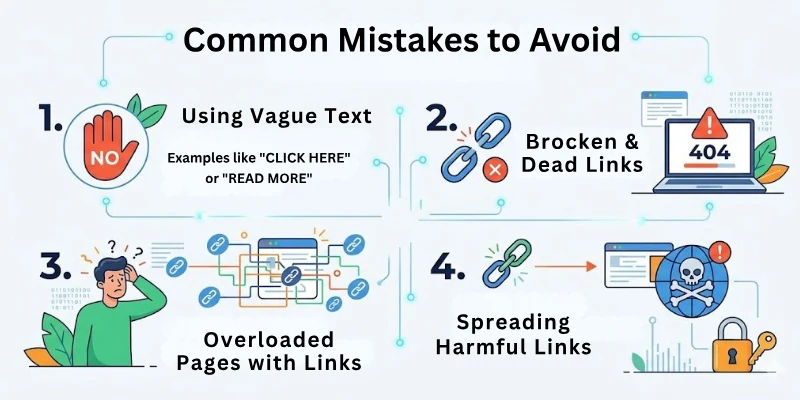
Before implementing links in your content, it is helpful to understand the mistakes that often reduce SEO performance.
Some of the most common issues include the following.
- Adding too many links that confuse readers
- Linking to irrelevant pages
- Using generic anchor text like click here
- Linking to low quality websites
- Ignoring internal linking opportunities
In my experience, the best approach is always to focus on usefulness. Every link should serve a purpose and provide additional value to the reader.
Comparison of Internal, Inbound, and Outbound Links
Here is a comparison table that represents the clear difference between these three basic types of links.
| Aspect | Internal Links | Inbound Links | Outbound Links |
| Direction | Links within the same website | Links pointing from external sites | Links pointing to external sites |
| Source | Generated within the website’s content | Links from other websites linking to yours | Links from your website to other sites |
| SEO Importance | Important for on-site SEO | Highly important for off-site SEO | Minimal impact on SEO ranking |
| User Navigation | Facilitates website navigation | Does not affect navigation | Redirects users to other sites |
| Link Juice Transfer | Helps distribute ranking power across pages | Passes authority & ranking power to your site | Passes authority & ranking power away |
| Usage | Used for cross-linking related content | Other sites find your content valuable | Directing users to related content |
| Relationship to SEO | Critical for site architecture and indexing | Aids in search engine discoverability & trust | Avoid excessive outbound links, which can harm SEO |
| Anchor Text | Often optimized with relevant keywords | Determined by external linking websites | Determined by your site |
| User Trust | Generally fosters higher trust | Can improve trust if from reputable sites | May affect trust depending on target sites |
| Possible Penalties | Over-optimization can lead to penalties | Poor-quality or spammy inbound links can hurt SEO | Excessive outbound links can be penalized |
Conclusion
Congratulations! You now understand the basic ideas behind the three main types of links: internal, inbound, and outbound. Your online profile will be stronger if you know how these links work and how important they are for SEO and user experience.
As you continue to build and improve your website, don’t forget to use:
- Internal links to enhance navigation
- Attract valuable inbound links to boost authority
- Leverage outbound links to provide credibility and additional resources to your audience.
So, guys, use these tips right away to make your website as useful as possible. Happy linking!
FAQs
Here are some of the most frequently asked questions related to types of links in SEO:
Internal links are links that connect pages within the same website, and they can have a positive effect on your SEO by enhancing navigation and distributing link authority.
Inbound links, also known as backlinks, are links pointing to your website from external websites. They are crucial for increasing the domain authority and search engine rankings of your website.
To attract high-quality inbound links, you should create valuable and shareable content, reach out to relevant websites for guest posting or collaborations, and ensure that your website provides a positive user experience.
Outbound links are links that direct the visitors of your website to external resources or references. By providing additional information and credibility, they can enhance the user experience.
Effective internal linking includes using descriptive anchor text, arranging content in a hierarchy, and making sure that all pages are easy to find using the site’s navigation.
The quality of inbound links is evaluated by search engines based on the authority and relevance of the linking site, the anchor text used, and the overall link profile.
Yes, outbound links can affect your search engine results indirectly by improving the user experience and your site’s credibility, but they don’t have much of an effect on SEO directly.
It’s important to find a good mix between the different kinds of links. Focus on making a strong structure for internal links, building a diverse profile of backlinks, and using outbound links when they are helpful and useful.
Avoid common backlink mistakes such as buying low-quality links, using manipulative link schemes, or excessively linking to irrelevant websites.
To get the best results, focus on internal links for navigation and user experience, work on getting high-quality inbound links, and use outbound links sparingly and carefully to support your content.





- Be Respectful
- Stay Relevant
- Stay Positive
- True Feedback
- Encourage Discussion
- Avoid Spamming
- No Fake News
- Don't Copy-Paste
- No Personal Attacks
- Be Respectful
- Stay Relevant
- Stay Positive
- True Feedback
- Encourage Discussion
- Avoid Spamming
- No Fake News
- Don't Copy-Paste
- No Personal Attacks
