What is Evergreen Content? Definition, Importance, Types & Tips
Published: 11 Feb 2026
Have you ever wondered why some blog posts continue to get traffic, clicks, and shares years after they are published, while others fade away within weeks? If the term evergreen content sounds confusing or unclear, don’t worry, you’re not alone.
Many content creators and marketers hear this phrase often but aren’t fully sure what it actually means or why it matters so much for long-term SEO success. This guide is designed to clear all that confusion and give you a complete understanding of what is evergreen content and how it works.
Inside this detailed guide, you’ll learn the definition of evergreen content, why it is important, the different types of evergreen content, proven tips to create it, and how to research evergreen topics that continue to deliver value over time.
So stay tuned, dear readers. We’re about to learn a lot!
What is Evergreen Content?
Evergreen content is content that is always relevant and useful, no matter when it was created. It’s like a good pair of jeans that never goes out of style.
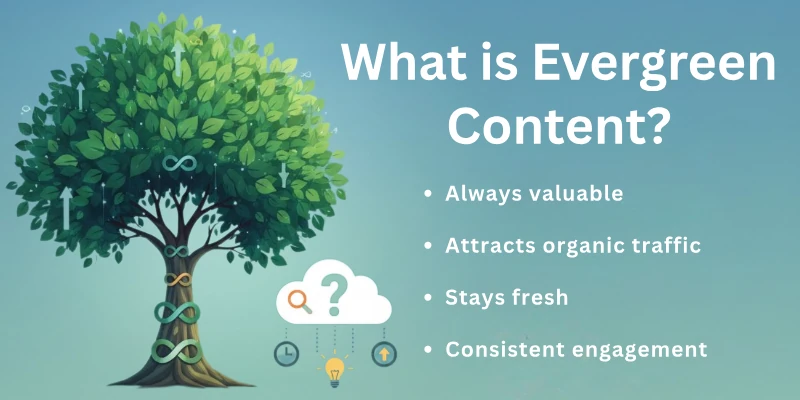
Here’s an example of evergreen content: a Wikipedia article about the history of the internet is evergreen content because it’s always relevant and informative. On the other hand, a news article about the latest celebrity gossip is not evergreen content because it will be outdated in a few days.
I hope now your definition regarding this evergreen is cleared up! In the next part, let me tell you about its importance!
Why Is Evergreen Content Important?
Evergreen content is important for several reasons in the realm of content marketing and online presence.
Here are some key reasons why this content holds significance:
- Lasting Relevance: Evergreen content remains valuable and relevant over time.
- Consistent Traffic: It provides a steady stream of traffic to your website.
- SEO-Friendly: Search engines favor evergreen content, leading to better rankings.
- Continuous Audience Growth: It attracts new readers long after publication.
- Time Efficiency: Requires less ongoing maintenance compared to time-sensitive content.
- Authority Building: Establishes your expertise and credibility in your niche.
- Shareability: Readers often share evergreen content, leading to organic growth.
- Monetization Opportunities: Can be a source of income through various methods.
- Reduced Bounce Rate: Keeps visitors engaged and exploring your site.
Types of Evergreen Content
Here’s a list of types of evergreen content with just their explanation.
- How-to Guides
- Tutorials
- FAQs
- Top 10 Lists
- Historical Articles
- Glossaries
- Resource Directories
- Case Studies
- Expert Interviews
- Beginner’s Guides
- Troubleshooting Guides
- Best Practices
- Educational Courses
- DIY Projects
- Health and Wellness Tips
- Recipes
- Travel Guides
- Financial Planning Advice
- Life Hacks
- Podcasts and Webinars
- Infographics
Let’s start covering each in detail.
1. How-to Guides
How-to guides are instructional pieces that explain step-by-step how to accomplish a task, solve a problem, or achieve a goal.
- Importance: These guides offer enduring value because they provide practical solutions to common problems.
- How: By offering clear instructions and focusing on universal tasks or skills.
- Example: “How to Start a Blog” – This guide outlines the steps to create a blog, a skill people will always be interested in.
2. Tutorials
Tutorials provide detailed, hands-on instructions for learning a new skill, using a tool, or mastering a software.
- Importance: They empower readers with knowledge and skills, making them invaluable.
- How: By breaking down complex processes into manageable steps.
- Example: “Adobe Photoshop Tutorial: Beginner’s Guide to Photo Editing” – This tutorial helps users learn a widely used software.
3. FAQs (Frequently Asked Questions)
FAQs answer common questions about a topic or product.
- Importance: They address user queries and offer instant solutions.
- How: By compiling and answering recurring questions.
- Example: ” SEO FAQ: All Your Search Engine Optimization Questions Answered” – This FAQ tackles common SEO inquiries.
4. Top 10 Lists
Top 10 lists highlight the best options or examples within a category.
- Importance: They help users make decisions or discover popular choices.
- How: By presenting a curated selection of items or ideas.
- Example: “Top 10 Must-Read Science Fiction Novels” – This list showcases perennially loved books in the genre.
5. Historical Articles
Historical articles delve into events, people, or eras from the past.
- Importance: They provide insights into the past, which remains eternally fascinating.
- How: By researching and presenting well-documented historical accounts.
- Example: “The Roaring Twenties: A Decade of Social and Cultural Change” – An article about a significant historical era.
6. Glossaries
Glossaries are lists of terms and their explanations, often within a specific field.
- Importance: They aid in understanding specialized terminology.
- How: By defining and organizing terms alphabetically.
- Example: “Investment Glossary: Key Terms Every Investor Should Know” – A glossary for the financial sector.
7. Resource Directories
Resource directories compile links and information about various resources related to a specific topic.
- Importance: They offer a one-stop reference for users seeking information.
- How: By categorizing and updating resource listings.
- Example: “Ultimate Web Design Resources: Tools, Tutorials, and Inspiration” – A directory for web designers.
8. Case Studies
Case studies examine real-life situations, providing in-depth analysis and solutions.
- Importance: They showcase practical problem-solving and decision-making.
- How: By investigating, documenting, and sharing specific cases.
- Example: “Marketing Case Study: How Company X Increased Conversions by 50%” – A business success story.
9. Expert Interviews
Expert interviews feature discussions with knowledgeable individuals in a particular field.
- Importance: They offer insights and expertise from authoritative sources.
- How: By conducting interviews or Q&A sessions with experts.
- Example: “Interview with Astrophysicist Dr. Jane Smith: Exploring the Mysteries of the Universe” – An interview with a renowned scientist.
10. Beginner’s Guides
Beginner’s guides are comprehensive introductions to a particular subject for individuals who are new or unfamiliar with it.
- Importance: They help newcomers grasp fundamental concepts and get started.
- How: By presenting information in a clear, approachable manner.
- Example: “Beginner’s Guide to Local SEO” – A guide for those new to the world of online business and SEO.
11. Troubleshooting Guides
Troubleshooting guides assist users in identifying and resolving common problems or issues.
- Importance: They offer solutions to frequent challenges, saving time and frustration.
- How: By providing step-by-step instructions for diagnosing and fixing issues.
- Example: “Troubleshooting Your Home Wi-Fi Network: Common Problems and Fixes” – A guide to resolving Wi-Fi connectivity problems.
12. Best Practices
Best practices content outlines recommended methods, strategies, or techniques for achieving optimal results in a specific area.
- Importance: It helps readers excel in their endeavors by following proven approaches.
- How: By sharing expert-recommended methods and tips.
- Example: “Email Marketing Best Practices: Boosting Your Campaign’s Effectiveness” – A guide to optimizing email marketing efforts.
13. Educational Courses
Educational courses are structured learning modules that teach a subject comprehensively.
- Importance: They provide a structured, in-depth education in a specific topic.
- How: By creating a curriculum with lessons, assignments, and assessments.
- Example: “Digital Photography 101: A Free Online Course for Beginners” – A full photography course available online.
14. DIY (Do-It-Yourself) Projects
DIY projects provide instructions for creating or building something on your own.
- Importance: They encourage creativity and hands-on skills.
- How: By offering step-by-step instructions and materials lists.
- Example: “DIY Home Garden: How to Build Your Own Raised Bed” – A guide to constructing a raised garden bed.
15. Health and Wellness Tips
Health and wellness tips content offers guidance on maintaining physical and mental well-being.
- Importance: It promotes a healthier lifestyle and self-care practices.
- How: By sharing advice on nutrition, fitness, mental health, and more.
- Example: “10 Tips for a Healthier Lifestyle: Easy Changes for Better Well-Being” – A list of actionable wellness tips.
16. Recipes
Recipe content presents instructions for preparing specific dishes or beverages.
- Importance: Recipes cater to a timeless human need for sustenance and culinary exploration.
- How: By listing ingredients, providing step-by-step cooking instructions.
- Example: “Classic Homemade Lasagna Recipe: Comfort Food at Its Best” – A recipe for a popular Italian dish.
17. Travel Guides
Travel guides offer information and recommendations for exploring specific destinations.
- Importance: They aid travelers in planning trips and discovering new places.
- How: By covering points of interest, accommodations, dining, and activities.
- Example: “Traveler’s Guide to Paris: Exploring the City of Lights” – A comprehensive guide to visiting Paris.
18. Financial Planning Advice
Financial planning advice content provides insights and strategies for managing money, investments, and financial goals.
- Importance: It helps individuals make informed financial decisions and secure their future.
- How: By offering tips, strategies, and expert insights on financial matters.
- Example: “Retirement Planning 101: A Guide to Securing Your Financial Future” – Advice on planning for retirement.
19. Life Hacks
Life hacks share clever, practical tips and tricks for making everyday life more efficient or enjoyable.
- Importance: They offer ingenious shortcuts for common challenges.
- How: By presenting innovative solutions to everyday problems.
- Example: “20 Life Hacks to Simplify Your Daily Routine” – A collection of time-saving and convenience-boosting hacks.
20. Podcasts and Webinars
Podcasts and webinars are audio or video content formats featuring discussions, interviews, presentations, or lectures on specific topics.
- Importance: They offer an interactive and convenient way to convey information and insights.
- How: By recording and sharing audio or video content that can be accessed and revisited at any time.
- Example: A podcast series on “Personal Finance Tips” or a webinar titled “Digital Marketing Strategies for Small Businesses”.
21. Infographics
Infographics are visual representations of data, information, or processes designed to be easily understood at a glance.
- Importance: They simplify complex information and engage users with visually appealing content.
- How: By creating graphical representations using charts, images, and concise text.
- Example: An infographic displaying “10 Ways to Reduce Energy Consumption at Home” or a data visualization illustrating “The Evolution of Technology”.
NOTE: The above mentioned content is considered as evergreen content because they focus on timeless topics and concepts. They provide alternative formats for presenting information, catering to different learning and engagement preferences among your audience.
How to Research for Evergreen Content
When I first started researching evergreen content, I thought it was complicated. But honestly, it’s more about thinking long-term and putting yourself in your audience’s shoes. Evergreen research means asking one simple question: “Will people still search for this a year or two from now?” If the answer feels like yes, you’re on the right track.
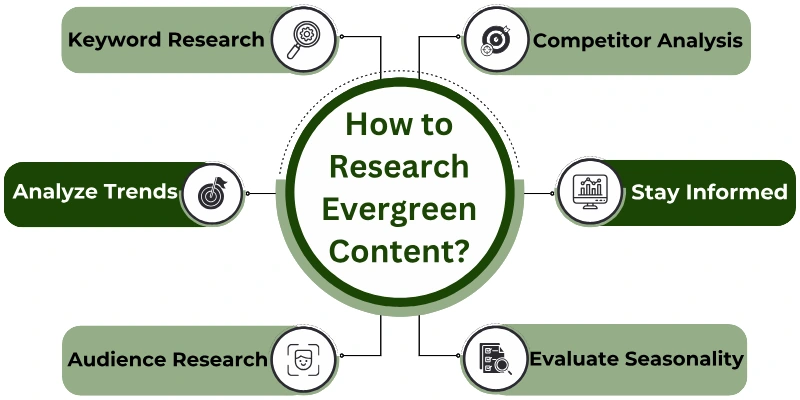
Let me walk you through how I personally approach it, step by step.
- Keyword Research
- Analyze Trends
- Audience Research
- Competitor Analysis
- Use Evergreen Tools
- Stay Informed
- Check Historical Content
- Consider Comprehensive Guides
- Search Engines
- Evaluate Seasonality
Let me guide you through each step.
1. Keyword Research
I always begin with keyword research because it shows what people are actually searching for, not what we assume they want. I use tools like Google Keyword Planner or Ubersuggest and look for keywords that feel timeless. These are the kinds of searches people make again and again, regardless of trends. If a keyword solves a common problem, it usually has evergreen potential.
- Focus on keywords with steady searches
- Avoid keywords linked to news or specific dates
- Choose problem-based or “how-to” searches
2. Analyze Trends
Before committing to a topic, I quickly check Google Trends. This helps me see whether interest stays stable or rises slowly over time. If I notice a sudden spike and then a sharp drop, I know it’s probably trend-based. Evergreen topics usually look calm and consistent on the graph.
- Check long-term trend data
- Avoid sharp rises and quick drops
- Choose topics with steady interest
3. Audience Research
This part is very personal for me because evergreen content comes from understanding people. I pay attention to what my audience keeps asking again and again. Forums, comments, and social media discussions are full of evergreen ideas. If people have the same questions year after year, that topic is worth covering.
- Read comments and questions carefully
- Explore forums and Q&A platforms
- Notice repeated problems or concerns
4. Competitor Analysis
I also like learning from competitors, not copying, but observing. I check which of their posts are still performing well after a long time. Then I ask myself how I can explain the same topic more clearly or deeply. This mindset helps me create better evergreen content.
- Review competitors’ long-lasting posts
- Look for gaps or outdated info
- Improve clarity and depth
5. Use Evergreen Tools
Sometimes I use tools like AnswerThePublic or BuzzSumo to spark ideas. These tools show real questions people are asking regularly. When I see the same type of question repeated in different ways, I know it’s evergreen. It saves time and gives confidence in topic selection.
- Find commonly asked questions
- Spot recurring audience interests
- Use tools for idea validation
6. Stay Informed
Staying informed doesn’t mean chasing every update. I simply stay connected to my niche and observe what topics never seem to disappear. The more you read and learn, the easier it becomes to spot evergreen ideas naturally. Over time, this skill becomes intuitive.
- Follow trusted blogs or creators
- Observe long-term discussions
- Focus on fundamentals, not hype
7. Check Historical Content
Sometimes the best evergreen ideas are already sitting on your website. I review old posts and see which ones still get visits. With small updates, those posts can become powerful evergreen assets again. Refreshing content is easier than creating from scratch.
- Check old posts with steady traffic
- Update examples and information
- Improve readability and SEO
8. Consider Comprehensive Guides
I’ve noticed that beginner guides and complete explanations always perform well. People are constantly searching for clear and simple explanations. When you explain a topic properly, it stays useful for a long time. These guides also help build trust.
- Create step-by-step guides
- Focus on core concepts
- Explain things simply
9. Search Engines
One simple trick I use is searching the topic on Google. If I see articles from years ago still ranking, that’s a green signal. It means the topic hasn’t lost its value. Search engines often tell you whether a topic is evergreen or not.
- Check ranking articles’ age
- Review content relevance
- Validate evergreen potential
10. Evaluate Seasonality
I try to be careful with seasonal topics. Some ideas only work for a short time. But if I focus on the concept instead of the season itself, the content can still be evergreen. It’s all about angle and presentation.
- Avoid time-limited topics
- Focus on general knowledge
- Turn seasonal ideas into timeless ones
Tips for Creating Evergreen Content
Follow these tips to create evergreen content for your site:
- Ensure your content is well-researched, accurate, and comprehensive. It should be a go-to resource on the chosen topic.
- Focus on writing high-quality, well-structured articles that are easy to read and understand.
- Use engaging and timeless headlines. Avoid clickbait or time-sensitive phrases in your titles.
- Incorporate visuals like images, infographics, and videos to enhance the content’s appeal.
- Organize your content logically, using headers, bullet points, and subheadings for easy navigation.
- Link to authoritative sources and cite your references to boost credibility.
- Make your content shareable by including social media sharing buttons.
- Update and refresh your evergreen content periodically to keep it current and relevant.
How to Maintain Your Evergreen Content Ranking
By following these steps you can make your evergreen content forever shining in SERPS:
- Regularly review your evergreen content to ensure that it remains up-to-date. Update information, statistics, and examples as needed.
- Keep an eye on changes in search engine algorithms and adjust your content accordingly to maintain SEO rankings.
- Encourage user engagement by responding to comments, questions, and feedback on your evergreen content.
- Promote your evergreen content on social media and through email marketing to continue attracting traffic.
- Monitor your content’s performance using analytics tools to identify areas for improvement and growth.
- Consider repurposing your evergreen content into different formats, such as videos, podcasts, or slideshows, to reach a wider audience.
- Interlink your evergreen content with related articles on your website to keep readers exploring and spending more time on your site.
- Seek backlinks from authoritative sources to enhance the credibility and SEO value of your evergreen content.
Conclusion
So, guys, you’ve learned in this article that evergreen content is timeless, valuable material that remains relevant to your audience long after it’s published. It provides consistent traffic, SEO advantages, and audience growth.
So, as you move forward, keep in mind that the ability to address universal questions, concerns, and interests in your niche is the key to creating content with long-term relevance.
FAQs: What is Evergreen Content
Here are some of the most commonly asked questions related to the what is evergreen content:
Evergreen content is content that remains relevant and valuable over time, while trending content is content that is popular for a short period of time.
Some common mistakes to avoid when creating evergreen content include:
- Writing content that is too promotional.
- Writing content that is not informative or engaging.
- Not updating your content regularly.
- Not promoting your content.
Evergreen content is also known as:
- Long-tail content
- Perpetual content
- Ageless content
- Timeless content
- Sustainable content
- Classic content
- Pillar content
There is no one-size-fits-all answer to this question. However, it is generally recommended that you publish new evergreen content at least once a month.
You can track the performance of your evergreen content using a variety of tools and resources, such as Google Analytics, HubSpot, and Salesforce. Some key metrics to track include:
- Website traffic
- Engagement
- Leads generated
- Sales generated
- Backlinks



- Be Respectful
- Stay Relevant
- Stay Positive
- True Feedback
- Encourage Discussion
- Avoid Spamming
- No Fake News
- Don't Copy-Paste
- No Personal Attacks
- Be Respectful
- Stay Relevant
- Stay Positive
- True Feedback
- Encourage Discussion
- Avoid Spamming
- No Fake News
- Don't Copy-Paste
- No Personal Attacks
