What is a Pillar Page? Importance, Creation & Types
Published: 2 Jan 2026
Have you ever wondered, “What is a Pillar Page”?
It’s a large, important page on your website that goes into great detail about a broad subject. It’s the foundation of your website’s content, and it’s intended to help you rank higher in search engine results pages (SERPs).
In this blog article, we will explain pillar pages in detail. We’ll explain what they are, why they’re important, and how to make your own. We’ll also go over how to use pillar pages to increase the SEO of your website.
So, what are you waiting for? Let us begin!
What Is a Pillar Page?
On your website, a foundation page known as a “pillar page” focuses on covering a core topic in great detail. It functions similarly to the backbone of the content on your website, linking to associated cluster pages that offer a more in-depth look at particular subject areas.
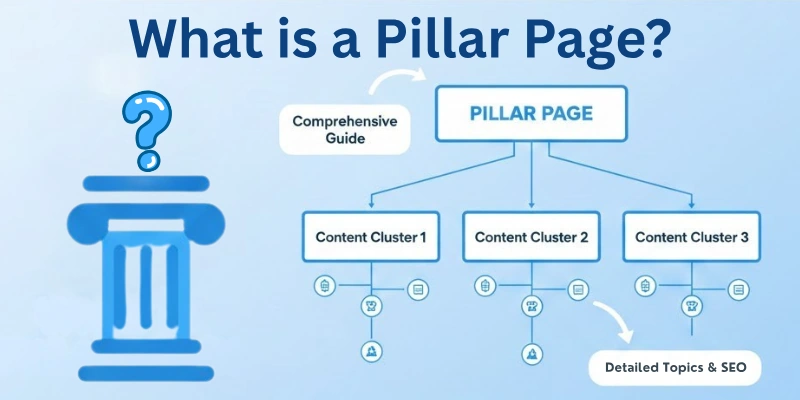
These pages let you demonstrate to search engines and users that you are an authority on a certain subject, and they can deliver a large amount of traffic to your website.
Here you have learned about the definition of pillar page, but I know that some confusion is still stuck in your mind, so to give you a more clear view, let me give you an example.
Example of Pillar page
Site: smseo.com
Main keyword for Pillar Page: SEO Guide
Pillar page: https://smseo.com/seo-guide
Other pillar pages on the same site:
- Keyword research guide
- On-page SEO guide
- Off-page SEO Guide
- Technical SEO guide
- Local SEO guide
These pillar pages cover all the major aspects of SEO, providing users with a comprehensive overview of the topic. They are also all linked to each other, which helps SMSEO to establish itself as an authoritative resource on SEO.
Example of pillar pages for a site whose niche is SEO Guide:
Pillar page 1
- SEO Basics: A Complete Guide for Beginners
Cluster pages will be:
- What is SEO?
- How do search engines work?
- How to choose the right keywords for your SEO campaign
- How to write SEO-friendly content
- How to optimize your website’s on-page SEO
Pillar page 2
- Keyword Research: The Ultimate Guide
Cluster pages will be:
- How to do keyword research
- What are long-tail keywords?
- How to choose the right keywords to target
These are just a few examples of pillar pages that you could create for a site whose niche is SEO Guide. You can fit the specific topics to your own expertise and interests.
Importance of Pillar Pages
Guys, let me tell you that pillar pages are super important for your website. Now you may be wondering if it is so important that it touches its peak…… exactly yes, man.
These points will show you the clear and vital importance of pillar pages for your site.
- Boosts your website’s topical authority: Pillar pages allow you to show to search engines and users your expertise on a specific niche. When your website has high-quality pillar pages, you’re more likely to rank higher in SERPs for related keywords.
- Attracts more visitors to your website: Pillar pages are frequently the first pages that users see when searching for information on a specific topic. You may increase the number of visits to your website by developing thorough and interesting pillar pages.
- Increases your conversion rate: Pillar pages can help you convert more people into buyers by offering them with all of the information they need to make a decision. Users are more likely to take action when they have all of the information they need in one place.
- Improves your website’s SEO: Pillar pages can boost your website’s SEO in many ways. Their first purpose is to target relevant keywords and phrases. Second, they help establish better-organized website architecture. Third, they increase engagement and improve bounce rate and dwell time on your website.
So for SEO beginners here, you can state that without pillar pages, your website is like a book with sub-topics but missing the main title.
How to Create a Pillar Page?
Here are some steps to create a pillar page:
- Choose a topic
- Identify related keywords and subtopics
- Create a content outline
- Write your pillar page
- Optimize your pillar page for SEO
- Add internal links to your cluster pages
- Promote your pillar page
Now, let’s cover each step in detail.
Step 1: Choose a Topic
Your pillar page should cover a topic that is relevant to your target audience and about which you are informed. It should also be a topic on which you can write deeply and make several cluster pages.
For example, if your site is about SEO, your pillar page could be about “SEO Basics” This is a broad topic that you could write about in great detail, and you could create cluster pages around specific aspects of digital marketing, such as On-page SEO, Off-page SEO, Technical SEO, Local SEO , etc.
Step 2: Identify Related Keywords and Subtopics
Once you have chosen a topic, you need to identify the related keywords and subtopics that you want to cover on your pillar page and cluster pages. You can use a keyword research tool to help you with this task.
For example, if your pillar page is about ” SEO Basics,” some of the related keywords and subtopics that you might want to cover include:
Niche Research
- How to do niche research?
- Advantages and disadvantages of niche research
- Parameters of niche research
On-page SEO
- What is meta title?
- What is post title?
- What is meta description?
Off-page SEO
- Types of SEO Links
- What is Link Building?
- Do-follow vs. No-follow Backlinks
Or
- Technical SEO
- Local SEO
- E-commerce SEO
Step 3: Create a Content Outline
After you have a list of keywords and subtopics, you need to plan out what will be on your main page. This will help you arrange your ideas and make sure that your main page talks about all the important parts of the topic you chose.
Your content outline should include the following sections:
- Introduction: This section should introduce the topic of your pillar page and provide a brief overview of the subtopics that you will be covering.
- Body: This section should cover all of the subtopics that you identified in step 2. Each subtopic should have its own heading, and you should use subheadings to break up each subtopic into smaller chunks of text.
- Conclusion: This section should summarize the main points of your pillar page and provide a call to action for your readers.
Step 4: Write your Pillar Page
When writing your pillar page, be sure to:
- Write in a clear and concise style.
- Use headings and subheadings to break up your text and make it easy to read.
- Include relevant keywords and phrases throughout your text.
- Provide links to your cluster pages for more detailed information.
Your pillar page should be broad and informative, but also simple to read and scan. Break up the content with bullet points and numbered lists to make it easier for readers to find the information they need.
Step 5: Optimize your Pillar Page for SEO
Once you have written your pillar page, you need to optimize it for SEO. This includes:
- Using the right keywords and phrases in your title tag, meta description, and throughout your text.
- Creating high-quality backlinks to your pillar page.
Your title tag and meta description are the first things searchers see when they find your pillar page, so make them interesting and relevant. Title tags and meta descriptions should be 60 and 155 characters, respectively.
Backlinks are links that go from one page to another. Search engines can tell that your website is reliable and authoritative if it has backlinks.
Step 6: Add Internal Links to Your Cluster Pages
Internal linking is an important part of SEO. It helps search engines to understand the structure of your website and the relationship between your different pages.
To add internal links to your cluster pages, simply link to the relevant cluster page from your pillar page when you mention the relevant keyword or phrase. For example, if your pillar page is about “SEO Basics” and you have a cluster page about “what is SEO,” you would link to the SEO cluster page from your pillar page whenever you mention the keyword “SEO.”
Step 7: Promote your Pillar Page
Once your pillar page is published, you need to promote it on social media, in your email newsletter, and through other channels. This will help to increase traffic to your pillar page and improve your SEO.
You can also promote your pillar page by submitting it to relevant websites and directories. For example, if you have a pillar page about “SEO Basics,” you could submit it to the Search Engine Land, Moz, Ahrefs, etc.
Types of Pillar Pages
There are six main types of pillar pages:
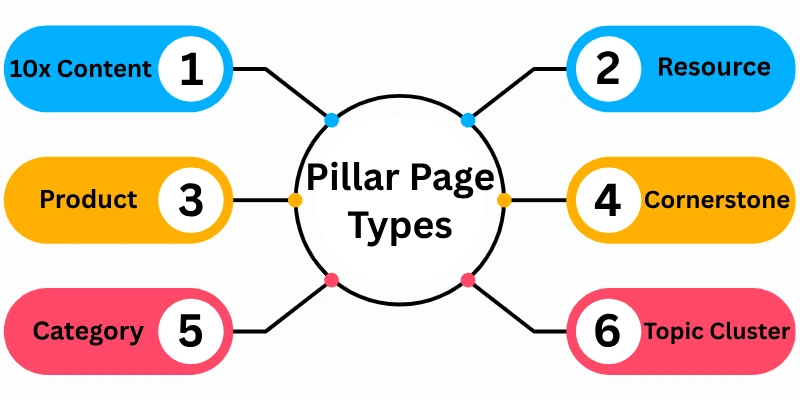
- 10x Content Pillar Pages
- Resource Pillar Pages
- Product or Service Pillar Pages
- Cornerstone Pillar Pages
- Category Pillar Pages
- Topic Cluster Pillar Pages
Let’s learn each.
1. 10x Content Pillar Pages
10x content pillar pages are the most in-depth sort of pillar page. They are intended to be the definitive resource on a certain topic. 10x content pillar pages often cover a wide range of subtopics linked to the primary topic. They are also frequently written by specialists in the field.
Here are some examples of 10x content pillar pages:
- Ultimate Guide to SEO
- How to Start a Blog: A Step-by-Step Guide
- The Complete Guide to Social Media Marketing
- How to Build a Successful Online Business
2. Resource Pillar Pages
The purpose of resource pillar web pages is to provide a one-stop shop for information on a specific topic. They often feature links to articles, blog posts, videos, infographics, and tools, among other things. Although resource pillar sites are sometimes shorter than 10x content pillar pages, they should nonetheless be complete and useful.
Here are some examples of resource pillar pages:
- SEO Resources
- Blogging Resources
- Social Media Marketing Resources
- Weight Loss Resources
- Online Business Resources
3. Product or Service Pillar Pages
Product or service pillar pages are intended to promote a single product or service. They often include product or service information such as features, benefits, and pricing. Testimonials and consumer reviews are frequently included on product or service pillar pages.
Here are some examples of product or service pillar pages:
- Weight Loss Program
- Blogging Platform
- Social Media Management Tool
- Online Business Coaching
4. Cornerstone Pillar Pages
Cornerstone pillar pages are the most significant pillar pages of a website. They are often the most extensive and in-depth, and they cover the most significant issues for the website’s target audience. Cornerstone pillar pages are often used to build authority and credibility for the website.
Here are some examples of cornerstone pillar pages:
- About Us
- Our Services
- Our Blog
- Our Contact Page
5. Category Pillar Pages
Category pillar pages address a wide range of topics. A website about health and fitness, for example, might include a “fitness” category pillar page. This page would link to sub-pillar pages covering specific fitness subjects like “weight loss,” “muscle building,” and “cardio.”
Here are some examples of category pillar pages:
- Fitness
- Health
- Nutrition
- Lifestyle
6. Topic Cluster Pillar Pages
Topic cluster pillar pages are similar to category pillar pages, however they are more focused on a certain topic. A marketing website, for example, might contain a “SEO” topic cluster pillar page. This page would link to sub-pillar pages on various SEO issues like “keyword research,” “link building,” and “content marketing.”
Here are some examples of topic cluster pillar pages:
- SEO
- Content Marketing
- Social Media Marketing
- Email Marketing
Conclusion
In this blog post, you have learned all about the pillar pages on the website. You have come to know that pillar pages are like the superheroes of your website. They’re the ones that do all the heavy lifting, driving traffic, generating leads, and making you look like a total boss.
So, if you’re serious about taking your website to the next level, then you need to create some epic pillar pages.
FAQs: What is a Pillar Page
Here are the most frequently asked questions related to the pillar pages on the website:
Depending on the extent and scope of the website, there can be any number of pillar pages. However, it is generally preferable to have a limited number of pillar pages, each of which covers a wide topic in depth.
No, most websites require more than one pillar page. A single pillar page cannot cover all of the topics that are relevant to a website. It is preferable to have numerous pillar pages, each covering a distinct major topic.
Yes, pillar pages can rank well in search engines. However, it is critical to optimize the pillar pages for the terms that are high in competition. Furthermore, the pillar pages should be high-quality and informative, providing users with useful content.
Well, no worries, but if your website has no pillar pages, you are missing out on an opportunity to increase your website’s SEO, topical authority, and user experience. Pillar pages can help you rank higher in search engines, attract more visitors to your website, and keep people on your website for longer.
Pillar pages can be difficult to rank due to high competition, but it is not impossible. To increase your chances of ranking your pillar pages, optimize them for the proper keywords and create helpful content that is informational and interesting to users.





- Be Respectful
- Stay Relevant
- Stay Positive
- True Feedback
- Encourage Discussion
- Avoid Spamming
- No Fake News
- Don't Copy-Paste
- No Personal Attacks
- Be Respectful
- Stay Relevant
- Stay Positive
- True Feedback
- Encourage Discussion
- Avoid Spamming
- No Fake News
- Don't Copy-Paste
- No Personal Attacks
