Trust Flow and Citation Flow: Simple Guide to TF vs CF in SEO
Published: 1 Apr 2026
Are you wondering why some websites rank higher on search engines while others struggle to get traffic? Many people think SEO is only about keywords and content. But in reality, backlinks play a very important role in SEO success.
Search engines look at many signals to decide whether a website is trustworthy and valuable. Two important metrics that help SEO professionals understand backlink quality are Trust Flow (TF) and Citation Flow (CF).
These metrics help measure how strong and reliable a website’s backlink profile is. They show whether a website is getting links from trusted sources or simply collecting many links without quality.
In this guide, you will learn:
- What Trust Flow (TF) means
- What Citation Flow (CF) means
- How both metrics work
- The difference between TF and CF
- Best practices to improve these SEO metrics
By the end of this guide, you will clearly understand how trust flow and citation flow influence your website’s SEO performance and search rankings.
What is Trust Flow (TF)?
Trust Flow is a metric created by the SEO tool Majestic SEO. It measures how trustworthy a website’s backlinks are. In simple words, Trust Flow shows the quality of links pointing to your website.
The main idea behind Trust Flow is simple: Trusted websites usually link to other trusted websites.

For example, if a well-known website links to your site, search engines consider that link valuable. But if your site receives links from spammy or low-quality websites, your trust level becomes weaker.
Because of this, Trust Flow focuses mainly on link quality instead of link quantity.
When your website receives backlinks from high-authority and reliable websites, your Trust Flow score increases. This means your website is seen as more trustworthy in the SEO world.
Factors Influencing Trust Flow
The main factors influencing Trust Flow (TF) include:
- Domain Authority and Trustworthiness
- Quality and Relevance of Backlinks
- Overall Link Profile Health
Let’s learn each in detail.
1. Domain Authority and Trustworthiness
The reputation of the website linking to you matters a lot.
Search engines evaluate the overall credibility of a website before considering its links valuable.
Many factors contribute to the trust level of a domain, such as:
- Website age
- Website history
- Content quality
- Industry reputation
- Backlink profile
Older websites with a strong reputation are usually considered more trustworthy.
When a high-authority website links to your site, some of that trust is passed to you. As a result, your Trust Flow score improves.
On the other hand, links from newly created or suspicious websites usually do not improve trust.
2. Quality and Relevance of Backlinks
Not all backlinks have the same value.
Some links can strongly improve your website authority, while others may provide little benefit.
High-quality backlinks usually come from:
- Well-known websites
- Industry experts
- Popular blogs
- Trusted news platforms
These links signal to search engines that your website contains useful and reliable information.
Relevance is also very important.
For example, if you run a digital marketing website, backlinks from marketing blogs are more valuable than links from unrelated industries like cooking or gaming.
When backlinks come from websites that are closely related to your niche, search engines understand that your content is more credible.
3. Overall Link Profile Health
A website’s link profile refers to the complete collection of backlinks pointing to that site.
A healthy link profile usually includes:
- Backlinks from different websites
- Links from relevant industries
- Natural editorial links
- Contextual links within articles
Having a diverse mix of links looks more natural to search engines.
However, if your backlink profile contains too many spam links, paid links, or irrelevant links, it can damage your Trust Flow.
This is why SEO experts regularly check their backlink profiles and remove harmful links.
Benefits of Trust Flow
Having a strong Trust Flow score offers many benefits for websites. Trust Flow does not just measure links. It also provides useful insights about your website’s credibility and authority.
Here are the main advantages of a high Trust Flow score:
- First, Trust Flow helps determine the reliability of your backlink profile. When your TF score is high, it usually means your website receives links from trustworthy sources.
- Second, websites with high Trust Flow often perform better in search engine rankings. Search engines prefer websites that are connected with other reputable sites.
- Another benefit is that Trust Flow helps identify strong link-building opportunities. By studying websites with high TF in your industry, you can discover potential places to earn valuable backlinks.
- Trust Flow also helps businesses choose reliable websites for partnerships, collaborations, and guest posting opportunities.
Finally, monitoring your TF score over time helps you track whether your link-building strategies are working or not.
Limitations of Trust Flow
Although Trust Flow is a helpful SEO metric, it is not perfect. Like any tool, it has some limitations.
Understanding these limitations will help you use the metric more wisely.
- First, Trust Flow focuses mainly on domain-level trust. It does not always evaluate the quality of individual pages on a website.
- Second, it does not analyze content quality or user experience. A website might have strong backlinks but still provide poor content.
- Another limitation is that TF does not measure user engagement signals, such as bounce rate, time on page, or click-through rate.
In rare cases, some websites may manipulate links to artificially improve their Trust Flow score. Because of this, TF should always be used together with other SEO metrics.
What is Citation Flow (CF)?
Citation Flow is another metric created by Majestic SEO. Unlike Trust Flow, Citation Flow measures the number of backlinks pointing to a website.
In simple terms, Citation Flow focuses on link quantity rather than link quality.
The idea is straightforward: If many websites link to a particular website, that website may appear more popular or influential.
When your website receives more backlinks, your Citation Flow score increases.
However, Citation Flow does not evaluate whether those links are trustworthy, relevant, or spammy. It simply counts how many links exist.
Because of this, a website may have a high Citation Flow but still have weak link quality. This is why SEO experts always analyze Citation Flow together with Trust Flow.
Factors Influencing Citation Flow
Here are some factors that influence citation flow:
- Link Quantity and Volume
- Link Growth and Velocity
- Link Relevancy and Context
Let me provide some additional details on each of these factors.
1. Link Quantity and Volume
The most important factor in Citation Flow is the total number of backlinks. When a website receives many backlinks from different sources, its CF score usually increases.
For example, a website that receives links from hundreds of blogs, forums, directories, and articles will likely have a higher CF score.
However, it is important to remember that more links do not always mean better SEO performance. Link quality still matters.
2. Link Growth and Velocity
Link velocity refers to how quickly a website gains new backlinks. If a website steadily earns backlinks over time, it usually indicates natural growth.
Search engines often see this as a positive sign because it shows that people genuinely find the content valuable.
However, if a website suddenly receives thousands of backlinks within a short time, it may raise suspicion of spam or artificial link building.
Such unnatural growth patterns can sometimes harm SEO performance.
3. Link Relevancy and Context
Even though Citation Flow mainly measures link quantity, the context of links can still influence overall link value.
Backlinks coming from websites within the same industry or niche usually provide more meaningful signals to search engines.
For example:
- A marketing blog linking to another marketing website makes sense.
- A random unrelated site linking to a marketing website may not be as valuable.
Relevant links help search engines understand the relationship between websites and the topics they cover.
Benefits of Citation Flow
Citation Flow provides several useful insights for SEO professionals.
It helps measure how widely a website is mentioned across the internet.
Here are some benefits of Citation Flow:
- First, Citation Flow gives a quick overview of link popularity. A higher score means the website is receiving a large number of backlinks.
- Second, it helps identify popular websites within a specific niche. Websites with higher CF scores often have strong online visibility.
- Citation Flow also helps track backlink growth over time. If your CF score increases gradually, it means your website is gaining more references across the web.
- Another advantage is that CF can help identify link-building opportunities. Websites with strong CF may be good targets for outreach and partnerships.
Finally, it allows quick comparison between different websites to understand their relative influence.
Limitations of Citation Flow
Although Citation Flow is useful, it has several weaknesses:
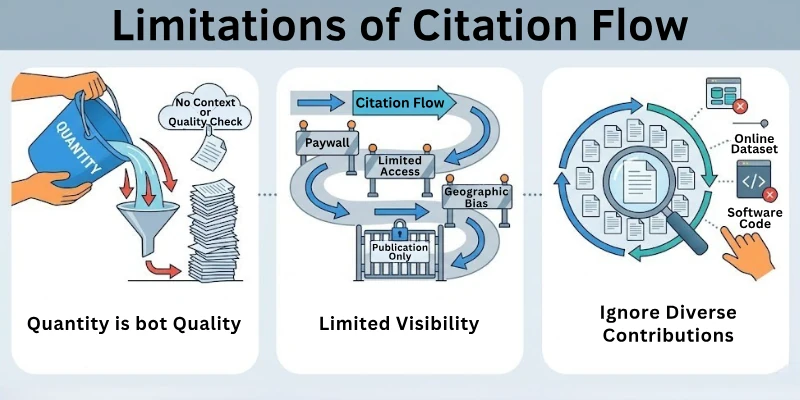
- First, CF focuses only on the number of backlinks, not their quality.
- This means a website could gain thousands of low-quality or spam links and still have a high CF score.
- Second, Citation Flow does not evaluate the credibility of linking domains.
- A link from a trusted authority website and a link from a low-quality blog may both increase CF equally.
- Another limitation is that CF cannot determine whether links are natural or artificially created.
Because of these reasons, relying only on Citation Flow can sometimes lead to misleading conclusions.
Comparing Trust Flow & Citation Flow
Trust Flow and Citation Flow are two different metrics that provide insights into different aspects of a website’s performance and authority.
Here’s a comparison between the two:
| Trust Flow | Citation Flow |
| TF measures the quality and trustworthiness of a website’s backlinks. | CF measures the quantity and volume of backlinks pointing to a website. |
| It evaluates the authority and credibility of the linking domains. | It provides a numerical representation of a website’s influence based on the number of links it has. |
| TF considers the relevance and context of the backlinks, assessing their impact on a website’s trustworthiness. | CF focuses on the overall link popularity and volume of citations received by a website. |
| A higher TF score indicates a stronger and more trustworthy link profile. | A higher CF score indicates a larger number of backlinks but does not assess the quality or trustworthiness of those links. |
Best Practices for Utilizing Trust Flow & Citation Flow
Here are some recommended practices for effectively employing TF and CF:
- Use Them Together
- Contextual Analysis
- Identify Outliers
- Analyze Trends
- Consider Other Metrics
- Balance Quality and Quantity
Let’s begin mastering each practice in depth.
1. Use Them Together
Trust Flow and Citation Flow measure different things, so it is better to check them together. TF tells you about link quality, while CF tells you about link quantity.
When you compare both, you can understand your backlink profile better.
- High TF and high CF means your site has many strong backlinks.
- High CF but low TF may mean you have many low-quality links.
- High TF but low CF means you have fewer but very strong links.
2. Contextual Analysis
It is important to analyze TF and CF based on your industry or niche. Different types of websites have different backlink patterns.
To understand your score better, you should compare it with similar websites.
- Compare your TF and CF with your competitors.
- Look at websites in the same niche.
- Identify what kind of links they are getting.
This helps you understand where your website stands.
3. Identify Outliers
Sometimes you may notice unusual differences between TF and CF scores. These differences can reveal problems or opportunities.
Looking for these patterns can help you understand your link profile.
- High CF but very low TF may show spammy backlinks.
- High TF but low CF means fewer but high-quality links.
- Sudden changes in scores may show link problems.
4. Analyze Trends
TF and CF scores change over time as your website gains or loses backlinks. Tracking these changes helps you see whether your SEO strategy is working.
Instead of checking the score once, monitor it regularly.
- Check TF and CF every few weeks.
- Look for steady growth in your scores.
- Identify sudden drops or increases.
This helps you understand the health of your backlink profile.
5. Consider Other Metrics
TF and CF are useful, but they should not be the only metrics you rely on. SEO performance depends on many factors.
Using other metrics together can give you a clearer picture.
- Domain authority
- Number of referring domains
- Organic traffic
- Keyword rankings
Combining different metrics helps you make better SEO decisions.
6. Balance Quality and Quantity
A strong backlink profile needs both quality and quantity. Getting many low-quality links will not help much, and getting only a few links may limit your growth.
The goal should be to maintain a good balance.
- Focus on earning links from trusted websites.
- Try to get links from relevant sources in your niche.
- Avoid spammy or low-quality backlinks.
This balanced approach helps improve both Trust Flow and Citation Flow over time.
Conclusion
This blog post talked about the most important things about Trust Flow (TF) and Citation Flow (CF). In terms of SEO and backlink analysis, we stressed how important it is to understand these measures. By looking at both TF and CF, you can get a full picture of your website’s link graph and find a good balance between the number and quality of backlinks.
Therefore, stay up-to-date by exploring the latest SEO trends and utilizing tools that offer comprehensive insights into your website’s link profile.
FAQs
Here are some of the most commonly asked questions related to the trust flow and citation flow:
Trust Flow (TF) measures the quality and trustworthiness of the backlinks pointing to a website. Citation Flow (CF) measures the number or quantity of backlinks a website receives, regardless of their quality.
By analyzing TF and CF, you can gain insights into the quality and quantity of your backlinks, allowing you to make informed decisions about your link-building strategies and improve your website’s authority and visibility.
Both metrics are important, as they provide different perspectives. It’s recommended to consider them together and strive for a balance between quality (TF) and quantity (CF) of backlinks.
Yes, it’s possible. A high CF score indicates a large number of backlinks, but a low TF score suggests lower quality or relevance of those backlinks. It’s important to assess both metrics to understand the overall health of your link profile.
Improving TF involves acquiring high-quality backlinks from reputable and relevant websites. To enhance CF, focus on increasing the quantity and volume of backlinks while ensuring they are from trustworthy sources.






- Be Respectful
- Stay Relevant
- Stay Positive
- True Feedback
- Encourage Discussion
- Avoid Spamming
- No Fake News
- Don't Copy-Paste
- No Personal Attacks
- Be Respectful
- Stay Relevant
- Stay Positive
- True Feedback
- Encourage Discussion
- Avoid Spamming
- No Fake News
- Don't Copy-Paste
- No Personal Attacks
