What is Topic Cluster Content? Definition, Example & Creation
Published: 4 Jan 2026
Have you ever wondered how Google choose which websites to show you when you search for something?
Google does this in part by looking at how websites are organized. If a website has a lot of pages that are all related to the same topic, Google is more likely to see that website as a topical authority on that topic.
This is where topic cluster content comes in.
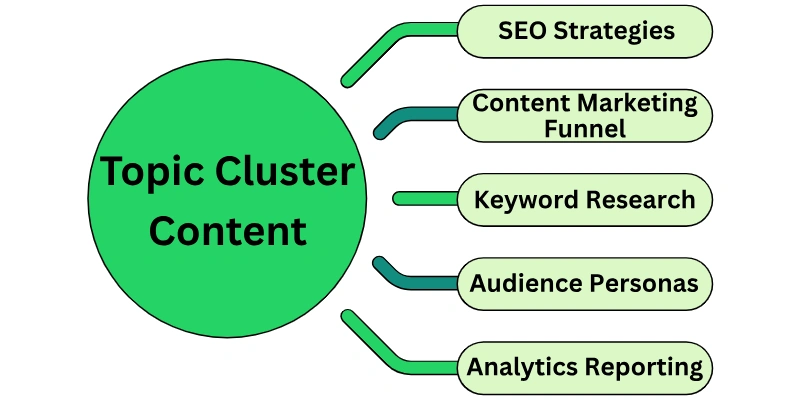
Topic clusters are a method of organizing the content on your website around different topics. Each topic cluster has a primary page, known as a pillar page, which provides a high-level summary of the subject. Then, there are a number of subpages that cover different aspects of the topic in more detail.
Topic clusters are an excellent approach to boost your website’s SEO while also making it easier for visitors to find the content they need.
In this blog post, we’re going to learn more about what is topic cluster content, how to create it and the benefits it offers.
What is Topic Cluster Content?
Topic cluster content is like the ultimate SEO dream team, but for your website. It’s a smart strategy where you create a bunch of related articles, all revolving around a central, pillar topic. Imagine the pillar as the superstar quarterback and the cluster content as its trusty wide receivers.
So, here’s the deal!!!!
The pillar page is your big, in-depth guide on a particular subject. It’s like the main event. Then, the cluster content is a bunch of shorter, more specific articles, all linking back to that superstar pillar. These articles dive deeper into subtopics, kind of like the quarterback’s passes to different receivers during a game.
In the SEO world, you might also hear topic clusters referred to as content clusters, content silos, or even hub-and-spoke content. But no matter what you call it, it’s like having a winning strategy in your playbook for scoring big in the search engine rankings.
How is Topic Cluster Content Different from Pillar Pages?
Pillar pages are menu mains. They thoroughly cover a big topic. A pillar page on “content marketing” might explain its benefits and types.
Cluster content, however, is like menu sides. It covers pillar page subtopics in greater detail. Cluster stuff for a content marketing pillar page might comprise blog entries on “how to write a blog post,” “how to promote your content,” and “how to measure the success of your content marketing efforts.”
Pillar pages provide an overview, while cluster content delves deeper. Pillar pages give a broad overview of a topic, whereas cluster content discusses it.
I hope you got your point clear here. Now let’s continue the learning of cluster content with deeper knowledge.
Example of Topic Cluster Content
Topic Cluster Example: Laptop Testing
Pillar Page: Laptop Testing: Comprehensive Guide
Cluster Pages:
- Different Types of Laptop Testing
- How to Test Laptop Performance
- How to Test Laptop Battery Life
- How to Test Laptop Display Quality
- How to Test Laptop Speakers and Microphone
- How to Test Laptop Ports and Connectivity
- How to Test Laptop Software and Applications
How the Content Relates:
All of the cluster pages are related to the main topic of laptop testing. The pillar page provides a broad overview of laptop testing, while the cluster pages cover different aspects of laptop testing in more detail.
For example, the cluster page on different types of laptop testing might discuss the following:
- Unit testing
- Integration testing
- System testing
- Acceptance testing
The cluster page on how to test laptop performance might discuss the following:
- CPU benchmarks
- GPU benchmarks
- RAM benchmarks
- Storage benchmarks
And so on.
Why is Cluster Content Important?
Have you ever been to a library and noticed how the books are arranged by topic? Topic clusters are similar to this for your website. They’re a method of organizing your material so that visitors can locate what they’re looking for easily.
Topic clusters, like a well-organized library, are also beneficial to the SEO of your website. Search engines prefer well-organized websites with a large amount of high-quality information on a certain topic. When you have a topic cluster, Google sees that you are knowledgeable about your subject and that your website is a helpful resource for those who are interested in that niche.
Benefits of Using Cluster Content
Here are some unique benefits of using topic cluster content:
- Improved SEO: Topic clusters assist search engines in comprehending the structure of your website, which can result in higher ranks in search engine results pages (SERPs).
- Increased traffic: More people will see your pages if they rank higher in SERPs. This could lead to increased traffic.
- Better user experience: When you put all of your related content together, users can easily move between pages and learn more about a topic, which improves your site’s UX.
- Increased engagement: When visitors can easily find related content, they’re more likely to stay on your website and explore more.
- More authority: By creating a comprehensive and well-organized topic cluster, you can establish yourself as an authority on your topic.
- Better content strategy: Assist you in creating a more strategic approach to content creation. By mapping out your topic clusters, you may find content gaps and create fresh content to address them.
How to Create Topic Cluster Content
By following the three steps mentioned below:
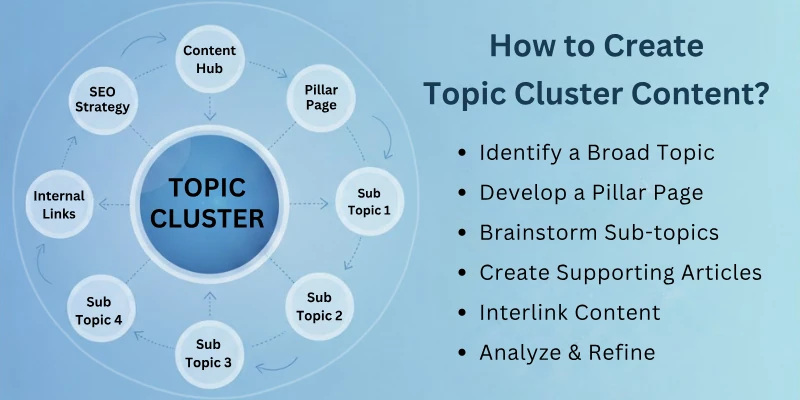
you can create cluster content for your site:
- Identifying Cluster Topics
- Creating Content that Covers Each Cluster Topic in Depth
- Linking your Cluster Content to Your Pillar Page
1. Identifying Cluster Topics
The first step in creating topic clusters is to identify your cluster topics. These are the subtopics that you will create content around.
- To identify your cluster topics, you can start by brainstorming a list of topics that are relevant to your core business or industry.
- Then, you can use keyword research tools to identify related topics that have high search volume and low competition.
- Once you have a list of potential cluster topics, you can start to group them together.
- Each cluster should focus on a specific subtopic within your core topic.
- For example, if your core topic is SEO, your cluster topics might include keyword research, on-page SEO, off-page SEO, and technical SEO.
2. Creating Content that Covers Each Cluster Topic in Depth
Once you have identified your cluster topics, you need to create content that covers each topic in depth. This includes creating a pillar page for each cluster topic.
- A pillar page is a long-form piece of content that provides a comprehensive overview of the topic.
- It should cover all of the important subtopics within the cluster, and it should be optimized for your target keywords.
- In addition to the pillar page, you should also create cluster pages for each subtopic.
- Cluster pages are shorter than pillar pages, but they should still be informative and provide value to your readers.
- Cluster pages should also be linked to the pillar page for the cluster topic that they belong to.
3. Linking your Cluster Content to Your Pillar Page
Internal linking is an important part of creating topic clusters. By linking your cluster content to your pillar page, you are helping search engines to understand the relationship between your different pieces of content and how they fit together into a cohesive topic cluster.
- To link your cluster content to your pillar page, you can use relevant keywords in your anchor text.
- For example, if you are linking to a cluster page on keyword research, you might use the anchor text “keyword research for SEO.”
- You should also link from your pillar page to your cluster pages.
- This will help visitors to your website to easily find the information that they are looking for.
Conclusion
In this post, we discussed the term “topic cluster content” in a website and how crucial it is for the success of your website. This article has given you in-depth insight into the significance and major components of topic cluster content. By applying these tactics, you’ll be fully furnished to increase your site’s exposure and engagement, ultimately driving more traffic and reaching your online goals.
FAQs
Here are some of the most commonly asked questions related to the cluster content in blogging:
There is no one-size-fits-all answer to this question. It is determined by the broadness of the pillar topic and the amount of content to be covered. A decent starting point, however, is to have at least 3-5 cluster pages for each pillar page.
When necessary, you should change the information in your topic cluster to keep it fresh and correct. This could mean adding new content, changing old content, or getting rid of content that is no longer relevant.
Some common mistakes to avoid when creating topic cluster content include:
- Not having a clear structure
- Not linking your pillar and cluster pages together
- Not writing high-quality content
- Not promoting your content
There are a number of tools that can help you create and manage topic cluster content. Some popular tools include:
- Ahrefs
- SEMrush
- Surfer SEO
- CoSchedule
- Contently
When choosing topics for your topic clusters, you should consider the following factors:
- Search volume
- Competition
- Your expertise
- Your audience



- Be Respectful
- Stay Relevant
- Stay Positive
- True Feedback
- Encourage Discussion
- Avoid Spamming
- No Fake News
- Don't Copy-Paste
- No Personal Attacks
- Be Respectful
- Stay Relevant
- Stay Positive
- True Feedback
- Encourage Discussion
- Avoid Spamming
- No Fake News
- Don't Copy-Paste
- No Personal Attacks
