Myths About SEO: 90+ Complete List of SEO Myths
Published: 13 Jul 2026
SEO is one of the most talked-about topics in digital marketing, but it is also surrounded by a lot of confusion and outdated beliefs.
Many people still follow old advice or misunderstand how search engines actually work today, which leads to ineffective strategies and wasted effort. From content length and backlinks to ranking factors and Google updates, there are countless ideas that sound true but are actually just myths.
In this guide, we will break down the most common myths about SEO so you can clearly understand what really matters in this year and what doesn’t.
SEO Myths: 100 Myths about SEO
Here is a list of 100 updated SEO myths:
- SEO is dead
- ChatGPT has killed Google Search
- Content length is the strongest ranking factor
- Google only ranks long-form content
- Zero-click searches make SEO useless
- E-E-A-T is a direct ranking factor (it’s not a single metric)
- Google has a “domain authority” score
- Keyword density improves rankings
- You must repeat keywords exactly to rank
- SEO is a one-time setup job
- Backlinks no longer matter
- Only dofollow links help SEO
- No-follow links are completely useless
- More backlinks always means better rankings
- Google indexes all pages instantly
- It takes exactly 30–60 days for backlinks to work
- All backlinks pass equal value
- .edu and .gov links are always more powerful
- Google favors big brands only
- Small websites can’t rank in 2026
- SEO is only about Google
- Bing SEO doesn’t matter
- Social media signals directly boost rankings
- More traffic automatically improves rankings
- High traffic means no keyword gaps exist
- Bounce rate is a direct ranking factor
- Dwell time is a confirmed ranking factor
- CTR manipulation always works
- Google uses Meta keywords tag
- Meta keywords still matter for SEO
- Title tags don’t matter anymore
- Meta descriptions affect rankings directly
- Google prefers newer domains only
- Older domains always rank better
- Exact-match domains guarantee rankings
- You must submit URLs manually to Google
- Google penalizes all duplicate content
- Duplicate content always leads to a penalty
- AI content is automatically penalized
- Human-written content always ranks better
- Google can’t understand AI content
- Keyword stuffing still works in some niches
- Hidden text helps SEO
- Footer links improve rankings significantly
- Internal linking has no big impact
- Site structure doesn’t matter much
- Page speed is not important anymore
- Core Web Vitals don’t matter
- Mobile-first indexing is optional
- HTTPS is not required for SEO
- JavaScript pages cannot rank well
- Google ignores JavaScript websites
- XML sitemaps guarantee indexing
- Robots.txt controls ranking
- Disavow tool boosts rankings
- Google penalties are always manual
- Algorithm updates always target bad SEO
- SEO results appear in 24 hours
- SEO only works for blogs
- Product pages don’t need SEO
- Local SEO is only about reviews
- More reviews always mean better rankings
- Star ratings directly control rankings
- “Near me” keywords boost local ranking automatically
- Google My Business (GBP) is optional for local SEO
- Posting daily on GBP guarantees ranking
- Location pages are unnecessary
- You only need one page per business
- Long URLs hurt rankings
- Short URLs always rank better
- URL keywords guarantee ranking
- Slugs don’t matter at all
- H1 tags are the strongest ranking factor
- Only H1 matters in headings
- Image SEO is not important
- Alt text is optional
- Videos don’t help SEO
- Embedding YouTube has no SEO value
- Schema markup guarantees rich results
- Structured data directly improves rankings
- Featured snippets can be forced
- You can “optimize” for Google AI Overviews directly
- AI search will replace SEO completely
- SEO is now only about prompts (not websites)
- Keyword research is dead
- Topic clusters are unnecessary
- Content updates don’t matter
- Republishing content hurts rankings
- Internal cannibalization doesn’t exist
- More pages always improve SEO
- Fewer pages always mean better SEO
- Thin content is always penalized
- Google prefers only expert writers
- Niche websites are always stronger than general ones
- E-commerce SEO is identical to blog SEO
- All backlinks from forums are toxic
- Guest posting is dead
- Press releases improve SEO automatically
- SEO results are permanent once achieved
- SEO is only a long game or only a short game (not both depending on strategy)
Now, let me clear your SEO misunderstandings with great detail.
1. Myth: SEO is dead
Misunderstanding: Many believe SEO is no longer useful because AI tools and social media have changed how people search. Some think organic search traffic is disappearing.
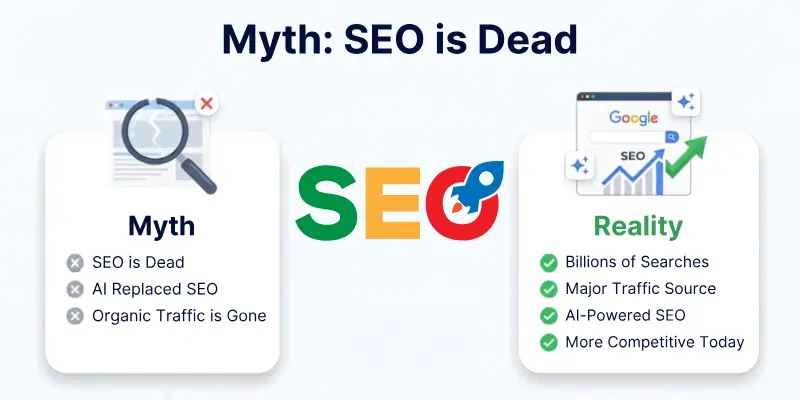
Reality:
- SEO is still one of the largest traffic sources on the internet
- Google processes billions of searches daily
- SEO has evolved into intent-based and AI-integrated search optimization
- Instead of dying, SEO has become more advanced and competitive
2. Myth: ChatGPT has killed Google Search
Misunderstanding: AI tools like ChatGPT are assumed to fully replace search engines by directly answering user questions.
Reality:
- ChatGPT provides generated responses, not real-time indexed web data
- Google still dominates live search, local search, and transactional queries
- AI tools often rely on search ecosystems for training and updates
- Users still use Google for shopping, services, navigation, and verification
3. Myth: Content length is the strongest ranking factor
Misunderstanding: Longer articles automatically rank higher because they are “more complete.”
Reality:
- Google does not rank based on word count
- Content must match search intent, not length expectations
- A 500-word precise answer can outperform a 3000-word article
- Relevance, clarity, and usefulness matter more than size
4. Myth: Google only ranks long-form content
Misunderstanding: Short content is believed to be invisible in search results.
Reality:
- Google ranks all content types: short blogs, product pages, FAQs, and landing pages
- Search intent decides content length requirement
- Informational queries may need long content, but navigational/product queries do not
- “Right format for intent” is what matters, not length
5. Myth: Zero-click searches make SEO useless
Misunderstanding: If users get answers directly on Google, SEO loses value because no one clicks.
Reality:
- Zero-click results still build brand visibility and authority
- Users often return later or search deeper after seeing snippets
- Featured snippets increase brand trust and recognition
- SEO now includes visibility, not just traffic
6. Myth: E-E-A-T is a direct ranking factor
Misunderstanding: E-E-A-T (Experience, Expertise, Authoritativeness, Trustworthiness) is treated like a measurable ranking score.
Reality:
- Google does not assign an E-E-A-T score
- It is a quality guideline used in evaluation systems
- Multiple signals (links, content quality, trust signals) influence it indirectly
- It is not a single algorithmic factor but a concept applied across systems
7. Myth: Google has a “domain authority” score
Misunderstanding: Websites are believed to have a fixed authority score assigned by Google.
Reality:
- Google does not use “Domain Authority” as a metric
- Authority is calculated dynamically based on many signals
- These include backlinks, relevance, engagement, and trust
- “Domain Authority” is a third-party SEO tool metric, not Google’s system
8. Myth: Keyword density improves rankings
Misunderstanding: Using a keyword repeatedly improves ranking strength.
Reality:
- Keyword stuffing can reduce rankings
- Google understands topics, synonyms, and context
- Overusing keywords signals low-quality content
- Natural writing with semantic coverage performs better
9. Myth: You must repeat keywords exactly to rank
Misunderstanding: Exact-match keywords are required multiple times in content.
Reality:
- Google uses semantic search and NLP models
- It understands variations like synonyms and related phrases
- Exact repetition is not necessary for ranking
- Context matters more than exact wording
10. Myth: SEO is a one-time setup job
Misunderstanding: Once SEO is done (keywords, pages, backlinks), no further work is needed.
Reality:
- SEO is ongoing, not static
- Algorithms change frequently
- Competitors continuously optimize their content
- Regular updates, audits, and improvements are required
11. Myth: Backlinks no longer matter
Misunderstanding: Many think Google has reduced or removed backlinks from ranking signals.
Reality:
- Backlinks are still one of the strongest ranking signals
- They help Google understand authority and trust
- What changed is quality > quantity, not elimination
12. Myth: Only dofollow links help SEO
Misunderstanding: No-follow links are believed to have zero value.
Reality:
- No-follow links can still bring traffic and visibility
- Google treats them as “hint-based signals”
- A natural backlink profile includes both types
13. Myth: No-follow links are completely useless
Misunderstanding: No SEO benefit exists from no-follow links.
Reality:
- They help with referral traffic
- They improve brand exposure
- They contribute to natural link patterns
14. Myth: More backlinks always means better rankings
Misunderstanding: Quantity alone improves rankings.
Reality:
- Low-quality or spam links can hurt rankings
- Relevance and authority matter more than count
- Fewer high-quality links outperform thousands of weak ones
15. Myth: Google indexes all pages instantly
Misunderstanding: Every published page appears in Google immediately.
Reality:
- Indexing depends on crawl budget and site authority
- Some pages take hours, days, or weeks
- Not all pages are indexed at all
16. Myth: It takes exactly 30–60 days for backlinks to work
Misunderstanding: Backlink impact always follows a fixed timeline.
Reality:
- There is no fixed time frame
- Impact depends on crawl frequency, authority, and competition
- Some links work in days, others take months
17. Myth: All backlinks pass equal value
Misunderstanding: Every link provides the same SEO benefit.
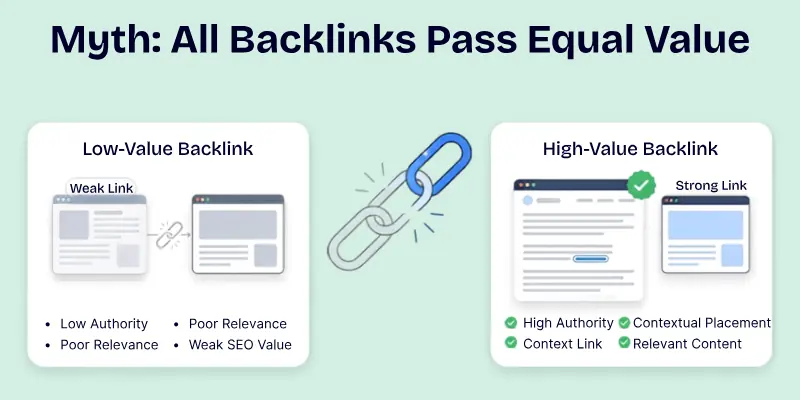
Reality:
- Authority, relevance, and placement matter heavily
- A contextual editorial link is stronger than a sidebar link
- Google evaluates link quality, not just existence
18. Myth: .edu and .gov links are always more powerful
Misunderstanding: Domain extension alone guarantees authority.
Reality:
- Google does not treat extensions as ranking signals
- A weak .edu page can be less valuable than a strong .com page
- Context and relevance matter more than extension
19. Myth: Google favors big brands only
Misunderstanding: Small sites cannot compete with large brands.
Reality:
- Big brands have trust advantages, not guaranteed ranking
- Small sites can outrank big brands with better content
- Google prioritizes relevance and user satisfaction
20. Myth: Small websites can’t rank in 2026
Misunderstanding: New or small domains are ignored by Google.
Reality:
- New websites can rank with strong topical authority
- Niche targeting improves competitiveness
- Google rewards helpful, focused content regardless of size
21. Myth: SEO is only about Google
Misunderstanding: Other search engines are irrelevant.
Reality:
- Google dominates, but Bing, Yahoo, and AI search exist
- SEO principles overlap across platforms
- Bing is growing due to AI integration
22. Myth: Bing SEO doesn’t matter
Misunderstanding: Optimizing for Bing has no value.
Reality:
- Bing powers multiple AI search tools
- It has significant desktop and enterprise traffic
- Optimization overlaps with Google SEO anyway
23. Myth: Social media signals directly boost rankings
Misunderstanding: Likes and shares improve Google rankings directly.
Reality:
- Social signals are not direct ranking factors
- They can indirectly influence traffic and backlinks
- Engagement helps visibility, not algorithm scoring
24. Myth: More traffic automatically improves rankings
Misunderstanding: High traffic alone pushes rankings higher.
Reality:
- Traffic does not directly affect rankings
- Engagement and content quality matter more
- Traffic can indirectly help through signals and links
25. Myth: High traffic means no keyword gaps exist
Misunderstanding: If traffic is high, keyword coverage is complete.
Reality:
- Pages can still miss valuable long-tail keywords
- Traffic doesn’t show full search coverage
- Keyword gaps exist even in high-performing pages
26. Myth: Bounce rate is a direct ranking factor
Misunderstanding: Google uses bounce rate in rankings.
Reality:
- Google does not use bounce rate directly
- It’s unreliable due to tracking limitations
- User satisfaction is measured in other ways
27. Myth: Dwell time is a confirmed ranking factor
Misunderstanding: Time spent on page is directly measured for ranking.
Reality:
- Google has never confirmed dwell time as a ranking signal
- It may be indirectly related to engagement
- No official algorithm metric uses it directly
28. Myth: CTR manipulation always works
Misunderstanding: Increasing clicks always boosts rankings.
Reality:
- Temporary effects may occur but are not stable
- Google detects unnatural CTR patterns
- Ranking depends on multiple signals, not clicks alone
29. Myth: Google uses Meta keywords tag
Misunderstanding: Meta keywords still influence ranking.
Reality:
- Google ignores meta keywords completely
- It has been deprecated for years
- It has no ranking value
30. Myth: Meta keywords still matter for SEO
Misunderstanding: Adding keywords in meta tags improves SEO.
Reality:
- No impact on rankings
- Can be safely ignored in modern SEO
- Focus should be on title and content
31. Myth: Title tags don’t matter anymore
Misunderstanding: Titles are no longer important for SEO.
Reality:
- Title tags are still a strong ranking signal
- They influence CTR and relevance
- One of the most important on-page SEO elements
32. Myth: Meta descriptions affect rankings directly
Misunderstanding: Meta descriptions improve ranking position.
Reality:
- They do not directly affect rankings
- They influence click-through rate only
- CTR can indirectly impact performance
33. Myth: Google prefers newer domains only
Misunderstanding: Fresh domains get ranking priority.
Reality:
- Domain age alone is not a ranking factor
- New domains can rank quickly with strong content
- Google evaluates content quality, not age
34. Myth: Older domains always rank better
Misunderstanding: Age guarantees authority.
Reality:
- Old domains can lose rankings if not maintained
- Fresh, better content can outrank older sites
- Authority depends on signals, not age
35. Myth: Exact-match domains guarantee rankings
Misunderstanding: Having keyword in domain ensures top rankings.
Reality:
- Exact-match domains have reduced importance
- They still need strong SEO to rank
- Content quality matters far more
36. Myth: You must submit URLs manually to Google
Misunderstanding: Pages won’t index without manual submission.
Reality:
- Google crawls sites automatically
- Submission only speeds up discovery
- Not required for indexing
37. Myth: Google penalizes all duplicate content
Misunderstanding: Duplicate content always leads to penalties.
Reality:
- Google usually filters duplicate content, not penalize
- Penalties occur only in spam cases
- Canonical tags handle duplication
38. Myth: Duplicate content always leads to a penalty
Misunderstanding: Any duplication hurts SEO.
Reality:
- Only manipulative duplication is penalized
- Common duplication (products, tags) is normal
- Google chooses canonical version
39. Myth: AI content is automatically penalized
Misunderstanding: AI-generated content is banned or downgraded.
Reality:
- Google does not ban AI content
- Low-quality content is the issue, not AI usage
- Helpful, original AI content can rank
40. Myth: Human-written content always ranks better
Misunderstanding: Human writing guarantees better rankings than AI.
Reality:
- Quality matters more than authorship
- Poor human content can still underperform
- Helpful, well-structured content wins regardless of source
41. Myth: Google can’t understand AI content
Misunderstanding: AI-written content is assumed to be invisible or unreadable to Google.
Reality:
- Google does not detect or block content just because it is AI-generated
- It evaluates quality, usefulness, and originality
- Poor content is ranked low regardless of whether it is human or AI-written
42. Myth: Keyword stuffing still works in some niches
Misunderstanding: Repeating keywords excessively can still boost rankings in competitive areas.
Reality:
- Keyword stuffing is outdated and harmful
- Google uses semantic understanding, not repetition-based ranking
- Overuse reduces readability and trust signals
43. Myth: Hidden text helps SEO
Misunderstanding: Hiding keywords in the background improves rankings.
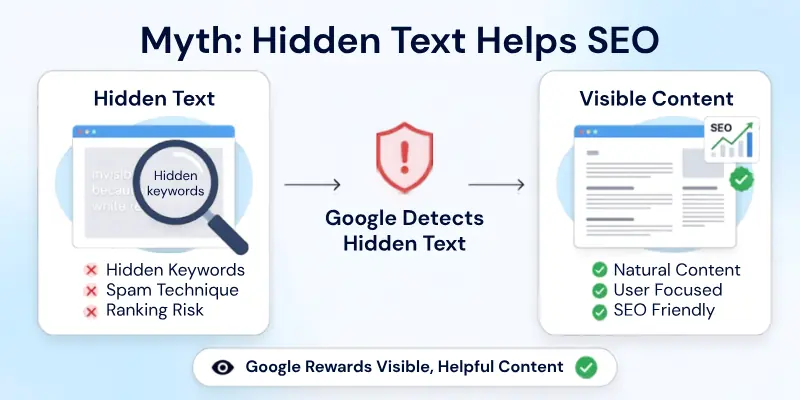
Reality:
- Hidden text is considered spam
- It can lead to ranking drops or penalties
- Google only values visible, user-facing content
44. Myth: Footer links improve rankings significantly
Misunderstanding: Adding many footer links boosts SEO power.
Reality:
- Footer links have very limited SEO value
- Google prioritizes contextual, in-content links
- Overusing footer links can look manipulative
45. Myth: Internal linking has no big impact
Misunderstanding: Internal links are optional and not important for SEO.
Reality:
- Internal linking helps Google understand site structure
- It distributes authority across pages
- Strong internal linking improves crawling and ranking
46. Myth: Site structure doesn’t matter much
Misunderstanding: Website organization has little effect on SEO performance.
Reality:
- Clear structure improves indexing and user experience
- Poor structure can reduce crawl efficiency
- Google relies on hierarchy to understand content relationships
47. Myth: Page speed is not important anymore
Misunderstanding: Speed no longer affects rankings due to modern internet improvements.
Reality:
- Page speed is still a confirmed ranking factor
- Slow sites reduce user engagement
- Speed impacts both desktop and mobile performance
48. Myth: Core Web Vitals don’t matter
Misunderstanding: Core Web Vitals are outdated metrics.
Reality:
- Core Web Vitals are part of Google’s page experience system
- They measure real user experience signals
- Poor scores can affect visibility in competitive rankings
49. Myth: Mobile-first indexing is optional
Misunderstanding: Desktop version still matters more than mobile.
Reality:
- Google primarily uses mobile versions for indexing
- Mobile usability is critical for rankings
- Desktop-only optimization is no longer enough
50. Myth: HTTPS is not required for SEO
Misunderstanding: SSL certificates have no ranking importance.
Reality:
- HTTPS is a basic trust and security requirement
- It is a confirmed lightweight ranking signal
- Browsers also warn users on non-secure sites
51. Myth: JavaScript pages cannot rank well
Misunderstanding: Google cannot properly index JavaScript-based websites.
Reality:
- Google can render and index JavaScript content
- Some delay may occur in rendering
- Proper implementation ensures full SEO compatibility
52. Myth: Google ignores JavaScript websites
Misunderstanding: JS frameworks like React or Vue are bad for SEO.
Reality:
- Google processes JS content using rendering systems
- SEO success depends on implementation, not technology
- Poor setup (not JS itself) causes indexing issues
53. Myth: XML sitemaps guarantee indexing
Misunderstanding: Submitting a sitemap ensures all pages will be indexed.
Reality:
- Sitemaps only help discovery, not indexing guarantee
- Google still evaluates quality before indexing
- Low-value pages may still be ignored
54. Myth: Robots.txt controls ranking
Misunderstanding: Robots.txt can improve or influence rankings directly.
Reality:
- Robots.txt only controls crawling access
- It does not improve rankings
- It can even accidentally block important pages
55. Myth: Disavow tool boosts rankings
Misunderstanding: Using disavow improves SEO performance.
Reality:
- Disavow tool is only for removing harmful link impact
- It does not boost rankings directly
- It is used in penalty or spam situations
56. Myth: Google penalties are always manual
Misunderstanding: Every ranking drop is caused by manual action.
Reality:
- Most ranking drops are algorithmic, not manual
- Google updates constantly adjust rankings automatically
- Manual penalties are relatively rare
57. Myth: Algorithm updates always target bad SEO
Misunderstanding: Updates only punish spam or black-hat SEO.
Reality:
- Updates refine ranking quality systems
- Even good sites can lose rankings temporarily
- Changes affect relevance, intent, and content quality
58. Myth: SEO results appear in 24 hours
Misunderstanding: SEO changes show immediate ranking impact.
Reality:
- SEO takes time due to crawling and evaluation cycles
- Changes may take days, weeks, or months
- Speed depends on authority and competition
59. Myth: SEO only works for blogs
Misunderstanding: SEO is only useful for informational content.
Reality:
- SEO applies to e-commerce, services, apps, and local businesses
- Product pages and landing pages heavily rely on SEO
- Any searchable content benefits from optimization
60. Myth: Product pages don’t need SEO
Misunderstanding: Only blog pages require optimization.
Reality:
- Product pages are critical for conversions and rankings
- They require optimized titles, descriptions, and structure
- Poor SEO reduces visibility and sales potential
61. Myth: Local SEO is only about reviews
Misunderstanding: Many believe reviews are the only factor in local rankings.
Reality:
- Reviews are only one signal
- Google also uses relevance, proximity, and profile completeness
- Website SEO and citations also matter
62. Myth: More reviews always mean better rankings
Misunderstanding: Quantity of reviews guarantees higher ranking.
Reality:
- Quality and relevance of reviews matter more than number
- Spam or fake reviews can hurt performance
- Consistency and trust signals are more important
63. Myth: Star ratings directly control rankings
Misunderstanding: Higher ratings automatically boost rankings.
Reality:
- Ratings influence user behavior, not ranking directly
- Google does not use star rating as a direct ranking factor
- It affects CTR and trust indirectly
64. Myth: “Near me” keywords boost local ranking automatically
Misunderstanding: Adding “near me” improves ranking in local search.
Reality:
- Google understands user location automatically
- “Near me” is not a ranking booster
- Local SEO depends on proximity and relevance, not keywords
65. Myth: Google Business Profile (GBP) is optional for local SEO
Misunderstanding: A website alone is enough for local ranking.
Reality:
- GBP is essential for local visibility
- It powers map listings and local pack results
- Without it, local SEO performance is limited
66. Myth: Posting daily on GBP guarantees ranking
Misunderstanding: Frequent posts improve ranking position.
Reality:
- Posting helps engagement but does not guarantee ranking
- Consistency is more important than frequency
- Core ranking signals remain reviews, relevance, and proximity
67. Myth: Location pages are unnecessary
Misunderstanding: One homepage is enough for all locations.
Reality:
- Location-specific pages improve local targeting
- They help rank for city-based queries
- Each location needs optimized content
68. Myth: You only need one page per business
Misunderstanding: A single page can target all services and locations.
Reality:
- Different services need separate optimization
- User intent varies by service and location
- Multiple pages improve relevance and rankings
69. Myth: Long URLs hurt rankings
Misunderstanding: URL length directly affects SEO negatively.
Reality:
- URL length is not a ranking factor
- Readability matters more than length
- Clean structure is more important than size
70. Myth: Short URLs always rank better
Misunderstanding: Shorter URLs automatically outperform longer ones.
Reality:
- No ranking advantage for short URLs
- Relevance and clarity matter more
- Both short and long URLs can rank equally
71. Myth: URL keywords guarantee ranking
Misunderstanding: Adding keywords in URL ensures top ranking.
Reality:
- Keywords in URL are a minor signal
- They do not guarantee ranking success
- Content quality and backlinks matter far more
72. Myth: Slugs don’t matter at all
Misunderstanding: URL slugs have zero SEO value.
Reality:
- Slugs help with clarity and CTR
- They support relevance signals
- They matter slightly, but not heavily
73. Myth: H1 tags are the strongest ranking factor
Misunderstanding: H1 alone controls ranking strength.
Reality:
- H1 helps structure content but is not dominant
- Google evaluates full page context
- Content quality outweighs heading tags
74. Myth: Only H1 matters in headings
Misunderstanding: Other headings (H2, H3) are irrelevant.
Reality:
- All headings help structure content
- They improve readability and SEO understanding
- H2/H3 support topical relevance
75. Myth: Image SEO is not important
Misunderstanding: Images do not affect search performance.
Reality:
- Images contribute to search visibility (Google Images)
- They improve engagement and UX
- Proper optimization helps accessibility and indexing
76. Myth: Alt text is optional
Misunderstanding: Alt text is unnecessary for SEO.
Reality:
- Alt text helps Google understand images
- It improves accessibility
- It supports image search ranking
77. Myth: Videos don’t help SEO
Misunderstanding: Video content has no SEO value.
Reality:
- Videos increase engagement and dwell time
- They can rank in Google video search
- Embedding videos improves content quality signals
78. Myth: Embedding YouTube has no SEO value
Misunderstanding: Embedded videos don’t contribute to rankings.
Reality:
- Embeds improve user engagement
- They can increase time on page
- Indirectly supports SEO performance
79. Myth: Schema markup guarantees rich results
Misunderstanding: Adding schema ensures rich snippets appear.
Reality:
- Schema helps Google understand content
- Rich results are not guaranteed
- Eligibility depends on quality and relevance
80. Myth: Structured data directly improves rankings
Misunderstanding: Schema boosts ranking position directly.
Reality:
- Structured data is not a ranking factor
- It improves interpretation and display
- It may indirectly improve CTR
81. Myth: Featured snippets can be forced
Misunderstanding: You can guarantee a featured snippet with formatting or keywords.
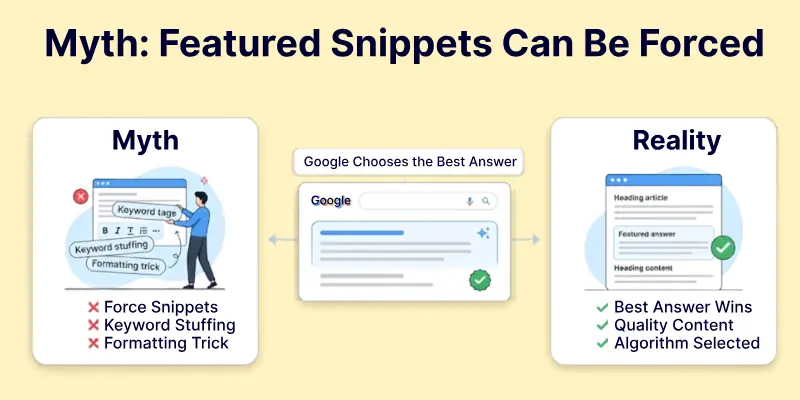
Reality:
- Featured snippets are algorithmically selected
- You can optimize chances, but not force them
- Google chooses based on best answer quality
82. Myth: You can optimize directly for Google AI Overviews
Misunderstanding: There is a direct “AI Overview optimization” method.
Reality:
- There is no separate optimization system for AI Overviews
- They pull from existing high-quality indexed content
- Strong SEO fundamentals still matter most
83. Myth: AI search will replace SEO completely
Misunderstanding: Traditional SEO will disappear due to AI search.
Reality:
- AI search still depends on indexed web content
- Websites remain the primary data source
- SEO is evolving, not disappearing
84. Myth: SEO is now only about prompts (not websites)
Misunderstanding: Prompt engineering replaces website optimization.
Reality:
- Prompts are user-side interactions
- Websites still provide structured information
- SEO is still needed for visibility in AI and search engines
85. Myth: Keyword research is dead
Misunderstanding: AI tools removed the need for keyword research.
Reality:
- Keyword research is still core to understanding intent
- It now focuses more on topics and entities
- AI helps research, but does not replace it
86. Myth: Topic clusters are unnecessary
Misunderstanding: Internal topic structure is outdated.
Reality:
- Topic clusters help Google understand authority
- They improve internal linking and relevance
- They are still widely used in modern SEO
87. Myth: Content updates don’t matter
Misunderstanding: Old content stays stable without updates.
Reality:
- Freshness is important for many topics
- Updating improves accuracy and rankings
- Stale content loses visibility over time
88. Myth: Republishing content hurts rankings
Misunderstanding: Updating old posts always resets SEO value.
Reality:
- Proper updates can improve rankings
- Google may re-evaluate refreshed content positively
- Only poor republishing (duplicate URLs) causes issues
89. Myth: Internal cannibalization doesn’t exist
Misunderstanding: Multiple pages targeting same keywords is fine.
Reality:
- Keyword cannibalization can split ranking signals
- Google may struggle to choose the best page
- Proper content structuring avoids this issue
90. Myth: More pages always improve SEO
Misunderstanding: Publishing more pages automatically boosts rankings.
Reality:
- Low-quality pages can dilute site authority
- Quality and relevance matter more than quantity
- Strategic content performs better than mass publishing
91. Myth: Fewer pages always mean better SEO
Misunderstanding: Smaller websites rank better by default.
Reality:
- Too few pages limit keyword coverage
- Coverage and depth matter in SEO
- Balance is key, not extremes
92. Myth: Thin content is always penalized
Misunderstanding: Any short content leads to penalties.
Reality:
- Thin content is not always penalized
- It may just rank poorly or be ignored
- Quality and usefulness matter more than length
93. Myth: Google prefers only expert writers
Misunderstanding: Only certified experts can rank.
Reality:
- Google values helpful content, not formal credentials only
- Experience and clarity also matter
- Expertise signals are contextual, not absolute
94. Myth: Niche websites are always stronger than general ones
Misunderstanding: Narrow niche always beats broad sites.
Reality:
- Niche helps focus, but authority matters too
- Large sites can dominate multiple topics
- Strategy determines success, not niche size alone
95. Myth: E-commerce SEO is identical to blog SEO
Misunderstanding: All SEO strategies work the same for shops and blogs.
Reality:
- E-commerce focuses on product intent and conversions
- Blogs focus on informational intent
- Different page structures require different strategies
96. Myth: All backlinks from forums are toxic
Misunderstanding: Forum links always hurt SEO.
Reality:
- Low-quality spam forums are harmful
- Relevant, active forums can provide value
- Context and quality matter more than source type
97. Myth: Guest posting is dead
Misunderstanding: Guest blogging no longer works.
Reality:
- Guest posting still works when done naturally
- It must be relevant and high-quality
- Spam guest posting is what lost value
98. Myth: Press releases improve SEO automatically
Misunderstanding: Publishing press releases boosts rankings.
Reality:
- Press releases alone don’t improve rankings
- They can help visibility and brand exposure
- SEO value depends on distribution and links earned
99. Myth: SEO results are permanent once achieved
Misunderstanding: Once ranked, a page stays ranked forever.
Reality:
- Rankings constantly change due to competition
- Updates and content decay affect positions
- SEO requires ongoing maintenance
100. Myth: SEO is only a long game or only a short game
Misunderstanding: SEO works either fast or slow, not both.
Reality:
- SEO has both short-term and long-term effects
- Quick wins (technical fixes, low competition keywords) exist
- Authority building is long-term
How Google Actually Evaluates Content Today
Google doesn’t rely on a single “magic factor” to rank content anymore. Instead, it uses a combination of systems that analyze quality, relevance, usefulness, and user satisfaction. Modern SEO is less about tricks and more about how well your content solves real search intent.
In 2026, Google’s evaluation is highly contextual, meaning the same page can rank differently depending on the query, user location, and intent. Here’s a simple breakdown of how Google actually evaluates content today:
- Search intent match: Google checks how well your content answers what the user is really looking for, not just keyword matching.
- Content quality and depth: It evaluates whether the content is helpful, complete, and clearly explains the topic without fluff.
- Relevance and context: Google analyzes semantic meaning, related topics, and overall context, not just exact keywords.
- E-E-A-T signals: Experience, expertise, authority, and trust signals are used as quality indicators across the site and content.
- User engagement signals (indirect): If users find content useful (clicks, satisfaction, return behavior), it can positively influence performance.
- Page experience: Factors like mobile usability, loading speed, and Core Web Vitals contribute to overall ranking evaluation.
- Content freshness: For time-sensitive topics, updated and recent content is often prioritized.
- Backlink quality: High-quality, relevant links still help Google understand trust and authority.
- Topical authority: Websites that consistently cover a subject in depth are more likely to rank higher in that niche.
- Machine learning systems: AI-based systems help Google interpret content meaning, quality patterns, and ranking behavior at scale.
Final Thoughts
In this guide, we have covered many common myths about SEO in detail and explained what is true and what is not in today’s search landscape. SEO keeps changing with new updates, but many old beliefs still confuse beginners and even experienced marketers. The key is to focus on practical strategies, user intent, and quality content instead of chasing outdated rules or assumptions.
Personal recommendation: Google has never fully revealed its exact ranking factors, so avoid getting confused by rumors or “guaranteed ranking tricks”. Instead, focus on building helpful content, strong site structure, and a good user experience, these are the things that truly matter in the long run.
FAQs
Here are some of the most frequently asked questions related to myths about SEO:
Many people believe outdated ideas like SEO being dead, keyword stuffing still working, or backlinks not mattering anymore. These myths about SEO can mislead beginners into using wrong strategies. In reality, SEO is still very active and constantly evolving with Google updates. The key is to follow modern SEO practices instead of old advice.
One of the biggest seo myths is that SEO is dead due to AI and new search features. SEO is not dead; it has simply changed over time with smarter algorithms. Websites still need optimization to rank and get organic traffic. So, the idea that SEO is finished is completely false.
An seo myth is a false or outdated belief about how search engines work. For example, thinking that keyword density alone can improve rankings is a myth. These wrong ideas often come from old practices that no longer work. Understanding real SEO helps you avoid such mistakes.
Myths about SEO continue because search engines keep updating their algorithms, and old information still circulates online. Many beginners also repeat outdated advice without checking current trends. This creates confusion and spreads misinformation. That’s why staying updated is very important in SEO.
Yes, following seo myths can hurt your website’s performance. If you focus on wrong tactics like keyword stuffing or ignoring user experience, your rankings may drop. SEO works best when you follow proven strategies based on real data. Avoiding myths helps you grow faster and safer.
A common seo myth is that keywords are no longer important. In reality, keywords still matter, but they must be used naturally. Google now focuses more on intent and context rather than repetition. So keywords are useful, but not in the old-fashioned way.
This is one of the popular myths about SEO. Not all backlinks are equal in value. High-quality, relevant links matter more than large quantities of low-quality links. Spammy backlinks can even harm your rankings.
Many believe seo myths like “publish once and forget” work, but that is not true. Content needs regular updates to stay relevant and competitive. Fresh and improved content performs better in search results. Google prefers updated and useful information.