What is Google Sandbox? Is this a Myth or Reality?
Published: 24 Jan 2026
Have you ever wondered why it’s so hard to rank a new website on Google? You’ve created great content, built high-quality backlinks, and optimized your website for search engines. But for some reason, you’re still stuck on page 10 of the search results.
The truth is, Google has a way of keeping new websites in check. It’s called the Google Sandbox.
The Google Sandbox is a period of time when Google temporarily suppresses the ranking of new websites. This is done to prevent spam and low-quality content from ranking high.
But don’t worry, there are things you can do to get your website out of the Google Sandbox. In this blog post, we’ll teach you everything you need to know.
What is the Google Sandbox?
Imagine that Google Search is a school, and the search results are the top students in each class. New websites are like new students at the school. They are not placed in the top classes right away, because they have not yet proven that they are good students. Instead, they are placed in lower classes, where they can learn and grow.
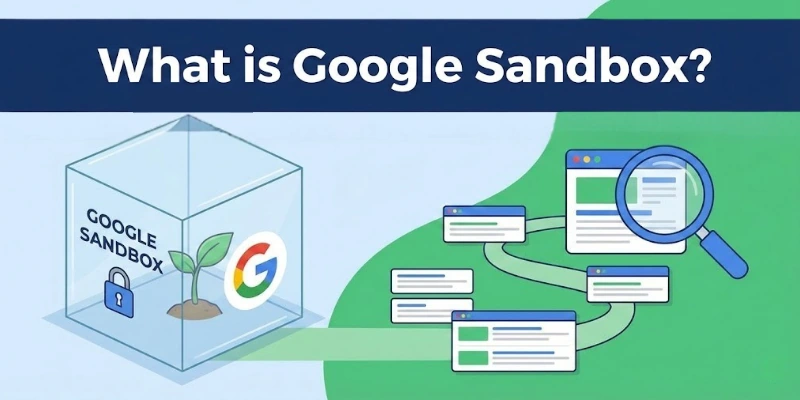
After a while, the new students are allowed to move up to higher classes, but they are still limited in how high they can go. This is because the school still needs to assess their performance and determine whether they are ready for the top classes.
Eventually, the new students are allowed to move into any class they want, and they can even compete for the top spots. This is because the school has now determined that they are high-quality students and that they belong in the top classes.
The Google Sandbox works in a similar way. It temporarily places new websites in a lower ranking position while Google assesses their quality. Once Google is satisfied that the website is high-quality, it will be allowed to rank higher in search results.
How Does the Google Sandbox Work?
Sad, but reality!
There is no official word from Google on how the Sandbox actually works, but there are a few theories.
One theory is that Google looks at a variety of factors, such as the age of the domain, the quality of the content, and the number of backlinks the website has. Another theory is that Google uses a machine learning algorithm to predict how well a new website will perform in the search results.
Regardless of how it works, the Google Sandbox is a temporary measure. Once Google has determined that a website is high-quality, it will be released from the sandbox and allowed to rank higher in search results. This process can take anywhere from a few weeks to a few months, depending on the website.
Identifying Signs of the Google Sandbox
Guys, just suppose that you have completely set up your site according to Google’s guidelines, like being fully technically and on-page optimized and submitted to Google, and you just thought that your site was put into the sandbox, whether it can be yes or no. So, are there some signs that can make you clear about this or not? Exactly, yes. Some of them I have come up with.
Some of the most common signs include:
- Your rankings are lower than expected. If you have created a high-quality website that is relevant to your target audience, but your rankings are still lower than expected, it is possible that you are in the Sandbox.
- Your rankings fluctuate wildly. If your rankings are constantly going up and down, it is also a sign that you may be in the Sandbox.
- You are not getting any new backlinks. If you have been trying to build backlinks to your website, but you are not getting any new ones, it is possible that you are in the Sandbox.
- Your traffic is stagnant. If your traffic levels have been stagnant for a long period of time, it is also a sign that you may be in the Sandbox.
It is important to note that these signs are not definitive proof that your website is in the Sandbox. However, if you are experiencing one or more of these signs, it is possible that you are in the Sandbox.
Here are some additional tips for identifying the Google Sandbox:
- Check your rankings for a variety of keywords. If your rankings are lower than expected for all of your keywords, it is more likely that you are in the Sandbox.
- Compare your rankings to your competitors. If your competitors have higher rankings than you for the same keywords, it is also a sign that you may be in the Sandbox.
- Use a backlink checker to track your backlinks. If you are not getting any new backlinks, it is a sign that you may be in the Sandbox.
- Use a traffic analytics tool to track your traffic levels. If your traffic levels have been stagnant for a long period of time, it is a sign that you may be in the Sandbox.
Impact of the Google Sandbox on New Websites
Google Sandbox can have a significant impact on new websites, making it difficult for them to rank well in search results for competitive keywords. This is because Google wants to give established websites a chance to compete, and it also wants to prevent new websites from ranking too high before they have proven themselves to be high-quality.
Here are some of the ways that the Google Sandbox can impact new websites:
- Lower rankings: New websites are typically ranked lower in search results than established websites. This is because Google gives more weight to factors such as domain age and backlinks when ranking websites.
- Slower traffic growth: Because new websites typically rank lower in search results, they may experience slower traffic growth than established websites.
- Difficulty ranking for competitive keywords: It can be difficult for new websites to rank well for competitive keywords. This is because established websites have a head start, and they often have more backlinks and higher domain authority.
Strategies to Overcome the Google Sandbox
There is no guaranteed way to overcome the Google Sandbox, but there are some strategies that can help you get through it more quickly. Here are a few tips:
- Create high-quality content. This is the most crucial thing you can do to increase your website’s ranking in Google search results. Make sure the content is useful, informative and relevant to your audience.
- Focus on long-tail keywords. Long-tail keywords are less competitive and more precise than short-tail keywords. As a result, they may be easier to rank for, particularly if your website is young.
- Build backlinks from high-quality websites. Backlinks serve as indicators to Google regarding the credibility and authority of a given website. Placing emphasis on obtaining backlinks from reputable websites that are pertinent to your own is crucial.
- Optimize your website for technical SEO. Ensure that your website loads quickly, is mobile-friendly, and is straightforward to navigate. This will facilitate the crawling and indexing of your website by Google.
- Promote your website on social media. By sharing your content on social media, you can increase brand awareness and attract visitors to your website. Additionally, additional backlinks from other websites may result.
- Be patient. Google may take some time to index and rank new websites. Don’t be disheartened if you don’t notice immediate benefits. Simply continue to create high-quality content and acquire backlinks, and your website will begin to rank better in search results.
Sandbox vs. Honeymoon Period vs. Dance Period
After giving a read to this table, you are going to clear up your concept with these three terms that are imposed on your newly established sites.
| Concept | Definition | Duration | Implications for site owners |
| Google Sandbox | A hypothesized filter that prevents new websites from ranking too high in search results too quickly | A few weeks to a few months | New website owners should focus on creating high-quality content and building backlinks. |
| Honeymoon Period | A period of time after a new website is launched when it may rank higher in search results than it deserves | A few weeks to a few months | New website owners should not expect their rankings to remain high indefinitely. |
| Dance Period | A period of time after a website makes changes to its content or structure when its ranking may fluctuate wildly | A few weeks | Website owners should avoid making major changes to their website too often. |
Google Sandbox: Myth or Reality
Whether or not the Google Sandbox is a myth is a matter of debate. Google has never officially confirmed its existence, but many SEO experts believe that it is real.
Here is what some Google experts and SEO experts have said about the Google Sandbox:
Google experts:
- Matt Cutts, former head of the Google Search Quality Team, said in 2005 that the Google Sandbox is “not a real algorithm,” but that there is a “soft period” when new websites are ranked lower in search results.
- John Mueller, Google Search Advocate, said in 2015 that there is no “specific sandbox” algorithm, but that Google does use a variety of factors to assess the quality of new websites.
SEO experts:
- Neil Patel, SEO expert and co-founder of NP Digital, believes that the Google Sandbox is real and that it can take several months for new websites to exit the Sandbox and start ranking well in search results.
- Brian Dean, founder of Backlinko, believes that the Google Sandbox is a myth and that new websites can rank well in search results from the start, as long as they have high-quality content and backlinks.
So, what is the truth? The reality is that we don’t know for sure whether or not the Google Sandbox is real. Google has never officially confirmed its existence, and there is no consensus among SEO experts on the matter.
However, even if the Google Sandbox is not a real algorithm, it is clear that Google does take into account the age of a website when ranking it in search results. This is why it is important for new website owners to focus on creating high-quality content and building backlinks. Over time, this will help their website to rank higher in search results, even if they are not in the Sandbox.
Conclusion
So, guys, in this article, we have covered everything you need to know about the Google Sandbox, including what it is, how it works, and how to get out of it.
But, loved ones, remember that – sandbox is just one factor that can affect your website’s ranking in search results. There are many other factors that you need to consider, such as the quality of your content, your website’s user experience, and much more!!!!
Andddd!!!!!
By creating a high-quality website that is relevant to your target audience, you can improve your chances of ranking well in search results, regardless of whether or not your website is in Google’s Sandbox.
So, what are you waiting for? Go and Start taking care of your site today!
FAQs
Here are some of the most commonly asked questions related to the Google sandbox:
The Google Sandbox is a hypothesized filter that Google uses to prevent new websites from ranking too high in search results too quickly. It is believed to be a temporary measure that is used to assess the quality of a new website and determine whether it is a good fit for the search results.
No, the Google Sandbox is not a penalty. It is a filter that Google uses to prevent new websites from ranking too high in the search results before they have had a chance to establish themselves.
If you think you’ve been unfairly penalized by the Google Sandbox, you can file a reconsideration request with Google. However, Google does not review all reconsideration requests, and they will only overturn a penalty if they determine that it was made in error.
Yes, you can still get traffic to your website while it’s in the Google Sandbox. You can get traffic from social media, direct visits, email marketing, and paid advertising. You can also try to rank for long-tail keywords, which are less competitive than short-tail keywords.
The Google Sandbox does not only affect newer websites; it can also affect older websites that have undergone significant redesigns or changed their content methods.
No, the Google Sandbox is only specific to Google. However, other search engines may also have their own algorithms that temporarily suppress the ranking of new websites.
Here are those:
- The Google Sandbox is a punishment for new websites.
- The Google Sandbox is permanent.
- There is a specific formula for getting out of the Google Sandbox.


- Be Respectful
- Stay Relevant
- Stay Positive
- True Feedback
- Encourage Discussion
- Avoid Spamming
- No Fake News
- Don't Copy-Paste
- No Personal Attacks
- Be Respectful
- Stay Relevant
- Stay Positive
- True Feedback
- Encourage Discussion
- Avoid Spamming
- No Fake News
- Don't Copy-Paste
- No Personal Attacks
