What is Google Honeymoon Period in SEO? All Covered
Published: 2 Dec 2025
Imagine you are baking a cake. You follow the recipe carefully, and the cake turns out perfectly. It is moist and fluffy, and the frosting is delicious. You take a bite, and it is heaven.
This is similar to the Google honeymoon period. When you first start using a new Google product, it is all new and exciting. You are discovering all of the features and possibilities, and you are amazed by how well it works.
But after a while, the cake starts to dry out. The frosting becomes too sweet. You start to notice the flaws in the recipe.
This is when the Google honeymoon period ends. You start to notice the flaws in the product, and you may even get bored with it.
In this blog post, we will discuss what the Google honeymoon period is, how long it typically lasts, and how you can make the most of it. We will also provide tips on how to avoid getting burned out on Google products.
Let us learn about Google’s Honeymoon Period now!
What is the Google Honeymoon Period?
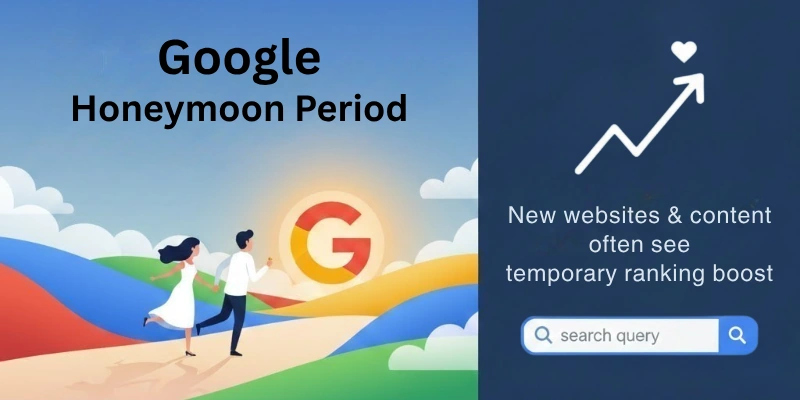
The Google honeymoon period is a time when Google ranks a new website or new content higher in search results pages (SERPs) than it normally would. This is due to Google’s attempt to test the new content to see how users respond to it. Google will keep the content ranked high if users click on it and stay on the website. However, if users do not click on the content or return back quickly, Google will reduce the ranking of the content in the SERPs.
After the Google honeymoon period ends, the website or content will settle into its normal ranking position. This can be higher or lower than its initial ranking, depending on how users interacted with it.
Now, you may be thinking that a website with zero content will also pass through this period. Exactly not! And the answer to your cute question is in the next part.
Does Honeymoon Apply to Every New Website?
Not at All!!
The honeymoon period does not apply to every new website. It only applies to new websites with high-quality unique content, perfect on-page SEO, and up-to-mark technical SEO. Google uses this algorithm to gauge the user experience of such websites. If a website has a good user experience, it will rank higher in search results. Otherwise, it will not rank at all.
Now, here comes a question: Let’s suppose that on our site, Google honeymoon is applied, but how do we guys know that?
Well, it’s a valid question. Let me guide you through this in the next part.
What are the Signs that Your Website is In the Google Honeymoon Period?
If you want to know if your website is currently enjoying the Google Honeymoon Period, here are some key signs that can help guides you:
- Sudden Ranking Surges: A sudden and big rise in your website’s search engine rankings right after it launches or gets a major update is one of the main signs that you are in the Google Honeymoon Period. This sudden rise in visibility is often a clear sign that Google is paying more attention to your site.
- High Click-Through Rates (CTR): A big rise in your website’s click-through rates is another good sign. This means that people are not only finding your website, but they are also interested enough in it to click through and learn more.
- Increased Organic Traffic: If you notice a big increase in organic traffic to your website without making any big changes to your marketing or advertising, this could be a sign that Google is still getting to know your site. This huge increase in visitors means that Google’s search algorithms like your site.
- Quick Indexing of New Pages: Google tends to quickly index any new content or pages you add to your website during the honeymoon period. This means that they show up in search results more quickly than usual.
- Ease of Ranking for Long-Tail Keywords: If you find it relatively easier to rank for certain long-tail keywords relevant to your niche during the initial phase, your website is most likely in the honeymoon phase with Google, allowing you to gain a competitive advantage in your niche.
Now, these are some signs that indicate that your site is enjoying the honeymoon period, but after the confirmation of this, there is a question about how this period actually works. So, to learn about this query, let’s move forward.
How Does Google Honeymoon Period Work?
When you first launch a new website, Google doesn’t have much information about it. It doesn’t know how high-quality the content is, how many backlinks it has, or how users are interacting with it. That’s why Google gives new websites a boost in the rankings during the honeymoon period. This gives Google a chance to gather more data about the website and determine its true ranking.
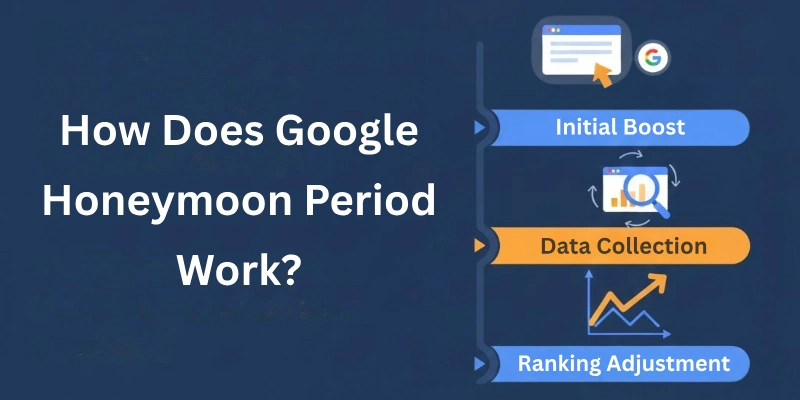
During the honeymoon period, Google will closely monitor how users interact with your website. If users are clicking on your website and spending time on it, this is a good sign to Google that your website is high-quality, relevant and has good user-experience. However, if users are not clicking on your website or are bouncing away quickly, this is a sign to Google that your website is not as high-quality or relevant as it thought it was.
After the honeymoon period is over, Google will use the data it has gathered to assign your website a more permanent ranking. If your website performed well during the honeymoon period, it’s likely that it will maintain a good ranking after the honeymoon period is over. However, if your website did not perform well during the honeymoon period, it’s likely that your ranking will drop.
Now, the next question appears: for how long does the Google honeymoon period last on our site? or for how much time our site enjoys this Google time period.
So, to clear up this question, let’s move on.
How Long Does Google Honeymoon Period Last?
Google does not officially define or disclose the duration of the honeymoon period. However, SEO experts generally agree that it lasts for 3-6 months after a new website is launched or after significant changes are made to an existing website.
During the honeymoon period, Google will give your website a boost in search rankings, even if it does not have a lot of backlinks or high-quality content yet. This is because Google wants to give new websites a chance to prove themselves.
Guys, from above to bottom, are you listening to the one phrase that Google gives you instant ranking? So why don’t you think it’s the right time to make your user experience up to par in the eyes of Google?
I think yes, but again here comes the question, ‘How”.
Well, the answer to your question is in the next part.
How to Make the Most of the Google Honeymoon Period?
Here are 12 tips on how to make the most of this period:
- High-Quality Content
- Keyword Research
- On-Page SEO
- Mobile Optimization
- Quality Backlinks
- Site Speed
- Technical SEO
- Sitemap Submission
- Social Signals
- Monitor Analytics
- User Experience
- Quality User Engagement
- Avoid Black-Hat Practices
Let’s start covering each in detail.
1. High-Quality Content
Make content that helps people and answers their questions clearly. Write in a simple, friendly voice and avoid repeating the same ideas. Google gives more value to content that is useful, fresh, and easy to read.
How to improve this during the honeymoon period:
- Write clear and short sentences
- Add examples to make ideas easy to understand
- Use headings so readers can scan easily
- Keep the information updated
2. Keyword Research
Find the words people search for and match your content to those topics. Focus on keywords that are not very hard to rank for, especially long phrases.
How to improve this during the honeymoon period:
- Pick keywords that match the user question
- Add related supporting keywords in your content
- Avoid using too many keywords
- Check what people are already searching for
3. On-Page SEO
Make every page easy for Google to understand. Place your main keyword naturally in the title, headings, URL, and description.
How to improve this during the honeymoon period:
- Use simple and clear titles
- Write helpful meta descriptions
- Add alt text to images
- Keep paragraphs short
4. Mobile Optimization
Make sure that your website works well on phones and is responsive. Since mobile-first indexing started, Google gives websites that are easy to use on phones more weight.
How to improve this during the honeymoon period:
- Use a mobile-friendly theme
- Make buttons easy to click
- Check how pages look on different screens
- Avoid tiny text or heavy images
5. Quality Backlinks
Focus on getting good backlinks from websites that are authority in your niche. Backlinks can give your website a big boost in authority during the honeymoon period.
How to improve this during the honeymoon period:
- Write content that others want to link to
- Share useful guides and posts in your niche groups
- Build connections with bloggers
- Avoid paid or spam links
6. Site Speed
Google likes websites that load quickly. Cut down on scripts and images that aren’t needed, use content delivery networks (CDNs), and turn on browser caching to make your site run faster.
How to improve this during the honeymoon period:
- Compress images
- Remove heavy plugins
- Use a caching plugin
- Clean old or unused code
7. Technical SEO
Fix any technical problems with your website, like broken links, 404 errors, and content that is already on the site. Check your site’s health often in Google Search Console.
How to improve this during the honeymoon period:
- Fix broken links
- Remove duplicate pages
- Set correct link redirects
- Check errors in Search Console
8. Sitemap Submission
Send your sitemap to Search Console so Google can find your pages faster. This helps new content get discovered during the honeymoon phase.
How to improve this during the honeymoon period:
- Keep your sitemap updated
- Remove unwanted pages from the sitemap
- Make sure only important pages are included
- Check indexing status often
9. Social Signals
Share your content on social platforms to get quick traffic. More visitors in the early days can support better ranking movement.
How to improve this during the honeymoon period:
- Pick platforms your audience uses
- Share short teasers to attract clicks
- Post at the right time when users are active
- Encourage comments and shares
10. Monitor Analytics
Track what is working and what is not. Analytics helps you understand user behavior and improve your strategy.
How to improve this during the honeymoon period:
- Watch your top-performing pages
- Note which keywords bring traffic
- Track bounce rate and time on page
- Improve pages that users leave quickly
11. User Experience
Make your site smooth, simple, and easy to use. A clear layout keeps visitors on your site longer.
How to improve this during the honeymoon period:
- Use a clean design
- Add clear calls to action
- Keep navigation simple
- Avoid distracting pop-ups
12. Quality User Engagement
Try to keep visitors active on your site. When users interact more, Google sees your content as helpful.
How to improve this during the honeymoon period:
- Add comment sections
- Add related posts
- Use simple visuals
- Ask questions to invite responses
13. Avoid Black-Hat Practices
Stay away from black-hat SEO techniques, such as keyword stuffing, cloaking, and buying low-quality backlinks. Google can penalize your website for such practices.
How to improve this during the honeymoon period:
- Do not buy backlinks
- Do not stuff keywords
- Do not hide text
- Keep all strategies clean and safe
So, guys, till here we were assuming all the good news for your site in terms of ranking, but what if Google makes the decision that your site is not up to par to stay on the very first page of Google?
It is very hurtful, but at times you guys need to stay cool and calm. And we need to follow up on these steps.
What to Do When the Google Honeymoon Period is Over?
If Google decides that your site is not up to par to stay on the very first page, it is important to stay cool and calm and follow these steps:
- Analyze your site to see why it may have been penalized. This could be due to a number of factors, such as poor quality content, thin content, duplicate content, or spammy backlinks.
- Make the necessary changes to your site. If you find any areas where your site can be improved, make the changes as soon as possible.
- Monitor your rankings closely. It may take some time for Google to re-crawl and index your site after you have made changes. Be patient and continue to monitor your rankings.
- Continue to create high-quality content and build high-quality backlinks. This is the best way to improve your rankings in the long term.
- Don’t panic. It can be tempting to make drastic changes to your site in an attempt to quickly improve your rankings, but this is not the best approach. It is important to take your time and make thoughtful changes.
- Be patient. It may take some time for Google to recognize your changes and improve your rankings. Don’t get discouraged if you don’t see results immediately.
- Seek professional help. If you are struggling to improve your rankings on your own, you may want to consider hiring a professional SEO consultant.
Remember, the Google honeymoon period is a normal part of the SEO process. Most sites experience a drop in rankings at some point. The important thing is to not give up and continue to work hard to improve your site.
What are Benefits & Drawbacks of the Google Honeymoon Period?
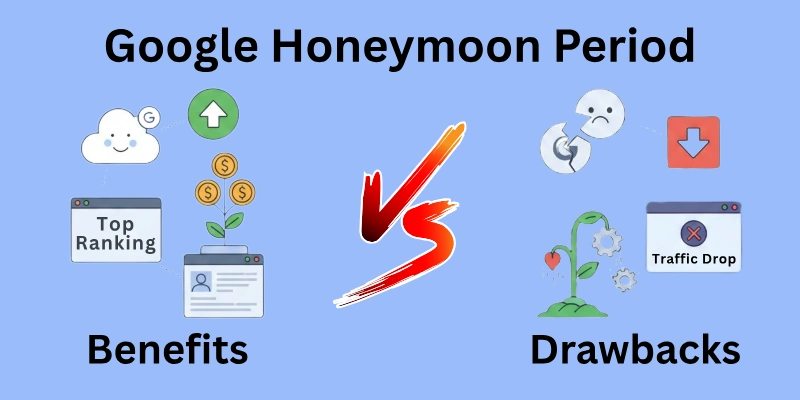
Here some advantages and disadvantages of honeymoon period.
Benefits
Here are some of the major advantages of the Google honeymoon period for your site:
- Increased traffic: During the honeymoon period, your site may receive a surge in traffic due to its newness and relevance.
- Improved rankings: Your site may also rank higher in search results during this time.
- Increased visibility: The increased traffic and rankings can lead to greater visibility for your brand.
- More opportunities: The increased visibility and traffic can lead to more opportunities for your business, such as partnerships, sales, and leads.
Drawbacks
Here are some of the disadvantages of the Google honeymoon period for your site:
- Temporary: The honeymoon period is only temporary, and your rankings may eventually drop if you don’t continue to create high-quality content and build backlinks.
- Misleading: The honeymoon period can give you a false sense of security, and you may think that your site is doing well even when it’s not.
- Unrealistic expectations: The honeymoon period can set unrealistic expectations for your site’s traffic and rankings in the long term.
- Discouragement: If your rankings drop after the honeymoon period, it can be discouraging, especially if you’ve put a lot of time and effort into your site.
Google’s Saying About Honeymoon Period
Google has not officially confirmed the existence of the “honeymoon period,” but there is a lot of evidence to suggest that it is real. Many SEO experts have observed that new sites often rank well for relevant keywords in the early stages of their launch, but then their rankings drop over time.
Google’s John Mueller has spoken about the honeymoon period on a few occasions. In one interview, he said that Google does not explicitly try to promote or demote new content, but that the company’s algorithms may rank new content higher in the search results in order to test it and see how users respond.
In another interview, Mueller said that the honeymoon period is “just a phase” and that new sites should focus on creating high-quality content and building backlinks in order to maintain their rankings in the long term.
So, is the Google honeymoon period real? There is no doubt that some new sites do experience a surge in rankings early on. However, it is important to note that this is not a guaranteed thing, and that rankings can drop after the honeymoon period if the site does not continue to produce high-quality content and build backlinks.
Relationship Between Google Honeymoon, Sandbox and Dance Period
In Google’s search results, a new site goes through three stages: the honeymoon period, the sandbox period, and the dance period.
- The honeymoon period is a short period of time, typically a few weeks, during which a new website is ranked higher in search results than it would normally be. This is because Google does not have enough data about the website to accurately determine its ranking.
- The sandbox is a filter that Google applies to new websites. It prevents new websites from ranking too high in search results until they have built up a good reputation. The sandbox period typically lasts for a few months.
- The dance period is a period of time during which a website’s ranking fluctuates as Google collects more data about it. The dance period can last for several months.
Conclusion
So guys, in this article, we’ve dived into the interesting world of Google’s honeymoon period. We’ve uncovered the secrets behind this fascinating concept and how it can impact your website’s ranking and visibility in search results.
So, the honeymoon period is a great opportunity for new sites to get some exposure and start building traffic. But it’s important to remember that it’s just a phase. If you want to keep your site ranking well in the long term, you need to keep creating high-quality content and building backlinks.
So go ahead, apply what you’ve learned, and watch your website flourish in the world of Google search! Happy optimizing!
FAQs
Here are some of the most commonly asked questions related to the Google Honeymoon Period:
No!!! The only sites whose technical and on-page SEO are best are those where the honeymoon period is applied. Some websites’ honeymoon periods are longer than others, depending on factors like content quality, keyword competitiveness, and backlinks.
The honeymoon period is applied to the single webpage of your site, only to the on keyword. Basically, not your whole website is ranked; only your one webpage is ranked in SERPS, so from this, it’s clear that the honeymoon period is also applied to your website only.
Google temporarily boosts new websites’ rankings to gather data on their user relevance. If many users stay on a new website instead of clicking away and choosing another option on the results page, Google knows it’s helpful.
If your website is not receiving the traffic you expected during the honeymoon period, it is critical to identify the root cause of the problem. This may entail reviewing your website’s analytics to determine which keywords are driving traffic and which are not. You may also need to audit your website’s SEO to ensure that it is optimized for the keywords you are targeting.
To keep your traffic levels high after the honeymoon period is over, you must continue to create high-quality content and build backlinks to your website. You should also monitor your website’s analytics on a regular basis to identify any areas that need improvement.





- Be Respectful
- Stay Relevant
- Stay Positive
- True Feedback
- Encourage Discussion
- Avoid Spamming
- No Fake News
- Don't Copy-Paste
- No Personal Attacks
- Be Respectful
- Stay Relevant
- Stay Positive
- True Feedback
- Encourage Discussion
- Avoid Spamming
- No Fake News
- Don't Copy-Paste
- No Personal Attacks
