What Is Google Dance Period and How to Deal With It?
Published: 24 Jan 2026
Guys, Is there another algorithm applied to a website in addition to the honeymoon period? What does it mean?
Does anyone have information on this?
Emmm.. Let me tell you that is the algorithm that is known as the ‘Dance Period’. It is associated with websites that undergo a honeymoon period.
In the world of search engine optimization (SEO), the terms “honeymoon period” and “dance period” are often mentioned in conjunction with websites experiencing sudden fluctuations in search rankings. Although Google does not formally recognize these periods, SEO professionals frequently use them to describe particular stages in the life cycle of a website.
Now, what actually is the dance period in Google? How does it work? All these questions are addressed below.
What Is the Google Dance Period?
The Google Dance Period happens because Google is trying to figure out where your website fits best in its search results. When a new website comes into the scene, Google gives it some temporary rankings to see how users respond to its content. It’s like a trial run.
Now, Google isn’t exactly sure about the perfect spot for your site. It’s like, ‘Hey, where should we put this?’ That’s where the Dance Period comes in. During this time, Google starts moving your website around in the search results to test different positions and see where it gets the best user experience.
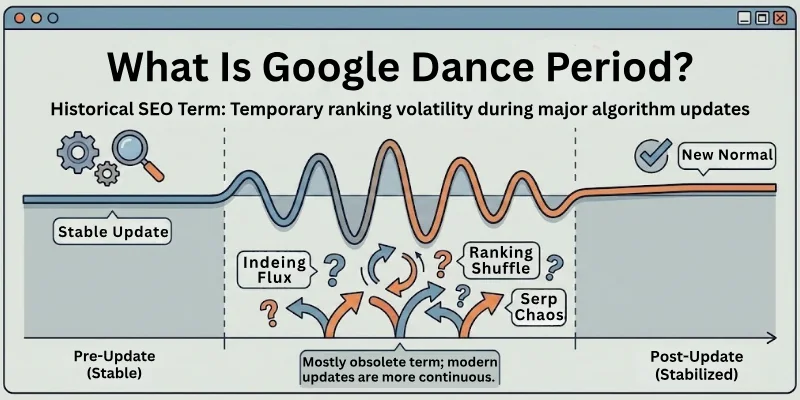
So, why does Google do this dance? It’s all about finding the sweet spot for your website. By shuffling it around, Google can see where users are most happy with your content, and that helps it decide the most fitting and permanent spot for your site in the search results. It’s basically Google’s way of testing the waters to make sure your website lands in the right place for users to find and love it.
So my SEO champs, here you can say that – the term “dance period” refers to a period of time when a website’s search rankings experience unpredictable fluctuations. This period is often seen as a sign that Google is actively evaluating the website’s quality and relevance.
Why Does the Google Dance Period Occur?
Alright, so imagine you’re planning a party. You set up everything: decorations, music, and snacks, but you’re not sure where to put the dance floor for the best vibe. That’s a bit like what Google goes through with the dance period.
Google wants to make sure your website is in the perfect spot in its search results because it’s all about giving users the best experience. User experience is like the feeling people get when they visit your site. If they like it, they stay and explore. If not, they might leave and find another party (or website).
Now, why does this dance happen mostly with new sites? Well, when a new website shows up, Google doesn’t have much info about it. So, during the dance period, Google is testing different spots to see where users respond the best. It’s like finding the best location for your party’s dance floor.
But here’s the twist: even if your site is new, it needs to have good on-page and technical SEO moves. Think of it like having a catchy invitation and making sure the venue is easy to find. If your site has these SEO basics, Google can better understand what your party (website) is about, making the Dance Period more effective.
So, the dance period is like Google’s way of making sure your website is the life of the online party, and good SEO is like sending out the coolest invitations and setting up a venue that everyone wants to be at!
How Does the Google Dance Period Impact Websites?
The Google dance period can have a significant impact on website rankings, both positive and negative. On the positive side, a website’s ranking may improve unexpectedly. And, on the negative side, a website’s ranking may decline unexpectedly.
Positive Impacts
The major positive impacts:
- Unexpected Ranking Improvements: During the Google dance period, Google’s algorithm may re-evaluate websites and identify those that have been overlooked or undervalued. As a result, these websites may experience sudden improvements in their rankings.
- Opportunities for New Websites: New websites may find it easier to rank during the Google dance period, as the algorithm is still evaluating the competitive landscape. This can be a good opportunity for new websites to gain visibility and establish a foothold in their niche.
Negative Impacts
Some negative impacts:
- Unexpected Ranking Drops: Well-established websites may experience temporary ranking drops during the Google dance period, as Google re-evaluates their relevance and authority against the updated ranking factors.
- Increased Volatility: Search engine rankings can change a lot, which can make it hard for website owners to keep track of their progress and make smart SEO decisions.
Impact on Website Traffic
Fluctuations in website rankings can also have an impact on website traffic. For example, if a website’s ranking improves during the Google dance, it may receive more organic traffic from search engines. Conversely, if a website’s ranking declines during the Google dance, it may receive less organic traffic.
Overall Impact
Overall, the impact of the dance on websites can be both positive and negative. It is important for website owners to be aware of this period and to take steps to mitigate its impact, such as continuing to create high-quality content and building backlinks.
Simple Ways to Stay Stable During the Google Dance
When your website rankings move up and down suddenly, it’s often part of the Google Dance. I’ve seen this many times while working on new sites and updated pages. It feels confusing at first, but it’s completely normal.
Google is testing your site before deciding its final position. The key is to stay calm and do the right things consistently.
- Stay Cool during Fluctuations
- Focus on User Experience
- Quality Content Matters
- Technical SEO Check
- Build Backlinks Wisely
- Monitor and Adapt
- Patience is Key
- Utilize Social Media
Below are the best strategies I personally follow during this phase.
1. Stay Cool During Fluctuations
During the Google Dance, rankings change almost daily. One day your page is up, the next day it drops. This does not mean your site is failing. Google is simply comparing your page with others. Panic changes usually do more harm than good.
Tips:
- Do not change keywords every day
- Avoid deleting or rewriting pages too fast
- Check rankings weekly, not hourly
- Trust your long-term work
2. Focus on User Experience
Google watches how real people use your website. If users stay longer and interact, it’s a good sign. I always focus on visitors first, not just search engines. A clean and easy site helps rankings settle faster. Happy users mean better stability.
Tips:
- Make pages easy to read
- Use short paragraphs and clear headings
- Improve page loading speed
- Keep navigation simple
3. Quality Content Matters
Content is the biggest deciding factor during the dance period. Google tests whether users find your content helpful or not. I always write as if I’m helping a real person. When content solves problems, rankings slowly become stable.
Tips:
- Write for humans, not robots
- Answer real questions clearly
- Avoid copying other websites
- Update weak content if needed
4. Technical SEO Check
Even good content fails if Google cannot read your site properly. Technical issues confuse search engines. I always do a basic technical check when rankings fluctuate. A clean technical setup helps Google trust your site faster.
Tips:
- Fix broken links
- Improve mobile responsiveness
- Reduce page loading time
- Check indexing in Search Console
5. Build Backlinks Wisely
Backlinks still matter, but timing is important. When performing the Google Dance, poor links can cause significant harm. My attention is solely directed toward links that are both natural and pertinent.
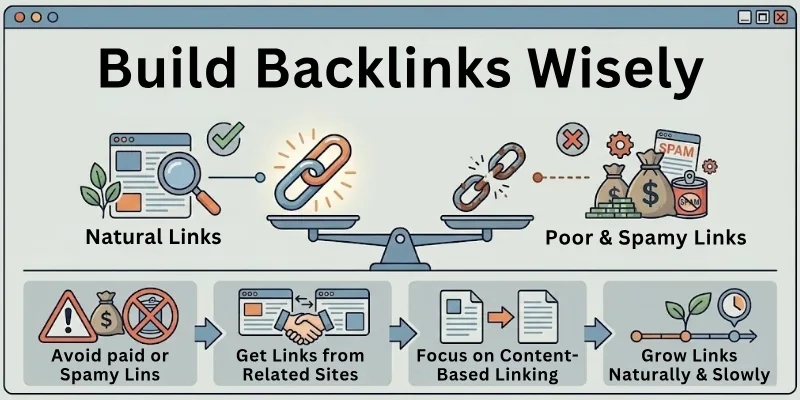
A single healthy link is preferable to ten unhealthy ones.
Tips:
- Avoid paid or spammy links
- Get links from related websites
- Focus on content-based linking
- Grow links slowly and naturally
6. Monitor and Adapt
During this time, I never ignore data. Analytics lets you know what’s really going on. I don’t guess; instead, I use data to guide small improvements. Rankings settle down better after smart changes are made.
Tips:
- Track traffic changes
- Watch bounce rate and time on page
- Improve pages that lose traffic
- Keep testing small changes
7. Patience Is Key
If you are just starting out as a blogger, this is the most challenging part. It takes Google some time to determine where your website should be placed. After weeks or even months, I’ve seen websites reach a stable state. Rushing usually ruins progress.
Tips:
- Give Google enough time
- Avoid daily strategy changes
- Stay consistent with publishing
- Think long-term, not short-term
8. Utilize Social Media
Lots of real people will visit your site if you use social media. It doesn’t directly affect the ranking, but it does make people click on things. Every time I post something, I share it to get early traffic signals. In this way, Google can see real engagement.
Tips:
- Share posts on relevant platforms
- Avoid spam posting
- Focus on real users, not likes
- Be consistent with sharing
Google’s Saying about Dance Period: Myth or Reality
Google’s official stance on the Google Dance is that it is not a real phenomenon. However, many SEO professionals and website owners believe that the Google Dance is real and that it can have a significant impact on website rankings.
There is some evidence to support the existence of the Google Dance. For example, a study by SEOmoz found that website rankings can fluctuate significantly during the first few weeks after a website is launched. This suggests that Google may be actively reevaluating its search results during this time.
However, there is also evidence to suggest that the Google Dance is not a real phenomenon. For example, a study by Search Engine Land found that website rankings do not fluctuate significantly during the Google Dance. This suggests that the fluctuations that are seen during this time may be due to other factors, such as changes in user behavior or the competition.
Ultimately, whether or not the Google Dance is real is a matter of debate. However, it is important to be aware of this phenomenon and to take steps to minimize its impact on your website’s ranking.
Conclusion
In this article, you have learned about the Google Dance period, a time when Google’s ranking algorithm is actively recalculating and updating its search results. This can lead to temporary fluctuations in website rankings, especially for new websites or those that have recently made significant changes.
So, guys, if you are concerned about your website’s ranking during the dance, there are a few things you can do to stay calm and avoid making any rash decisions.
- First, remember that it is normal for rankings to fluctuate during this time.
- Second, focus on continuing to create great content and promoting your website.
- Finally, be patient and wait for the Google Dance to settle down.
In the meantime, you may have some more questions about the Google Dance. Check out the FAQs below for answers to some of the most common questions.
FAQs
Here are some of the most commonly asked questions related to the Google dance period:
The Google Dance can affect all websites, but it is most likely to affect new websites or those that have recently made significant changes. This is because Google is still trying to determine where these websites should rank in its search results.
The duration of the Google Dance can vary, but it typically lasts for a few days or a week. However, it is possible for the dance period to last for longer, especially if Google is making major changes to its ranking algorithm.
Yes, the Google Dance can also be applied to old sites. This can happen if Google makes a major change to its ranking algorithm or if an old site has recently made significant changes.
Yes, it is possible for an old ranking site to be replaced by a new one during the dance period. This is because Google is constantly reevaluating its search results, and a new site may be able to outperform an old site if it is more relevant and provides more value to users
The Google Dance is generally beneficial. In fact, it can be a healthy part of the search engine optimization (SEO) process. This is because it forces websites to constantly compete for rankings, which can help to improve the overall quality of the search results.




- Be Respectful
- Stay Relevant
- Stay Positive
- True Feedback
- Encourage Discussion
- Avoid Spamming
- No Fake News
- Don't Copy-Paste
- No Personal Attacks
- Be Respectful
- Stay Relevant
- Stay Positive
- True Feedback
- Encourage Discussion
- Avoid Spamming
- No Fake News
- Don't Copy-Paste
- No Personal Attacks
