Difference Between DA & PA (Domain Authority vs Page Authority)
Published: 21 Dec 2025
Do you know the difference between DA and PA in SEO? These are two important metrics when it comes to Search Engine Optimization (SEO), and they can play a big role in your website’s ranking in search results.
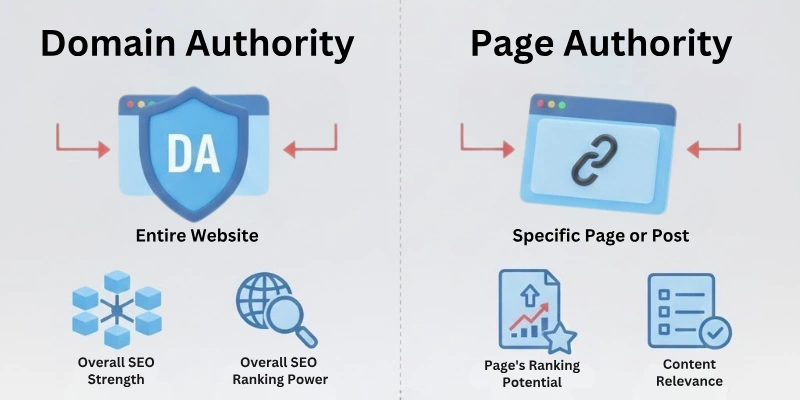
In this article, we’ll take a closer look at DA (Domain Authority) and PA (Page Authority), and explain what they mean, how they’re calculated, and how you can improve them.
We’ll also discuss the key differences between the two metrics, and which one is more important for SEO. So guys, without further ado let’s move forward.
What are Domain Authority and Page Authority in SEO?
Moz, a company that provides SEO tools and services, created Domain Authority and Page Authority. Moz calculates these indicators using a proprietary algorithm, and the measurements are updated on a regular basis.
Imagine you’re a teacher, and your students are websites. Domain Authority (DA) is like the student’s overall grade point average (GPA). It’s a measure of how well the website is doing overall, based on a number of factors, such as the number and quality of backlinks to the website, the age of the domain, and the quality of the content on the website.
Page Authority (PA) is like the student’s grade for a specific assignment. It’s a measure of how well a specific page on the website is doing, based on factors such as the number and quality of backlinks to the page, the quality of the content on the page, and how well the page is optimized for search engines.
I hope you have yet to clear up the concept of how these two parameters are different in their context. Now let’s move forward to explore more!
Why DA and PA Are Important for SEO?
SEO professionals use domain authority (DA) and page authority (PA) to assess the strength of a website and its individual pages. A website with a high DA and PA is more likely to rank well in search results, resulting in more visitors.
DA and PA are important for SEO because search engines use them as one of many factors to rank websites. When a user searches for a keyword, search engines like Google look at a variety of factors to determine which websites to display on the first page of results. These factors include the quality of the website’s content, the number and quality of backlinks to the website, and the website’s DA and PA.
And you guys know that DA and PA are all about high-quality backlinks, so Google thinks that this site is more trustworthy and needs to rank higher.
But let me tell you one thing: many times, sites with low DA and PA also got ranked. So, you should keep moving slowly and successfully.
Which One is More Important: DA or PA?
DA is generally thought to be more important than PA because it measures a website’s overall strength. PA, on the other hand, is important because it can help individual pages rank higher in search results for relevant keywords.
In general, you should work on increasing your DA because it will help all of your website’s pages rank higher in search results. If you have specific pages that you want to rank higher for specific keywords, you can also focus on improving their PA.
How to Improve DA and PA?
You should concentrate on the following to increase your Domain Authority (DA) and Page Authority (PA):
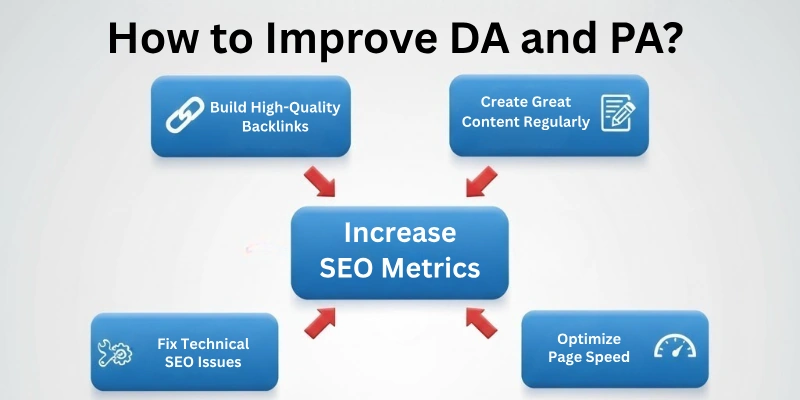
- Create high-quality content: The quality of your content has an impact on both DA and PA. Make certain that your content is informative, interesting, and well-written.
- Create backlinks from high-quality websites: Backlinks refer to SEO links that link from other websites to your own. Backlinks from websites of superior quality are more valuable than those of lower quality.
- Improve the loading speed and user experience of your website: Search engines prefer websites that load quickly and provide a positive user experience. Check that your website is easy to use and that your pages load quickly.
- Optimize your website for search engines: Increasing a website’s visibility in search engine results is the objective of SEO. This includes incorporating relevant keywords throughout your site and acquiring backlinks from high-quality websites.
- Guest blogging: An excellent way to obtain backlinks from high-quality websites. Guest blogging entails writing an article for another website and including a link to your own website in the author bio.
- Submit your website to directories: You can submit your website to a variety of online directories. This can help to increase the visibility of your website and attract backlinks.
- Use social media to promote your website: Social media is an excellent tool for promoting your website and content. Make sure to add a link back to your website when you share your content on social media.
Key Differences between Domain Authority & Page Authority
Here, I have made a comparison for you, and I have listed all the key differences that can be covered in term of DA vs. PA.
| Aspect | Domain Authority (DA) | Page Authority (PA) |
| Definition | Measures overall domain authority. | Assesses the authority of a single web page. |
| Scope | Considers the entire domain or website. | Focuses on a specific page within the domain. |
| Calculation | Based on a combination of various factors, including backlinks to the entire domain. | Calculated based on factors specific to the individual page. |
| Purpose | Used to evaluate the domain’s potential to rank in search results. | Evaluates the potential of a single page to rank. |
| Timeframe | Represents a more long-term measure of authority. | Reflects a more short-term view of a page’s authority. |
| Changes over time | Changes relatively slowly. | Can change more rapidly due to page-specific factors. |
| Affected by site size | Often influenced by the overall size and age of the website. | Not significantly affected by the size or age of the website. |
| Useful for | Useful for understanding the overall health of a website’s SEO efforts. | Useful for assessing individual page performance and optimization. |
| Importance of backlinks | Heavily relies on the quantity and quality of backlinks to the domain. | Relies on the backlinks pointing to the specific page. |
| Site-wide vs. Page-specific | Represents the authority at the domain level. | Focuses on the page’s specific authority. |
| Influenced by subdomains | Takes into account the entire domain, including subdomains. | Does not consider subdomains; it’s page-specific. |
| Competitive analysis | Helps compare the strength of different websites. | Useful for comparing the performance of various pages within a single site. |
| Importance for link building | A consideration when building domain-wide backlinks. | Relevant when building links to specific pages. |
| Ranking prediction | Provides a broad idea of a site’s ranking potential. | Indicates how well a specific page might rank for specific keywords. |
| Used by search engines | Not a ranking metric utilized by search engines. | Not a ranking metric utilized by search engines. |
| Moz-specific | Developed by Moz as a proprietary metric. | Also a proprietary metric by Moz. |
| Updating frequency | Typically updated on a monthly basis. | Updates can be more frequent, reflecting page changes. |
| Historical analysis | Can provide historical data on domain performance. | Offers historical data specific to a page. |
| Change strategies | Strategies might involve improving the overall backlink profile of the domain. | Strategies may focus on optimizing individual pages and their content. |
| Helps with site structure | Primarily used for assessing the overall website’s SEO performance. | Useful for optimizing internal links and page-specific SEO efforts. |
Conclusion
In this article, we have covered the following key differences between Domain Authority (DA) and Page Authority (PA) in SEO. Improving DA and PA takes time and effort, but it is worth it in the long run. Having a high DA and PA can help your site get more visitors and rank higher in search results.
But, if you are a beginner, don’t get discouraged if your DA and PA scores are low at first. It takes time to build up these metrics. Just focus on creating high-quality content and building backlinks from high-quality websites. Over time, your DA and PA scores will improve.
FAQs
Here are some of the most commonly asked questions related to the difference between DA and PA in SEO:
It can take several months or even years to see significant results from improving your DA and PA. However, you should start to see some improvement within a few weeks or months.
Some of the most common mistakes people make when trying to improve their DA and PA are as follows:
- Trying to buy backlinks.
- Focusing on quantity over quality when building backlinks.
- Not creating high-quality content.
There are a number of tools that you can use to track your DA and PA over time, such as Moz, Majestic, and SEMrush. These tools will show you how your DA and PA have changed over time and how you compare to other websites in your industry.
Some common misconceptions about DA and PA include:
- DA and PA are the only factors that search engines use to rank websites.
- DA and PA are a measure of traffic.
- A high DA and PA guarantees a high ranking in search results.
Moz created Domain Authority (DA) and Page Authority (PA), while Ahrefs created URL Rating (UR) and Domain Rating (DR). All four metrics are used to assess the strength of a domain or page, but their algorithms differ.
In general, DA and PA are considered to be more widely used and trusted than UR and DR. However, all four metrics can be useful for SEO professionals.






- Be Respectful
- Stay Relevant
- Stay Positive
- True Feedback
- Encourage Discussion
- Avoid Spamming
- No Fake News
- Don't Copy-Paste
- No Personal Attacks
- Be Respectful
- Stay Relevant
- Stay Positive
- True Feedback
- Encourage Discussion
- Avoid Spamming
- No Fake News
- Don't Copy-Paste
- No Personal Attacks
