What is PA (Page Authority) in SEO? All Factors Explained
Published: 26 Dec 2025
Hey there! So, what the heck is PA in SEO? Well, don’t worry, I’ve got your back.
PA stands for Page Authority, and it’s sort of like a popularity contest for web pages. In this article, we’ll go over what Page Authority is, why it’s important for your website’s SEO, and how you can boost your PA to get your pages to the top of the search results ladder.
So buckle up, and let’s solve the mystery of this SEO jargon!
What is PA in SEO?
Page Authority (PA) is a Moz indicator that predicts how well a particular web page will rank in search engine results pages (SERPs).
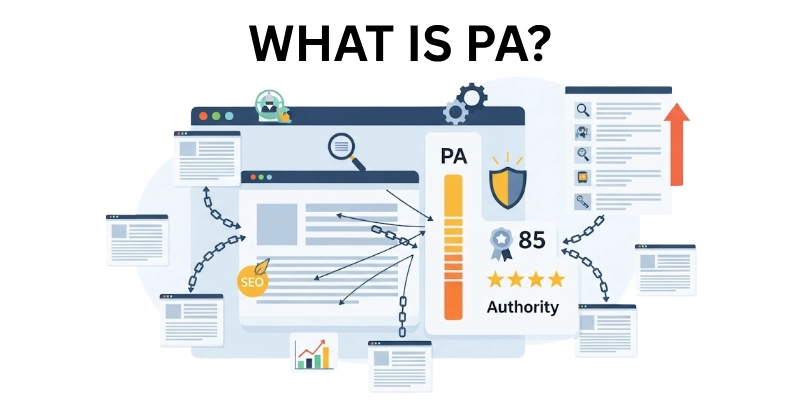
It’s similar to a popularity contest for web pages, but instead of measuring the number of likes and followers, PA considers the quantity and quality of backlinks they have. Backlinks are links from other websites to your own, and they are a strong indicator to search engines that your page is authoritative and trustworthy.
As a result, a web page with a high PA score is more likely to rank well for its target keywords than a web page with a low PA score.
BUT!!
It is crucial to note that PA is not the only element that search engines like Google examine when ranking web pages. They also consider the page’s content, domain authority, and user experience.
Why is PA Important in SEO?
Suppose you’re a student working on a research paper on a specific topic. You want your paper to be found on Google so that other students can use it as a reference.
You begin by producing a high-quality, well-researched, and informative paper. But that is insufficient. You should also encourage other students to link to your work from their own.
The better your PA score, the more high-quality backlinks you have to your work. The higher the PA score, the more probable it is that your paper will rank well on Google.
As a result, PA is vital in SEO because it informs search engines that your page is of high quality and authoritative.
How is PA Scored?
Moz scores PA on a 100-point logarithmic scale, making it easier to improve from 20 to 30 than from 70 to 80. Moz utilizes a machine learning model to find the method that best predicts results across thousands of SERPs and calculates PA scores using that calculation.
Moz uses these parameters for estimating PA:
- The number of backlinks to the page
- The domain authority of the linking pages
- The quality of the content on the page
Here’s a tip:
Don’t focus too much on trying to increase your PA score directly. Instead, focus on creating high-quality content and getting backlinks from other high-quality websites. If you do that, your PA score will naturally increase over time.
What is a “Good” PA in SEO?
A “good” PA score is like a high GPA. It’s a good indication that your web page is authoritative and trustworthy. But it’s not the only thing that matters. Search engine like Google also look at other factors, like the quality of your content and the popularity of your website.
So, what’s a “good” PA score?
It depends on your competition. If you’re in a competitive niche, you’ll need a higher PA score to rank well. But if you’re in a less competitive niche, you can get away with a lower PA score.
Here’s a general rule of thumb:
- If you have a PA score of 60 or higher, you’re in good shape.
- If you have a PA score of 70 or higher, you’re doing great.
- If you have a PA score of 80 or higher, you’re killing it.
- If you have a PA score of 90 or higher, you’re a beast.
If your PA score is lower than 60, don’t worry. There are things you can do to improve it, such as creating high-quality content and getting backlinks from other high-quality websites.
How to Check PA?
There are a number of different tools that you can use to check Page Authority, including:
- Moz Link Explorer
- Ahrefs
- SEMrush
- Ubersuggest
To check your Page Authority (PA) using Moz Link Explorer:
- Go to Moz Link Explorer: https://moz.com/link-explorer and create an account if you don’t already have one.
- Enter the URL of the page that you want to check in the search bar and click “Analyze.”
- Once the analysis is complete, scroll down to the “Overview” section and look for the “Page Authority” metric.
To check your PA using Ahrefs:
- Go to Ahrefs: https://ahrefs.com/ and create an account if you don’t already have one.
- Enter the URL of the page that you want to check in the search bar and click “Enter.”
- Once the analysis is complete, scroll down to the “Overview” section and look for the “Domain Rating” metric.
To check your PA using SEMrush:
- Go to SEMrush: https://www.semrush.com/ and create an account if you don’t already have one.
- Enter the URL of the page that you want to check in the search bar and click “Analyze.”
- Once the analysis is complete, scroll down to the “Organic Research” section and look for the “Authority Score” metric.
To check your PA using Ubersuggest:
- Go to Ubersuggest: https://ubersuggest.com/ and enter the URL of the page that you want to check in the search bar.
- Click on the “SEO Analyzer” tab and look for the “Domain Authority” and “Page Authority” metrics.
NOTE: These tools all use slightly different methodologies to calculate PA, so you may get slightly different scores from each tool.
How do I Improve Page Authority?
Here are some steps that Moz recommends to improve PA:

- Focus on building SEO links from relevant and authoritative websites. Not all backlinks are created equal. Backlinks from high-quality websites in your niche are more valuable than backlinks from low-quality websites.
- Create linkable content. This is content that other people are likely to want to link to, such as in-depth blog posts, infographics, and research studies.
- Build internal links to your target page. Internal links from high-authority pages on your website can help to boost the PA of your target page.
- Promote your content on social media. Sharing your content on social media can help to increase its prominence and attract backlinks from other websites.
- Improve your website’s overall SEO. This includes optimizing your website for target keywords, improving your technical SEO, and building a strong brand reputation.
- Use Moz’s Link Explorer tool to monitor your link profile. This tool can help you to identify any low-quality backlinks that you need to disavow.
Why Did My PA Change?
Moz calculate PA on a variety of factors, including the number and quality of backlinks to the page, as well as the authority of the linking domains. So, there are a few number of reasons why your PA might change, including:
- Fluctuations in your backlink profile. If you gain or lose backlinks, your PA will change accordingly. Moz says that you should focus on getting high-quality backlinks from sites that are known to be trustworthy.
- Changes to Moz’s algorithm. Moz periodically updates its algorithm to improve the accuracy of its metrics. These algorithm updates can sometimes lead to fluctuations in PA values.
- Changes to the competitive landscape. If your competitors are improving their SEO, it may become more difficult for your page to rank highly. To stay ahead of the competition, Moz recommends that you regularly update your content and build high-quality backlinks.
Conclusion
In this article, we have covered everything you need to know about Page Authority (PA) in SEO.
Guys, here I am again saying that it is important to note that PA is not a direct ranking factor used by Google. But it is a useful metric for SEO professionals to track and improve a page’s overall ranking potential.
Here are some of the key takeaways from this article:
- PA is calculated using a variety of factors
- PA scores can be improved by building high-quality backlinks to your pages
- PA is not a direct ranking factor
So, if you are serious about improving your website’s SEO, it is important to focus on Off-page SEO techniques.
FAQs
Here are some of the most commonly asked questions related to what is page authority in SEO:
DA stands for Domain Authority, and PA stands for Page Authority. Both metrics are developed by Moz. And they are used to predict how well a website or page will rank on search engine result pages.
PA measures the strength of a single page, while DA measures the strength of an entire domain. So, if you have a high PA score for a particular page, that means that page is likely to rank well for its target keywords.
Google has stated that PA is not a direct ranking factor. But, it is a metric that is interrelated with rankings. This means that pages with a higher PA tend to rank higher than pages with a lower PA.
Yes, low-PA sites can also get ranked. Google considers many factors when ranking websites, including content quality, user experience, and backlinks.
Yes, it is possible for a new blog website to compete with high-PA sites, but it will take time and effort. You need to create high-quality content that is informative and engaging, and you need to build backlinks from other trustworthy websites.