Doorway Pages: The Black Sheep of SEO
Published: 4 Dec 2025
Have you ever stumbled upon a webpage that seems to have no purpose other than to redirect you to another page? If so, you might have just encountered a doorway page, a black-hat SEO technique.
But what exactly are doorway pages in SEO, and how do they impact search engine optimization (SEO)? Let’s explore the world of doorway pages and figure out how this method works.
But remember that the sole purpose of this blog post is to provide you with information about this technique; do not try to implement it on your site. Because it can penalize your website.
Let’s dive in!
Doorway Pages Definition
Once upon a time, doorway pages were a common practice in SEO, as they could effectively boost a website’s ranking for specific keywords. But search engines like Google grew wise to this tactic and started penalizing websites that used doorway pages.
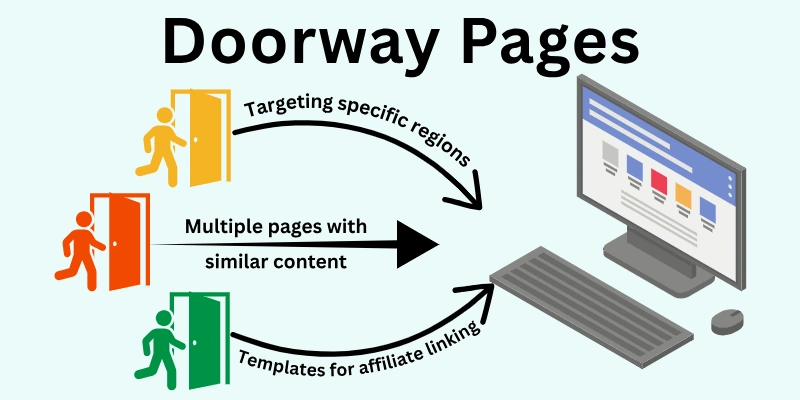
These pages, often laden with irrelevant content and keyword stuffing, served as gateways to redirect users to more relevant pages within the same site. Even though this method may have helped SEO in the short term, it hurt the quality of search results and made the user experience worse in the long run.
For example, if a user clicks on one result, does not like it, and then tries the next result in the search results page and is taken to that same website, they are known as doorway pages. These pages are also known as bridge pages, portal pages, jump pages, gateway pages, or entry pages.
Examples of Doorway Pages
To further illustrate the concept of doorway pages, consider the following examples:
- Multiple domain names targeting specific regions: A business might create multiple domain names, each targeting a different region, and then redirect all traffic from these domains to a single landing page. This practice aims to manipulate search results by appearing prominently for local searches in various regions.
- Templates solely for affiliate linking: A website might create numerous pages using the same template, each filled with affiliate links for different products or services. This approach aims to maximize affiliate commissions by generating a large number of pages that rank for specific keywords.
- Multiple pages with similar content: A website might have multiple pages with nearly identical content, each targeting a slightly different variation of a keyword. This tactic aims to increase the chances of appearing in search results for various keyword combinations.
Purpose of Doorway Pages
The purpose of doorway is to manipulate search engine rankings. They are web pages that are specifically designed to rank well for certain keywords, but they do not provide any real value to users. Instead, they redirect users to other pages on the same website.
Doorway pages are created by using a variety of techniques, such as keyword stuffing, content scraping, and cloaking. They are often low-quality and irrelevant to the user’s search intent.
SEO Impact of Doorway Pages
Doorway pages are like a bad first date. They’re designed to impress search engines, but they’re not interested in providing any real value to users. So, search engines wise up to their tricks and punish websites that use them. This can lead to lower rankings and less traffic.
So, if you want to have a successful SEO strategy, avoid doorway pages like the plague. Focus on creating high-quality content that users actually want to read, and you’ll be glad you did.
Google’s Stance on Doorway Pages
Google is not a fan of doorway pages. In fact, they’ve said that doorway pages are a “black hat SEO technique” that can “harm the quality of the user’s search experience.” This means that if you use doorway pages, you’re likely to be penalized by Google, which can lead to lower rankings and less traffic.
Google has been cracking down on doorway pages for years, and they’ve only gotten stricter. In 2015, they even updated their Webmaster Guidelines to specifically address doorway pages. The update stated that “Doorway pages that are created solely for search engines can harm the quality of the user’s search experience.”
So, if you’re thinking about using doorway pages, don’t. It’s simply not worth the risk.
How to Identify Doorway Pages
Identifying doorway pages can be tricky, but here are some key indicators to look for:
- Multiple pages with identical or near-identical content: Doorway pages often use the same content across multiple pages, with only minor variations in keywords or formatting.
- Excessive keyword stuffing: Doorway pages often cram keywords into their content in an unnatural or repetitive manner, making the text difficult to read and understand.
- Low-quality or irrelevant content: Doorway pages often lack substantive content that provides genuine value to users. They may be filled with generic text or irrelevant images.
- Redirection to other pages: Doorway pages often redirect users to other pages on the same website, without providing any clear explanation or context.
- Lack of user engagement: Doorway pages often have low user engagement metrics, such as low bounce rates, short visit durations, and few social shares.
P.S. If you suspect that your website may have doorway pages, it’s important to take action to remove or modify them. Failing to do so could lead to penalties from search engines and a decline in traffic.
Best Practices for Avoiding Doorway Pages
Here are some tips you guys can follow to stay away from the doorway page on your site:
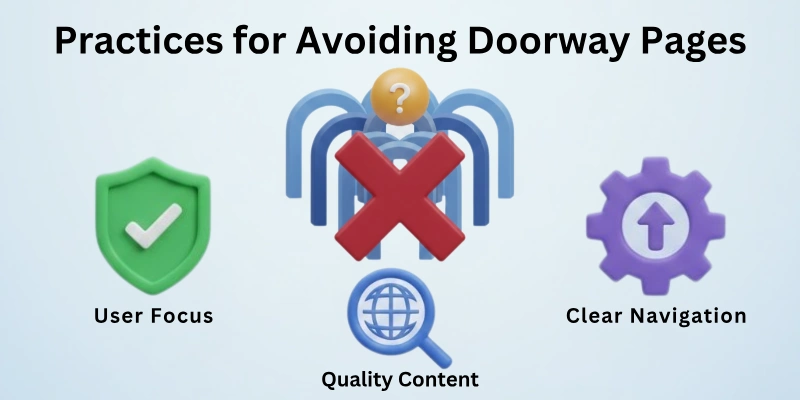
- Create high-quality, original content: This is the most important thing you can do to avoid doorway pages. Search engines love fresh, original content that is relevant to your target audience.
- Use keywords naturally: Don’t stuff your pages with keywords. Instead, use them naturally throughout your content.
- Avoid creating multiple pages for the same keyword: This is a surefire way to get penalized by search engines.
- Use canonical tags: Canonical tags tell search engines which page is the original version of a page. This can help to avoid duplicate content penalties.
- Get links from other websites: Links from other websites are a sign of authority and trust. The more links you have, the higher your website will rank in search results.
- Follow Google’s Webmaster Guidelines: The Webmaster Guidelines are a set of rules that Google uses to determine which websites are high-quality and which ones are not. Make sure to follow these guidelines to avoid getting penalized.
- Be patient: It takes time to build a successful website. Don’t expect to see results overnight. Just keep creating great content and following these best practices, and you will eventually see your website rise in the search rankings.
Penalties for Using Doorway Pages
Here is a short explanation of the penalties your site can get due to using doorway pages:
- Lower search rankings: Using doorway pages can lead to lower search rankings for your website. This is because search engines like Google prioritize websites that provide genuine value to users. Doorway pages, on the other hand, are designed to manipulate search results and provide a poor user experience.
- Manual penalties: In some cases, Google may manually penalize your website if they find that you are using doorway pages. This can be a more serious penalty, as it can result in your website being completely removed from Google’s search results.
- Loss of traffic: As a result of lower search rankings and manual penalties, you may lose a significant amount of traffic to your website. This can have a negative impact on your business, as you may be able to generate fewer leads and sales.
SEO Tools for Detecting Doorway Pages
Here’s a brief explanation of the best SEO tools for detecting doorway pages:
- Google Search Console: This free tool from Google can help you identify doorway pages on your website. It provides insights into how your website is performing in search results and can flag potential issues, including doorway pages.
- Screaming Frog: This paid tool is a powerful website crawler that can scan your site and identify doorway pages, along with other SEO issues. It provides detailed reports and can help you prioritize your cleanup efforts.
- DeepCrawl: Similar to Screaming Frog, DeepCrawl is a paid website crawler that can thoroughly analyze your site and identify doorway pages. It offers advanced features like data visualization and real-time crawling.
- Sitebulb: Another paid website crawler, Sitebulb provides comprehensive analysis of your website’s SEO performance, including identifying doorway pages. It offers a user-friendly interface and can generate detailed reports.
- Botify: Botify is a paid website crawler that specializes in detecting doorway pages and other SEO issues. It provides in-depth analysis and can help you identify even the most subtle doorway pages.
Conclusion
Well, my friends, that’s a wrap on our journey into the dark world of doorway pages. We’ve learned the ins and outs of these manipulative tactics and why they’re a major no-no in the eyes of search engines.
Remember, the key to SEO success lies in creating genuine value for your users. Focus on creating high-quality content, optimizing your keywords naturally, and providing a better user experience. And always stay away from black-hat methods like doorway pages.
So, as we say goodbye, let’s promise to keep your websites clean and our SEO practices honest. A good reputation is worth more than any short-term boost in rank.
FAQs
Here are some of the most commonly asked questions related to the doorway pages in SEO:
Even if you’re new to SEO, it’s crucial to avoid doorway pages. They may seem like a quick fix to boost rankings, but the long-term consequences are far more detrimental. Focus on building a strong foundation for your website by creating high-quality content and following ethical SEO practices.
If you discover that you have doorway pages on your website, it’s important to remove them as soon as possible. You can either delete the pages or redirect them to more relevant content. Additionally, report the doorway pages to Google using the Search Console to avoid potential penalties.
While you can’t directly control what others do, you can take steps to protect your website from doorway pages created by third parties. Use canonical tags to identify the original version of your pages, and regularly monitor your website for any suspicious activity.
As search engines become more sophisticated in detecting and combating manipulative techniques, doorway pages are becoming increasingly ineffective and outdated. Focus on creating genuine value for users and following ethical SEO practices to ensure your website’s long-term success.
Doorway pages are specifically designed to manipulate search engine rankings, while landing pages are designed to guide users towards a specific action, such as making a purchase or subscribing to a newsletter. Landing pages provide value to users and are considered acceptable SEO practices.
In very rare cases, doorway pages might be used for legitimate purposes, such as providing temporary redirects during website maintenance or testing. However, these instances should be strictly limited and should not involve manipulating search engine rankings.




- Be Respectful
- Stay Relevant
- Stay Positive
- True Feedback
- Encourage Discussion
- Avoid Spamming
- No Fake News
- Don't Copy-Paste
- No Personal Attacks
- Be Respectful
- Stay Relevant
- Stay Positive
- True Feedback
- Encourage Discussion
- Avoid Spamming
- No Fake News
- Don't Copy-Paste
- No Personal Attacks
