What is Dwell Time in SEO & How to Measure It?
Published: 30 Nov 2025
In search engine optimization (SEO), dwell time is a crucial factor influencing website rankings. This metric, along with other ranking factors, is considered by Google and Bing.
This blog post delves into the concept of dwell time, clarifying its distinction from bounce rate, a commonly mistaken notion.
Without further ado, let’s dive in on this journey to unlock the secrets of dwell time in SEO!
What is Dwell Time in SEO?
As you know, Google ranks websites with a good user experience. Google evaluates the page experience using different metrics, but it mostly depends on how the user feels while visiting that particular site.
So, dwell time in SEO is somehow also related to page experience, which is an important aspect. So is the explanation for it.
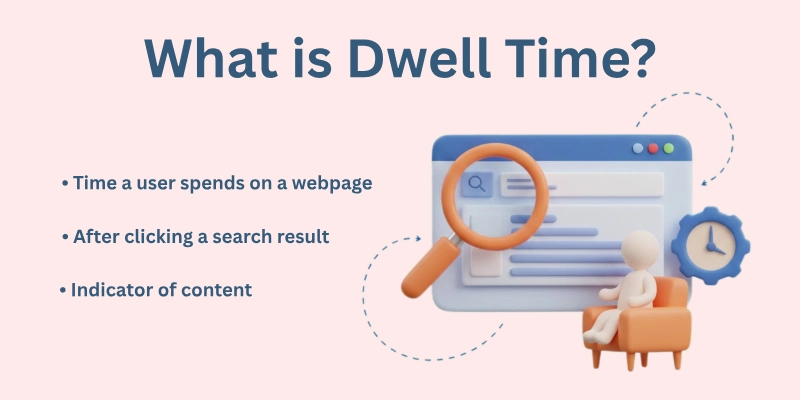
Imagine you’re browsing the web, searching for information on a particular topic. You click on a few links, but you’re not finding what you’re looking for. After a few seconds, you quickly click back to the search results and try another link.
That’s dwell time. It’s the amount of time a user spends on a page before clicking back to the search results. It’s like a user giving your website a quick glance and then deciding whether it’s worth sticking around or not.
If users are spending a lot of time on your pages, it means your content is relevant and valuable. Search engines take that as a sign that your website is providing high-quality information, and they reward you with higher rankings.
Okay, guys. Before moving forward, let me clarify the concept of bounce rate and dwell time. Many of you consider these the same SEO terms.
Difference between Dwell Time & Bounce Rate in SEO
Imagine you’re visiting a restaurant. You look at the menu, decide what you want, and order your meal. After finishing your meal, you leave the restaurant. That’s like dwell time in SEO. It’s the amount of time a user spends on a page before leaving your website.
Now, imagine you go to a different restaurant. You look at the menu, but you don’t see anything you like. You leave the restaurant without ordering anything. That’s like the bounce rate in SEO. It’s the percentage of users who visit your website and leave without viewing more than one page.
In simpler terms, dwell time measures how long users spend on your pages, while bounce rate measures how many users leave your website after viewing only one page.
I hope that your concepts are clear now, so let’s move forward to cover further details.
Why is Dwell Time Important for SEO?
Dwell time is an important factor in SEO (search engine optimization) because it counts how long users stay on a page before returning to the SERP.
Here’s why dwell time is essential for SEO:
- Indicates Content Relevance: Longer stay time indicates to search engines that users find the content relevant, which fulfills their search goal.
- Enhances User Engagement: Dwell time represents the level of engagement users have with your website. Users who spend more time on your site indicate they are interested in your content and find it helpful.
- Reduces Bounce Rate: When people spend more time on your pages, the bounce rate decreases, indicating to search engines that your content is helpful.
- Increases Organic Traffic: Your website’s rankings in search results improve as your dwell time increases. This drives more organic traffic to your website.
- Distinguishes Content from Competitors: Dwell time distinguishes content from competitors. If your dwell times routinely outperform your competitors, your content is more valuable and entertaining, offering you a SERP advantage.
- Drives Long-Term SEO Success: Dwell time is a long-term indicator of website relevancy and engagement. You can build long-term SEO success by regularly creating high-quality content.
How is Dwell Time Measured?
You can’t directly measure dwell time yourself, but you can look at something similar in Google Analytics called “average engagement time.”
This shows how long visitors stay on your page. However, it doesn’t tell you if they left your site right away or checked out more pages. Dwell time helps search engines understand if people find your content helpful or if they quickly return to look for something else.
Improve Your Dwell Time with Proven Strategies
So guys, here I have come up with 10 optimization tips that will improve the dwell time of your web pages:
- Optimize Meta Titles and Meta Descriptions
- Hook Readers in the Intro
- Keep Search Intent in Mind
- Don’t Use Clickbait
- Add Internal Links to Useful Resources
- Improve Page Load Speed
- Use Images and Videos
- Write Clear and Easy-to-Read Content
- Use Relevant CTAs (Calls to Action)
- Keep Content Up to Date
Let’s learn about each strategy.
1. Optimize Meta Titles and Meta Descriptions
All right, so your users’ journey kicks off on the SERPs (search engine results pages). The very first thing they see is your meta title and meta description. You want to make sure those are spot-on—accurate and crisp, so they spark enough curiosity to make people want to click on them. That’s your first impression, so make it count!
2. Hook Readers in the Intro
Once a user lands on your page, the next big thing they notice is the intro, also known as the hook. And here’s a pro tip: use the PAS formula. It stands for:
- P – Problem: Call out the problem they’re facing.
- A – Agitation: Stir it up a bit and remind them why it’s such a hassle.
- S – Solution: Then, swoop in with your solution!
This is hands down the best way to craft an engaging intro that grabs attention right from the get-go.
3. Keep Search Intent in Mind
It’s super important to understand keyword intent. Why? Because this helps you figure out exactly what your users are searching for. Once you nail down their search intent, you can craft content that fully satisfies their needs. That’s how you get more detailed and optimized content that really hits the mark.
4. Don’t Use Clickbait
Steer clear of clickbait tactics. Seriously, they’re a no-go. First off, it’s not ethical, and second, it breaks trust with your audience. If users feel tricked, it’s pretty much a given that your user experience will take a hit, and that could harm your site’s rankings, too. So yeah, skip the clickbait.
5. Add Internal Links to Useful Resources
Another great strategy is to add internal links and links to other useful resources. This boosts your content’s credibility and makes your site a trusted resource in its niche. Plus, it helps with topical authority, basically, showing search engines that your site knows its stuff, which is a big plus for ranking higher.
6. Improve Page Load Speed
Nobody likes a slow website. Make sure your page loads fast, and a big part of that is optimizing your images. If your site takes even 5 to 10 seconds to load, visitors will get frustrated and probably hit the back button, which means they’ll head back to the SERPs, and that’s not good for your site.
7. Use Images and Videos
Try to spice up your content with relevant visuals—images and videos. There’s a saying that goes, “80% of what people learn is visual,” so by adding visuals, you keep people interested and engaged on your page.
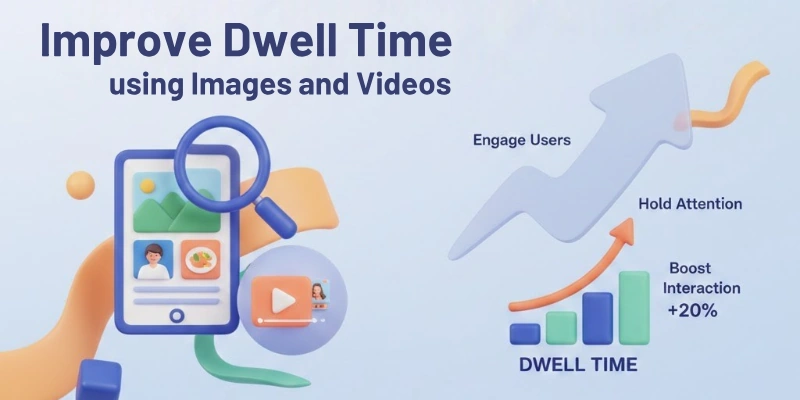
It’s also a good idea to place an image or video right after your hook paragraph to keep that momentum going.
8. Write Clear and Easy-to-Read Content
Think about your audience and their reading level. Tailor your content to match their needs and requirements. Use simple vocabulary short sentences, and break the content into manageable sections. Adding bullet points and a table of contents can also make your content easier to navigate.
9. Use Relevant CTAs (Calls to Action)
Adding relevant CTAs is key. These should be tied to your niche or the specific content on the page. Be sure to place them strategically throughout your content so that your users can easily follow through. This builds trust and encourages action.
10. Keep Content Up to Date
Always keep your content fresh by updating it regularly. When you make changes, use the “updated” tag instead of the “published” tag. This lets users know that your content is current and relevant. If they see that a page has been recently updated, they’re more likely to stick around and read through the rest of your content.
Conclusion
So, friends, in this blog post, we’ve learned that dwell time is a key factor that search engines look at when deciding how high to rank your website. The longer people spend on your pages, the more likely it is that search engines will think your website is relevant and valuable. This will lead to your website ranking higher in search results, which means more people will see it.
So, guys, try improving your dwell time and see a big boost in your website’s traffic and rankings.
FAQs
Here are some of the most frequently asked questions related to the dwell time:
A single person or organization did not create dwell time. It is a natural metric that arises from how users interact with websites. Search engines, such as Google, measure dwell time to assess the relevance and engagement of websites.
A good dwell time depends on the type of content, your niche, and the user’s search intent. For example, a blog post might have a longer dwell time than a product page. Generally, a dwell time of 2-3 minutes is considered good for most websites.
Google has not explicitly confirmed that dwell time is a direct ranking factor. However, there is evidence to suggest that it plays a role in their search algorithm. Websites with longer dwell times tend to rank higher in search results.
Dwell time can vary significantly across different types of websites and content. For instance, news articles typically have shorter dwell times than in-depth research papers. Similarly, product pages with clear visuals and concise descriptions tend to have shorter dwell times than those with lengthy product specifications.
Dwell time is often correlated with user satisfaction. Users who are satisfied with a website’s content and experience are more likely to spend more time on it. Conversely, users who find a website’s content irrelevant or difficult to navigate are more likely to leave quickly.
Pogo-sticking happens when a user quickly clicks back and forth between search results, trying to find what they need. Dwell time is how long they stay on a page before going back to the search results. Pogo-sticking is a sign that users aren’t satisfied, while a longer dwell time can mean they found something useful.
Yes, mobile users may behave differently. They might leave faster if your site isn’t mobile-friendly or if it’s hard to navigate. Optimizing your site for mobile can help improve dwell time on mobile devices.
It’s hard to fake or manipulate dwell time. Tricks like adding unnecessary content or forcing users to stay longer usually don’t work because search engines are smart enough to detect these tactics. Instead, focus on providing real value.
Not always. If users quickly find what they need and leave, it might still be a positive experience. The key is to make sure your content satisfies their search intent, whether they stay for a long time or leave quickly.