Global vs. Local Website: Which Is Better for Your Business?
Published: 24 Feb 2026
Today, there are more than 1.1 billion to 1.34 billion websites, and each one serves a different purpose. Some websites are made for people all over the world, while others are targeted toward a certain local market.
Global websites are usually owned by big companies or organizations, and they sell goods or services to people all over the world. Local websites, on the other hand, are usually run by small businesses or private people, and they focus on a certain area.
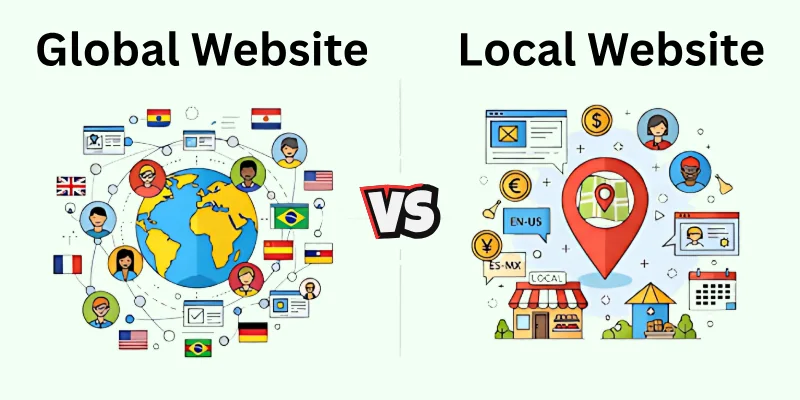
In this article, we will explore the key differences between global vs. local websites. We will discuss the pros and cons of each type of website, and we will offer advice on how to choose the right type of website for your business.
So, whether you are just starting out or looking to redesign your existing website, this article will assist you in selecting the best type of website for your business and audience.
Let us start with what exactly the website means!!!
What is a Website & Why is It Important?
A website is a group of web pages and other related resources that are linked together by a shared domain name and posted on at least one web server. A website can be as simple as a single static page or as complicated as an application with tens of thousands of changing pages.
There are a lot of reasons why websites are important. One can use them to:
- Provide information about a business or organization
- Sell products or services online
- Build a community around a shared interest
- Provide a platform for self-expression
- Educate and inform the public
- Promote a cause or movement
In today’s digital world, any business or group that wants to reach people all over the world needs to have a website. Websites allow businesses to connect with customers and potential customers from all over the world, 24/7.
Moreover, websites are important for people as well. You can use them to build your personal brand, share your work, or find people who like the same things you do.
However, guys!!!
Here comes a question: Should we make a global site or a local site to fulfill our needs? Which one is going to be best for us?
I know this question is quite tough to answer.
So, for you guys, I have come up with a detailed overview related to global and local websites. By knowing them, you can make a better decision for yourself.
What is a Global Website?
A global website is one that is intended to be available to individuals from all over the world. It is usually owned by a huge corporation or organization with consumers or users in numerous countries.
Global websites are often translated into various languages in order for visitors from all over the world to comprehend them. They also frequently include tools that allow users to access the website in their native currency and time zone.
Here are some examples of global websites:
- Amazon
- Wikipedia
- YouTube
Let’s dig into the next part of the article to learn more about global sites.
Pros and Cons of Global Websites
Here is a list of all the advantages and disadvantages of global sites, and after reading that, you can get your mind clear on the concept of which site category is best for you.
Pros of Global Websites
Here are some of the major advantages of global websites:
- Reach a global audience: Allow businesses to reach customers all over the world.
- Increase brand awareness: Help businesses to build brand awareness and recognition on a global scale.
- Generate leads and sales: Used to generate leads and sales from customers all over the world.
- Improve customer service: Used to provide customer support to customers all over the world.
- Reduce costs: Help businesses to reduce costs by centralizing their marketing and sales efforts.
Cons of Global Websites
The major disadvantages of global websites are:
- Cost of development and maintenance: Can be more expensive to develop and maintain than local websites.
- Need to localize content: Needs to be localized for different languages and cultures in order to be effective.
- Competition: Face competition from other global websites and local websites in all of the markets they serve.
- Compliance: Need to comply with all applicable laws and regulations in the countries they operate in.
For Whom Is it Beneficial to Have a Global Website?
The answer to this question is that a global website is most helpful for businesses that want to reach a bigger audience and grow beyond their home market.
This covers both online businesses and businesses that have locations in more than one country. And groups that want to tell people all over the world about their causes or services.
So, guys, if you’re thinking about making a world website, there are a few things you should remember:
- First, ensure that your website is appropriately translated into the languages of your target markets.
- You should also localize your website’s content and messaging to appeal to other cultures.
- Furthermore, you must ensure that your website is optimized for search engines in different countries.
So, it’s clear that creating and maintaining a global website can be challenging, but it can be a very rewarding investment for businesses that are looking to expand their reach in the online world.
What is a Local Website?
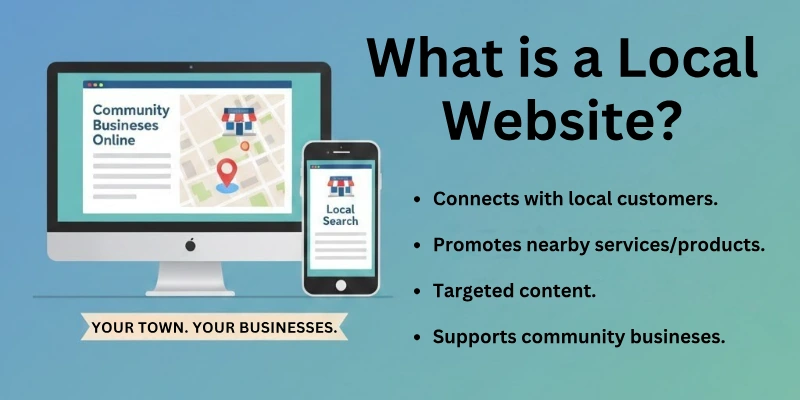
A local website is a website that is meant to reach people in a certain area. It is usually owned by a small business or group that wants to reach local customers.
Local websites usually focus on giving information about the company or organization, like what it sells or does, when it’s open, and how to get in touch with it. They might also have things that are only available in the local area, like a map of where the company is or a list of local events.
Here are some examples of local websites:
- A restaurant’s website that lists its menu, hours of operation, and location.
- A dentist’s website that provides information about their services, hours of operation, and contact information.
- A local real estate agent’s website that lists homes for sale and rent in the area.
Local websites can be about anything that is important to the people in the area. They can be a great way for companies to connect with their customers and supporters and give them the information and services they need.
Pros and Cons of Local Websites
Here are some advantages and disadvantages of local websites; you can take a look at them to make a better decision for your business site.
Pros of Local Websites
The major advantages of local websites:
- Improved visibility: Makes your business visible to anyone with an internet connection, but especially to those in your local area.
- Improved brand awareness: Help you to create a strong brand identity and build awareness of your business in your local area.
- Increased sales and leads: Used to generate leads and sales for your business.
- Improved customer service: Used to provide customer support and answer questions from potential and existing customers.
- Reduced costs: Help you to reduce costs in a number of ways. For example, you can use your website to distribute marketing materials and provide customer support, which can reduce the need for print materials.
Cons of Local Websites
Some disadvantages of having a local site:
- Limited reach: Will only reach people who are searching for businesses in your local area.
- Increased competition: If you are operating in a competitive industry, you may find that it is difficult to stand out from your competitors with a local website.
- Cost: Can be costly, especially if you hire a professional web designer or developer.
For Whom Is it Beneficial to Have a Local Website?
The answer to this question is that a local website is most beneficial for businesses looking to establish a strong presence within their specific region or city.
This applies to both online businesses and brick-and-mortar establishments operating in the local area. Additionally, local community groups and organizations can benefit from a local website to connect with their immediate audience.
So, folks, if you’re considering creating a local website, keep these key points in mind:
- Ensure that your website’s content is highly specified to your target area.
- Highlight your physical location and provide accurate contact information.
- Optimize your website for local search engines, such as Google Maps, and use local keywords and phrases relevant to your area.
- Keep your website updated with information about local events, news, and trends.
So guys, creating and maintaining a local website can be a rewarding investment for businesses aiming to establish a strong local presence.
One Global Website vs. Multiple Local Websites
The decision between one global website and several local websites is determined by the organization’s aims and intended audience.
A single worldwide website provides consistent branding, streamlined content administration, and cost savings. It may, however, struggle to accommodate varied local tastes and languages.
Multiple local websites, on the other hand, allow for personalized content, improved SEO targeting, and cultural sensitivity but require more resources and sophisticated management.
To effectively engage global and local audiences, the selection should be in line with your international strategy, balancing consistency and customization.
Difference Between Global vs. Local Website
Here I have designed the difference table between global and local sites to make the differences easily digestible.
| Aspect | Global Website | Local Website |
| Target Audience | Worldwide or multiple countries | Specific local region or country |
| Content | Often in multiple languages | Primarily in one local language |
| Products/Services | Offer a wide range of products/services | Tailored to local market needs |
| Branding | Consistent global branding | May have localized branding and messaging |
| Pricing | May have standardized pricing | Prices adjusted for local market conditions |
| Currency | Supports multiple currencies | Typically uses the local currency |
| Shipping/Logistics | Global shipping and logistics networks | Localized shipping and logistics |
| SEO and Keywords | Requires international SEO strategies | Focus on local SEO and keywords |
| Customer Support | Multilingual and global support | Localized customer support |
| Cultural Sensitivity | Requires sensitivity to diverse cultures | Tailored to the local culture and norms |
| Marketing Strategies | Global marketing campaigns | Localized marketing strategies |
| Legal Compliance | Complies with international laws/regulations | Adheres to local laws/regulations |
| Content Localization | May require translation and localization | Created in the local language and context |
| Domain and Hosting | Often uses a generic top-level domain (e.g., .com) | May use country-specific domains (e.g., .uk) |
| User Experience | Consistent user experience worldwide | Tailored user experience for local users |
| Analytics | Global analytics for a broad view | Local analytics to track regional performance |
| Payment Methods | Multiple global payment options | Local payment methods integrated |
| Competitors | Face competition on a global scale | Face competition primarily locally |
Conclusion
In this article, we have covered the definition, pros and cons, and differences of both global and local websites in detail. Each option offers unique advantages and considerations.
As an expert, I recommend starting with a local website if you are a beginner or small business. It is easier to manage, less competitive, and helps you build trust step by step. Once your business becomes stable and strong, you can expand to a global website.
But if you already have a strong team, budget, and delivery system, you can start globally. The most important thing is to choose what fits your business capacity and long-term goals.
FAQs: Global vs. Local Website
Here are some of the most frequently asked questions related to the difference between local and global websites:
There are between 1.34 billion and over 1.4 billion websites on the internet as of early 2026. But only a small portion of these are thought to be “active,” which means they are updated or visited often. About 190 to 200 million active sites are thought to exist.
Local websites focus on a particular geographic area, such as a city, region, or country. They frequently offer details about local businesses, events, and services. International websites target a worldwide audience and may provide products and services in multiple languages and regions.
A global URL is an address for a website that is accessible globally. Common top-level domains include .com, .net, and .org. A local URL is a web address that is geographically specific. It may have a country-code top-level domain (ccTLD) like .uk, .de, or .jp.
Yes, a business can have both. Many companies start with a local website and later create a global version. Some businesses use separate country domains, while others use subfolders like /us/ or /uk/ to target different regions.
It depends on your target audience. A local website is better for ranking in a specific city or country. A global website works better if you want to reach users in multiple countries. Your SEO strategy should match your business goals.
Generally, yes. A local website usually requires fewer resources, less content, and simpler management. A global website may need multiple languages, international shipping, and advanced technical setup, which can increase costs.
Not always, but it is recommended. If you are targeting different countries, offering content in their local language improves user experience and trust. It can also help with international SEO.
Start by analyzing your target market, budget, and business capacity. If you mainly serve customers in one area, go local. If your products or services can be delivered worldwide and you have the resources to manage it, you can choose global.
A single page on a website is referred to as a webpage. A website is a collection of interconnected webpages. A website may consist of one or more webpages.





- Be Respectful
- Stay Relevant
- Stay Positive
- True Feedback
- Encourage Discussion
- Avoid Spamming
- No Fake News
- Don't Copy-Paste
- No Personal Attacks
- Be Respectful
- Stay Relevant
- Stay Positive
- True Feedback
- Encourage Discussion
- Avoid Spamming
- No Fake News
- Don't Copy-Paste
- No Personal Attacks
