What is CTR: Complete Guide to Click-Through Rate
Published: 4 Feb 2026
Ever wondered why certain search results get more clicks than others? The answer lies in a crucial metric called click-through rate (CTR). It is a numerical representation of how often your website’s listing is clicked on when it appears in search engine results pages (SERPs).
So what exactly does this term mean, what is the role of SEO, and how can I optimize it? In this blog post, I’ll address all of these concerns.
Let’s dive in!
What is CTR?
Click-through rate (CTR) is an important indicator in search engine optimization (SEO) that measures the effectiveness of your website’s rankings in search engine results pages (SERPs). It represents the percentage of users who click on the link to your website when it appears in search results.
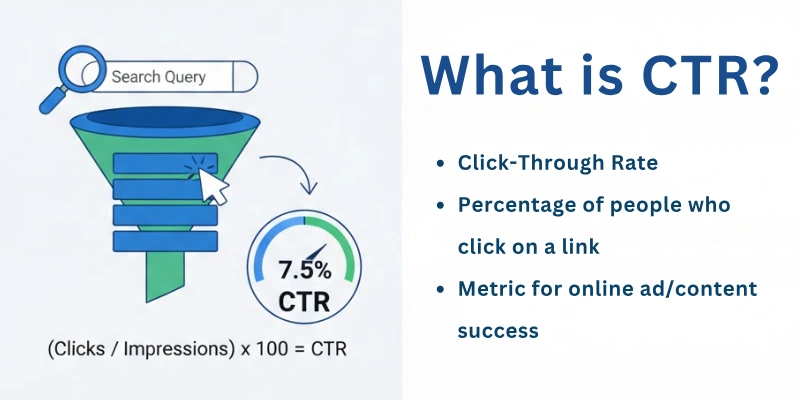
A higher CTR shows that your website’s content is relevant and interesting to users, whereas a lower CTR indicates that your website may not be appropriately addressing potential visitors’ search intent.
Why is CTR Important for SEO?
These bullet points will show you how vital the CTR is in the field of SEO:
- Visibility Boost: Your site will likely show up higher on search engine results pages (SERPs) if it has a high click-through rate (CTR).
- User Engagement: It reflects user engagement; the more clicks there are, the more users interact with your content.
- Relevance Check: It’s a thumbs up from users, indicating that your information is relevant and engaging enough for them to click.
- Keyword Effectiveness: Assists in determining the success of your chosen keywords and whether they resonate with your intended audience.
- Competition Edge: A high CTR can provide you an advantage over competitors because search engines may favor sites with greater click-through rates.
- Quality Signal: High CTR is seen by search engines as a quality signal, indicating that your content meets user expectations.
- Improved Rankings: A continuously high CTR can have a long-term favorable impact on your site’s rankings in search results.
- Feedback Loop: Low CTR may suggest the need for improved meta tags or content relevance, providing a feedback loop for SEO optimization.
- Conversion Potential: While CTR is concerned with clicks, a well-optimized website can result in higher conversion rates and commercial outcomes.
- User Satisfaction: Finally, a high CTR indicates that users value your content, which contributes to total user satisfaction.
How is CTR Calculated?
The formula for calculating CTR (click-through rate) is:
CTR = (clicks / impressions) * 100%
In this formula:
- Clicks is the number of times users clicked on the link.
- Impressions is the number of times the link was displayed.
For example, if your site is ranking on the keyword “Advantages and Disadvantages of Internet” and a user searches for that keyword and sees your site listed in the first results, then your site has received one impression. If the user then clicks on your site’s listing, then your site has also received one click.
Therefore, your site’s CTR for that keyword would be:
CTR = (1 click / 1 impression) * 100% = 100%
A high CTR serves as a reliable indicator that your website is pertinent to the specific keywords that are being searched by users. It also indicates that visitors find your website useful and informative.
Different Types of CTR’s in SEO Contexts
In this section we will discuss three of the most common CTRs in SEO:
- Organic CTR
- Paid CTR
- Local CTR
Let’s take start with organic CTR!!!
Organic CTR
Here we go:
- Organic CTR is the click-through rate for search results that appear organically in search engine results pages (SERPs).
- It is influenced by a number of factors, including the relevance of your website or webpage to the search query, the quality of your content, and the overall ranking of your website in the SERPs.
- A high organic CTR can help to improve your website’s visibility and traffic.
Paid CTR
Here’s the breakdown:
- Paid CTR is the click-through rate for search results that appear as paid ads.
- They are typically displayed above or to the right of organic search results.
- Paid CTR is primarily influenced by the quality of your ad copy and the relevance of your ad to the search query.
- A high paid CTR can help you to generate more leads and sales.
Local CTR
Here’s a brief explanation:
- Local CTR is the click-through rate for search results that appear in the local pack.
- The local pack is a group of search results that appear at the top of the SERPs for local searches, such as “software house near me” or “plumbers in my area.”
- Local CTR is influenced by a number of factors, including the proximity of your business, the number of positive reviews, and the overall ranking of your business in the local pack.
- A high local CTR can help you to attract more local customers to your business.
Does Click-Through Rate (CTR) Impact SEO?
Google has said publicly that CTR is not a ranking criterion. However, they have accepted that it can be a useful signal for determining user intent and relevance. This implies that, while CTR may not directly affect your rankings, it can provide significant information that can help you improve your SEO overall.
John Mueller, Senior Webmaster Trends Analyst at Google and Danny Sullivan, Public Liaison for Search at Google states that:
“CTR is not a ranking factor, but it’s something that we look at to understand user intent. If we see that a lot of people are clicking on a particular result, we may infer that the result is relevant to the query and that we should rank it higher.”
Optimizing CTR for SEO Success
As you guys know, a high CTR indicates that your website’s content is the best, and conversely, a low CTR suggests that your website’s content is not that up to par.
But, guys, there is no need to worry about this if your site has a low CTR . Because of this, I have come up with some tips on how you optimize CTR and enhance your website’s SEO success.
- Compelling Title Tags
- Optimize Meta Descriptions
- Use of Power Words
- Include Keywords Naturally
- Schema Markup
- Rich Snippets
- URL Structure
- A/B Testing
- Emotional Appeal
- Clear Call-to-Action (CTA)
- Utilize Numbers and Lists
- Avoid Clickbait
- Monitor Competitor Strategies
Let’s learn about these all tips in detail.
1. Compelling Title Tags
Title tags are the first thing users notice in search results, so they must grab attention instantly. A well-written title clearly explains what the page is about and why it is worth clicking. If your title looks boring or unclear, users will skip it even if you rank on page one. Strong titles improve both visibility and trust.
- Titles under 60 characters display properly on Google
- Action words increase engagement
- Clear benefits lead to higher CTR
- Keywords should feel natural, not forced
2. Optimize Meta Descriptions
Meta descriptions support your title by giving users a short preview of your content. While they do not directly affect rankings, they heavily influence click decisions. A good description explains value, solves a problem, and invites users to take action. Poor or missing descriptions often reduce CTR.
- Ideal length is 150–160 characters
- Clear summaries perform better
- CTAs encourage clicks
- Matching search intent improves trust
3. Use of Power Words
Power words trigger curiosity and emotion, which naturally increases clicks. When used correctly, they make your listing stand out among competitors. These words help users feel that your content is useful, exclusive, or urgent. However, they must always match the content to avoid disappointment.
- Words like proven, simple, effective work well
- Emotional words increase attention
- Overuse can reduce credibility
- Balance emotion with clarity
4. Include Keywords Naturally
Keywords help search engines understand your page and reassure users that your content matches their query. When keywords are placed naturally, they improve both rankings and CTR. Forced or repeated keywords make titles look spammy. Natural placement builds trust and readability.
- Place main keyword near the start
- Use variations instead of repetition
- Avoid keyword stuffing
- Focus on user intent
5. Schema Markup
Schema markup helps search engines understand your content more clearly. It allows your page to appear with extra features like FAQs, ratings, or product details. These enhancements make your result more noticeable and clickable. Pages with schema often get higher CTR than regular listings.
- Improves SERP appearance
- Supports rich results
- Increases visual visibility
- Helps Google interpret content
6. Rich Snippets
Rich snippets provide extra information directly in search results. They help users quickly decide if your page answers their question. Because they take up more space, they naturally attract more attention. This leads to better CTR without changing rankings.
- Star ratings build trust
- FAQ snippets increase space
- Product info attracts buyers
- Improves user confidence
7. URL Structure
A clean URL helps users understand the page topic before clicking. Short and readable URLs look more trustworthy in search results. Messy URLs can confuse users and reduce clicks.

Simple URLs support both SEO and user experience.
- Short URLs perform better
- Use hyphens, not symbols
- Include keywords naturally
- Avoid unnecessary numbers
8. A/B Testing
A/B testing helps you discover what actually works instead of guessing. By testing different titles and descriptions, you can improve CTR over time. Even small wording changes can create noticeable improvements. Testing allows data-driven SEO decisions.
- Improves CTR accuracy
- Reduces guesswork
- Helps optimize headlines
- Uses real user behavior
9. Emotional Appeal
People often click based on emotion rather than logic. Emotional headlines feel more relatable and human. When users connect emotionally, they are more likely to choose your result. This makes emotional appeal a powerful CTR booster.
- Builds connection
- Increases curiosity
- Encourages engagement
- Works best with clarity
10. Clear Call-to-Action (CTA)
A CTA tells users what they should do next. Without it, users may ignore your listing even if it looks helpful. Clear CTAs guide user behavior and increase engagement. They make your content feel purposeful.
- Encourages action
- Improves clarity
- Boosts CTR
- Matches user intent
11. Utilize Numbers and Lists
Numbers make titles easier to scan and understand. They also set clear expectations about the content. Users often prefer structured and organized information. This makes numbered titles more clickable.
- Improves readability
- Builds credibility
- Attracts attention
- Sets clear value
12. Avoid Clickbait
Clickbait may increase clicks briefly, but it harms trust in the long run. When users don’t find what they expect, they leave quickly. High bounce rates negatively affect SEO signals. Honest titles perform better long term.
- Reduces trust
- Increases bounce rate
- Hurts brand reputation
- Google may rewrite titles
13. Monitor Competitor Strategies
Competitor analysis helps you understand what works in your niche. By studying their titles and descriptions, you can identify gaps and improve your own listings. This helps you stand out without copying. Smart comparison leads to better CTR strategies.
- Spot content gaps
- Improve uniqueness
- Learn SERP trends
- Strengthen positioning
Conclusion
In this article we’ve unraveled the mystery behind the term “CTR in SEO,” Focusing specifically on how the Click-Through Rate impacts the success of a website in search engine results. Throughout this discussion, we’ve explored various strategies to optimize CTR too.
So guys, apply these practices to your website, fine-tune your content, and watch as your CTR flourishes.
FAQs
Here are some of the most commonly asked questions related to the CTR:
A high click-through rate is not necessarily a must for a site to rank well in search engine results pages (SERPs). While a high CTR can be a signal to search engines that your content is relevant and engaging, it is not the only factor that determines ranking.
No, CTR is important for all pages in search results, not just the first page. However, the first page generally receives more visibility and traffic, making CTR optimization particularly vital for those rankings.
No, a low CTR does not necessarily mean that your site will not rank well. There are many sites that rank well with low CTRs. As mentioned earlier, the quality of your content and the overall authority of your website are more important factors in determining ranking.
A high CTR can have a financial benefit for your site by increasing the number of visitors who click through to your site. This can lead to more leads, sales, and revenue. However, it is important to note that a high CTR is not a guarantee of financial success.
Most of the time, websites that have a higher position on the Search Engine Results Pages (SERPs), particularly those that are in the top three positions, have a higher click-through rate (CTR).
CTR is a metric that measures how many people click on something, while CTA is a call-to-action that encourages people to click. Think of CTR as the “score” and CTA as the “invitation” that drives that score. Both work together, without a strong CTA, your CTR may stay low even if your content is good.